


The temptation to think of EU MDR certification as a milestone is strong. Something you achieve, check off your list, and move on from. But in practice, it’s part of the ongoing lifecycle management of your device.
Whether you’re preparing for certification, already certified, or somewhere in between, it’s really important to understand what your certificate actually represents and what it expects from you overtime.
Especially if you’re sitting in regulatory or quality, where you’re the one keeping everything aligned while scrutiny keeps increasing.
In this post, we’ll walk through what EU MDR certification really is, how it differs from CE marking, how it’s issued, and what it actually covers. And just as importantly, what it takes to maintain it, because that’s usually where things start to feel… heavier.
Key takeaways
What is EU MDR certification?
At its core, EU MDR certification is the formal confirmation that your device complies with the EU Medical Device Regulation (MDR; Regulation (EU) 2017/745) and can be placed on the European market.
But in practice, it’s not just “a certificate.” It’s the outcome of your conformity assessment process where a Notified Body looks at your device, your clinical evidence, and your quality management system. If everything holds up, they issue one or more certificates that together define your compliance.
One thing I see quite often is that certification is treated like a one-time approval. Something you get, and then you’re done.
In reality, it reflects a very specific scope, assessed in a very specific way, at a specific point in time. And it only stays valid as long as you continue to meet those conditions.
Scilife Academy: EU MDR - Medical Device Regulation


What does EU MDR certification actually represent?
Your certification is always tied to a defined scope, and that scope matters more than many teams initially expect.
It typically includes:
- The device or device group and its intended purpose
- Risk classification (Class I, IIa, IIb, or III)
- Conformity assessment route (e.g. Annex IX, X, or XI)
- Medical device QMS coverage, where relevant
- Conditions and validity period
So it’s not a blanket approval for “everything you make.” It’s approval for exactly what’s described. Nothing more, nothing less.
The different categories of EU MDR certification
The type of certification you need depends largely on your device classification.
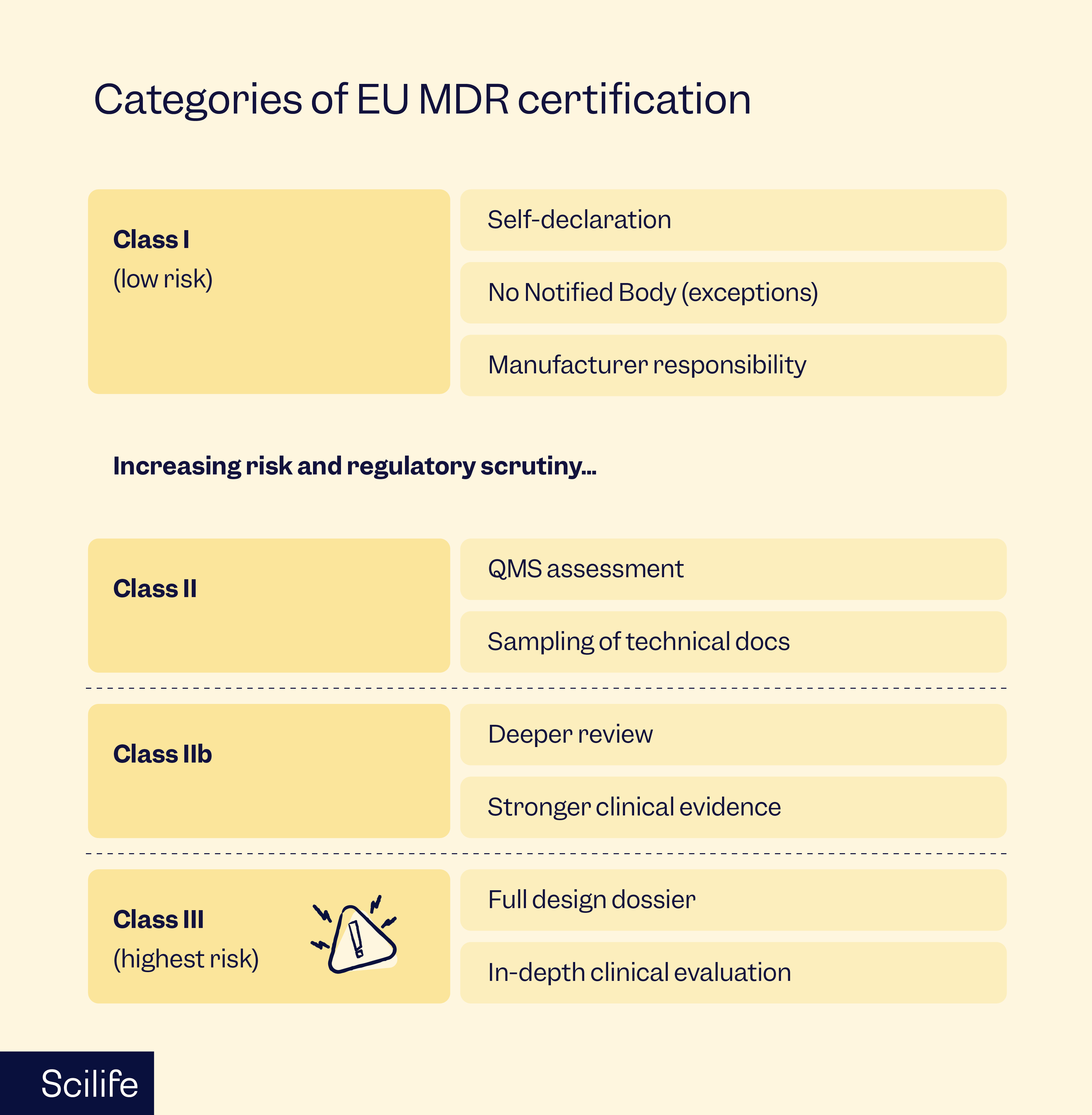
Class I devices (self-declared conformity)
- You self-declare compliance
- No Notified Body certificate (with a few exceptions like sterile or measuring devices)
- Full responsibility still sits with you as the manufacturer
This is often seen as the “easy” category, but the regulatory expectations are still very real.
Class IIa, IIb, and III devices (Notified Body certification)
For higher-risk devices, you need Notified Body involvement:
- Class IIa: QMS assessment and sampling of technical documentation
- Class IIb: More detailed review and stronger clinical evidence
- Class III: Full design dossier assessment and in-depth clinical evaluation
Depending on your route, you might end up with a QMS certificate, technical documentation assessments, or type-examination certificates.
Together, these define what has actually been assessed and approved.
Why understanding this matters
This might sound a bit obvious, but it’s where things often start to drift.
EU MDR certification is not broad, and it’s not static. It defines what you’re allowed to place on the market, how it was assessed, and what you’re expected to maintain.
And that becomes very real once you’re in audits, updates, and ongoing Notified Body interactions. That’s usually where teams start to feel the weight of MDR.
Is MDR certification the same as CE marking?
This is one of those questions that comes up all the time. And it’s completely fair, because the terms are often used interchangeably.
But they’re not the same.
EU MDR certification is the outcome of conformity assessment. It’s an actual certificate issued by your Notified Body, confirming that your device meets MDR requirements.
CE marking, on the other hand, is your declaration that your device complies with applicable EU legislation. There is no “CE certificate.” It’s simply the symbol you place on your device or packaging to signal compliance.
So, your MDR certificate is the technical proof from your Notified Body that your device meets the requirements. The CE mark is how you show that to the world.
Recommended learning: EU MDR explained: key changes, timeline updates, and practical steps.

How is an EU MDR certificate issued and what does it cover?
Getting certified follows a fairly structured path, even if the details vary.
You start by selecting a Notified Body and choosing your conformity assessment route, most often Annex IX.
From there, the Notified Body will typically do two things:
- Audit your quality management system, usually through ISO 13485.
- Review your technical documentation, including clinical evaluation, risk management, and performance data
For higher-risk devices, this review goes deep. It’s not just “do you have the documents,” it’s “do your clinical and technical arguments actually hold up.”
If everything meets expectations, you’ll receive one or more certificates.
In reality, this is rarely a one-pass process. There are almost always rounds of questions, clarifications, and updates. A big part of certification is being able to defend your documentation under scrutiny.
What is the difference between EU MDR and IVDR certification?
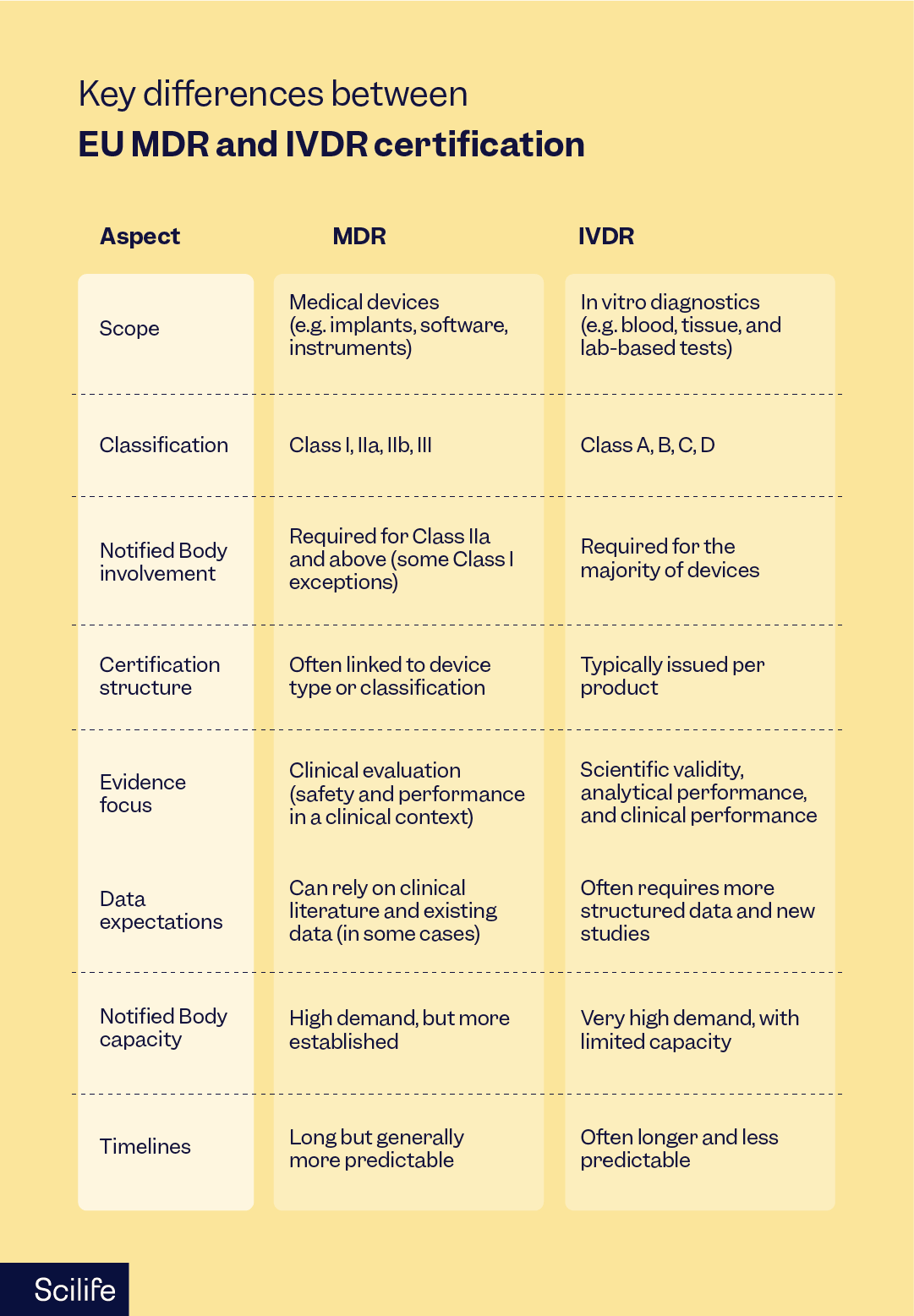
MDR and IVDR follow the same overall regulatory logic. You go through conformity assessment, demonstrate compliance, and (where required) obtain certification from a Notified Body.
But in practice, they feel quite different. And if you’re used to working under MDR, IVDR can be a bit of a shift.
Here’s a side-by-side view to make that clearer:
A note on timelines
IVDR has put a lot of pressure on Notified Bodies. More devices need certification, and the depth of review is higher. The result is longer and less predictable timelines compared to MDR.
So while MDR and IVDR are built on the same foundation, IVDR is generally more demanding in terms of evidence, Notified Body involvement, and timelines.
EU MDR checklist


How to get EU MDR certified
The certification process is structured, but it’s not just a single submission.
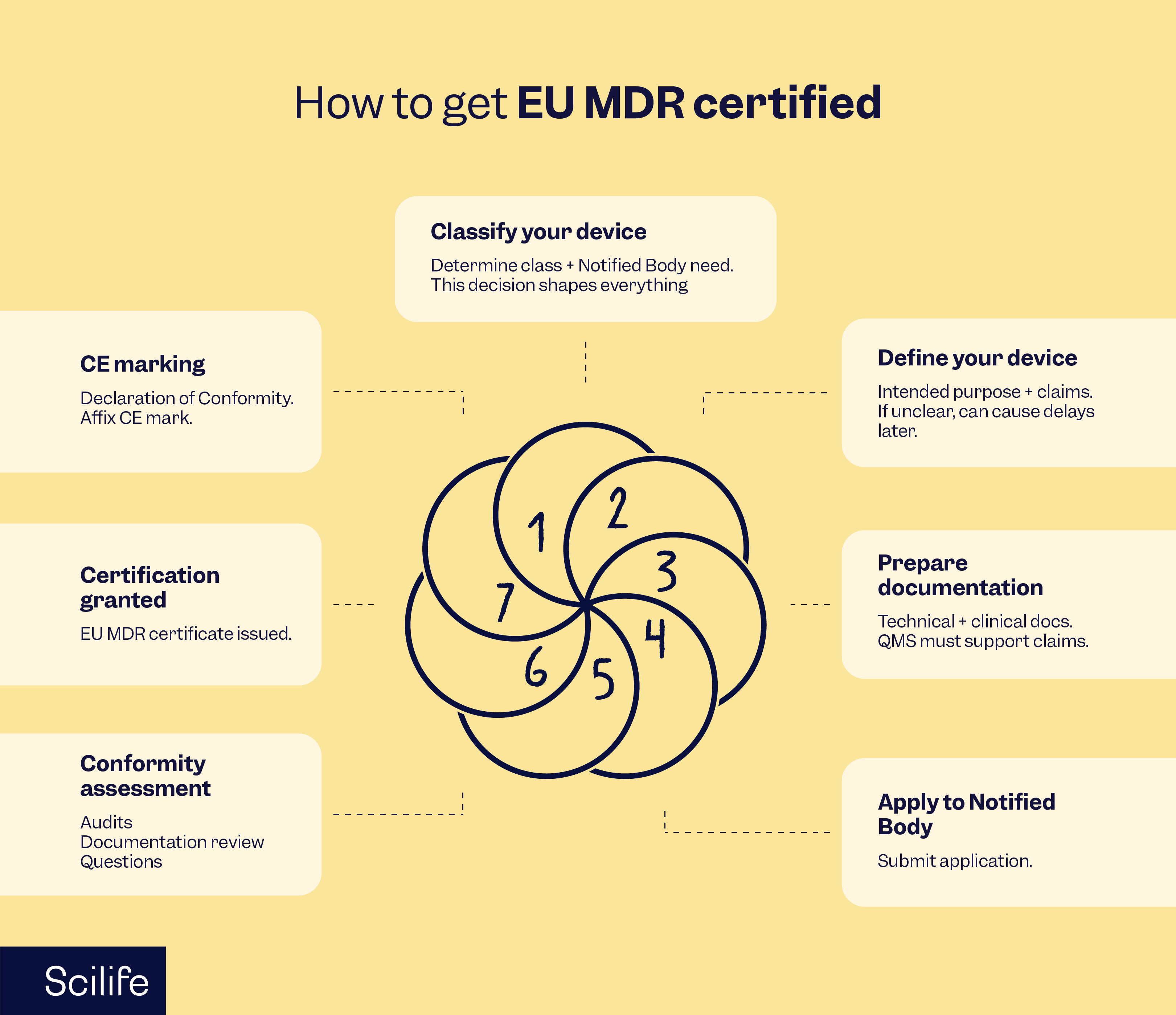
You start by determining your device classification and whether a Notified Body is required. That decision shapes everything that follows.
Then you define your device, intended purpose, and claims clearly. If those are still shifting, certification becomes much harder.
Next comes preparing your technical and clinical documentation and making sure your QMS actually supports what you’re claiming in practice.
Once that’s in place, you apply to a Notified Body and go through conformity assessment. That usually means EU MDR audits, documentation review, and a few rounds of questions.
If everything aligns, certification is issued, and you can complete your Declaration of Conformity and affix the CE mark.
And then… you’re not done. You’re just moving into the next phase.
Where companies often get caught off guard
Interestingly, most issues don’t show up during certification. They show up afterwards.
For example:
- You make a change to the device that affects performance or intended purpose.
- You introduce a new variant that isn’t clearly covered by your existing scope.
- Your clinical data evolves, but your documentation doesn’t keep up.
- Your QMS changes without being communicated.
- You make changes to your labels without letting your Notified Body know (yes, some notified bodies will want to see all your label changes).
Internally, these can feel like small or reasonable changes. From a Notified Body perspective, they can directly affect whether your certificate is still valid.
How to ensure EU MDR certification validity
Getting certified is one thing. Keeping it valid is where the real work is.
Once your certificate is issued, you’re in an ongoing relationship with your Notified Body. And maintaining certification means continuously showing that your devices and your system still meet MDR requirements.
In practice, that includes:
- Surveillance audits
- Periodic surveillance reviews of your technical documentation (STED files)
- Keeping technical documentation and clinical evaluation up to date
- Communicating significant changes
- Preparing for renewal before expiry
Maintaining certification isn’t just about “keeping things updated.” It’s about actively managing your regulatory position and staying within scope.
How QMS software supports MDR certificate maintenance
Maintaining EU MDR certification means you have to stay aligned over time across your quality system, documentation, and real-world data.
And that’s where many teams start to feel the pressure. Updates happen in different places, documentation drifts, and communication becomes reactive.
A well-implemented electronic QMS can really help here. It centralizes documentation, supports change control, and makes sure updates to clinical, PMS or Post-Market Surveillance, and risk data are reflected consistently.
It also makes EU MDR audit preparation much easier and gives you a clearer, more traceable way to demonstrate compliance.
Solutions like we have here at Scilife are built with exactly these challenges in mind. By connecting quality processes, documentation, and regulatory requirements, they support a more proactive approach.
Because in the end, maintaining certification isn’t about reacting when the Notified Body comes back with questions. It’s about having a system that holds up when they do.