<img height="1" width="1" style="display:none;" alt="" src="https://px.ads.linkedin.com/collect/?pid=489233&amp;fmt=gif">

Build robust quality that scales without slowing down your science.

Biotech teams move fast and face rising expectations as they approach GMP, audits, and key milestones. Scilife’s lean, scalable QMS helps standardize processes, accelerate audit readiness in biotech, and build confidence with partners and investors—all without slowing innovation.

Ask our experts anything Explore Scilife eQMS
Illustration of test tubes representing Biotech GMP readiness and quality management | Scilife
Biocartis logo | Scilife
DNAScript logo | Scilife
Polpharma logo | Scilife

Challenges in biotech quality management:

When quality can’t keep up with growth.

Early biotech teams rely on spreadsheets and shared drives to move quickly. But as they move into clinical development, tech transfer, and GMP, those systems become fragile, creating risk when credibility, audits, and partnerships matter most.

Scaling slows when quality systems can’t support evolving processes and data.

Manual documentation weakens traceability across experiments, decisions, and changes.

Unclear ownership creates gaps between R&D, QA, and operations.

Audit pressure rises as expectations outgrow informal processes.

Don’t wait for audits, partnerships, or GMP deadlines to force a rushed fix—build scalable quality foundations early with a system that grows with your science.
 

Build scalable quality foundations with a modern biotech QMS, without slowing momentum.

Scilife helps biotech teams establish compliant, future-ready quality systems early with a guided, low-effort implementation—and without unnecessary complexity.

How Scilife helps:

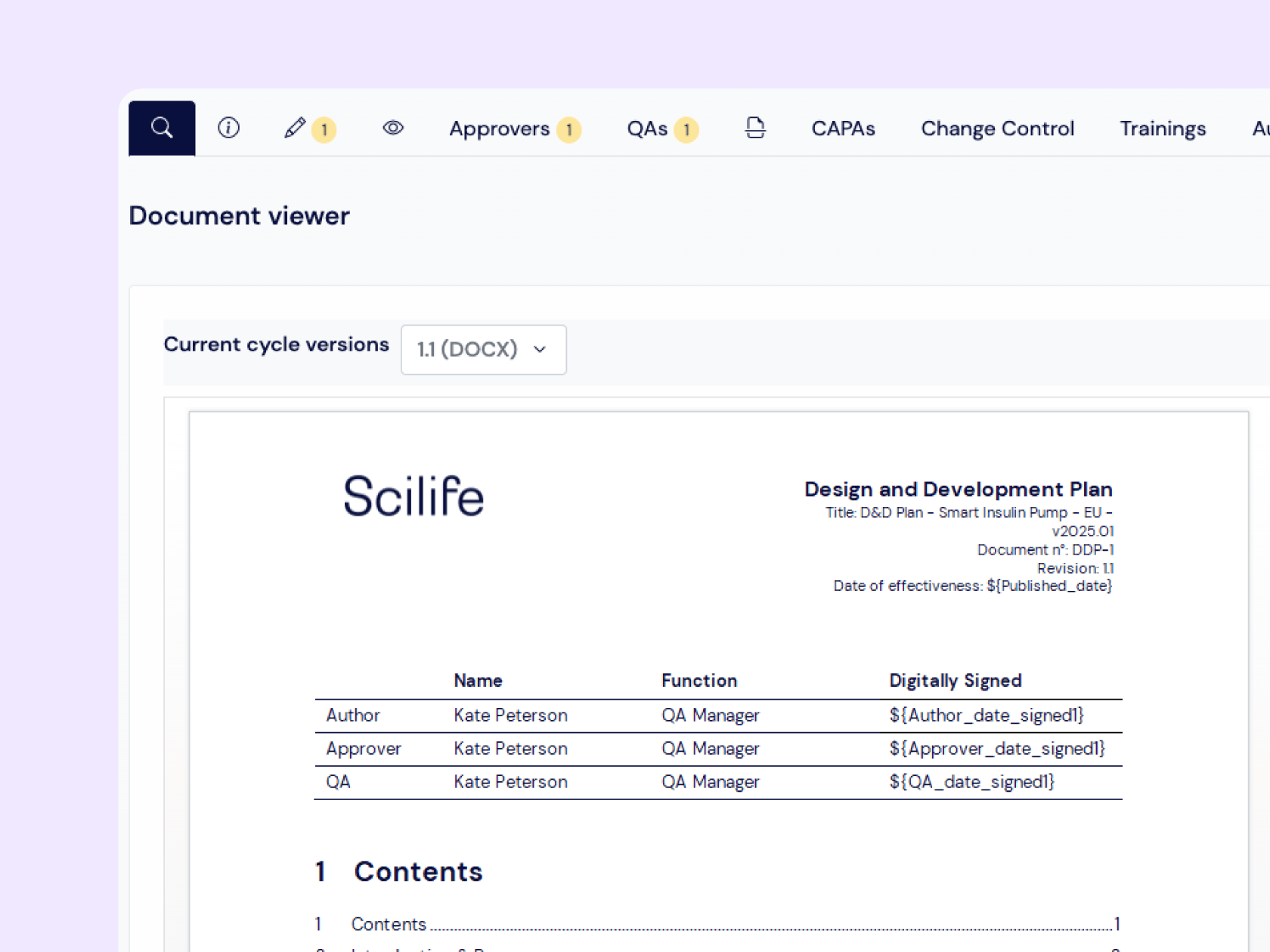
Screenshot representing the Document Control manager | Scilife

Lean document control that grows with your organization.

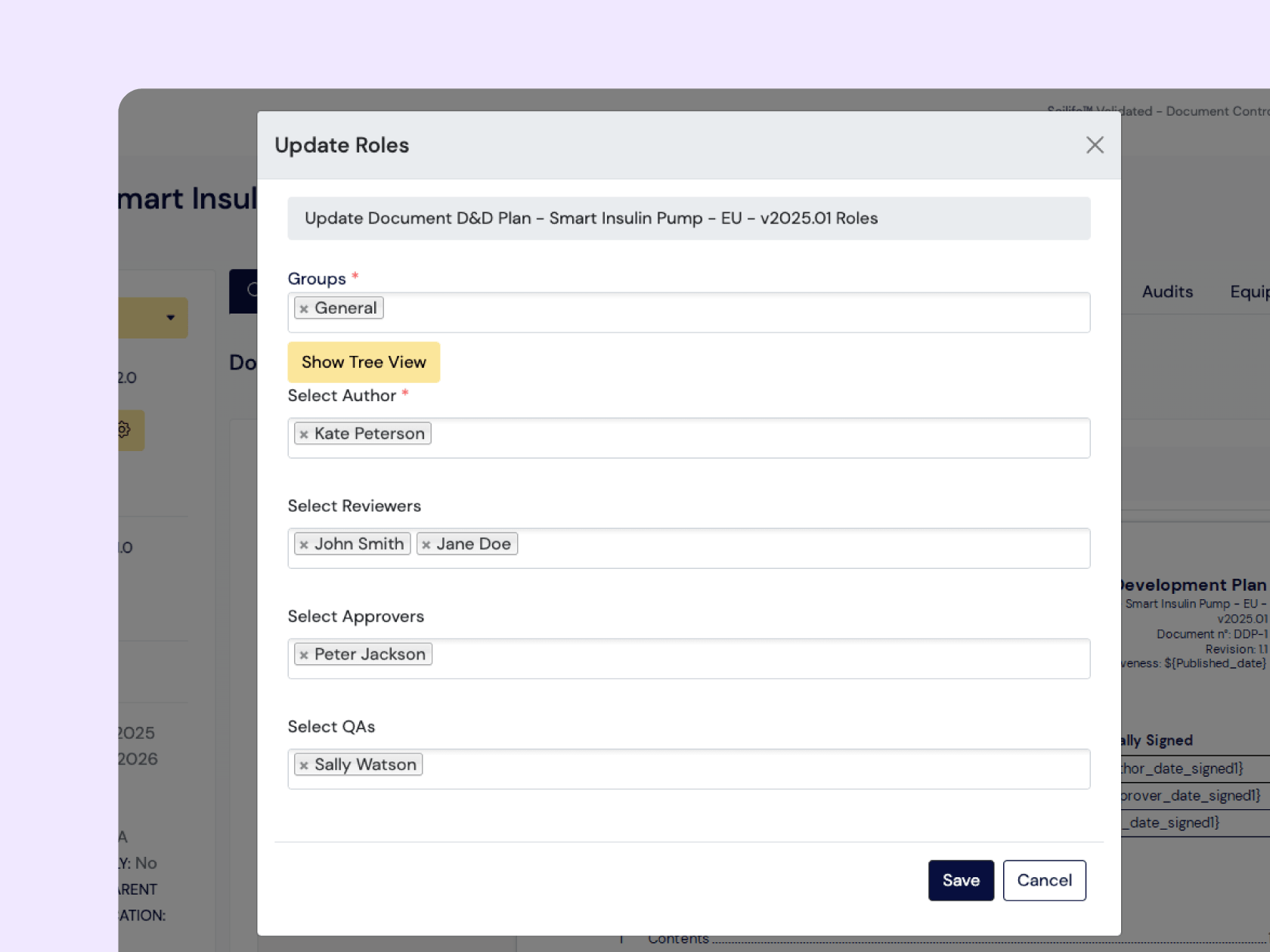
Screenshot representing the approvals workflow | Scilife

Clear ownership and workflows for small, under-resourced QA teams.

Illustration of GxP and GMP quality compliance badges | Scilife

Early GxP and GMP alignment without overengineering.

Onboarding manager for easy eQMS implementation | Scilife

Guided onboarding to support fast adoption and future audits.

Up to 66%

faster GMP certification than average.

Up to 80%

fewer recurring quality issues as teams scale.

90 days

onboarding

Ask our experts anything Explore Scilife eQMS

Built for biotech company growth — lean today, audit-ready tomorrow

Scilife supports biotech teams from early development to GMP readiness, helping them build credibility with regulators, partners, and investors.

Why biotech teams trust Scilife:

Biotech-icon-1


—   Proven experience supporting early-stage and scaling life sciences teams.
—   Built to grow with your organization as processes and requirements mature.
—   Structure without bureaucracy, clarity without overhead.
—   Supports the transition from research to controlled environments.

Engineered for regulated growth:

Ruler illustration to symbolize precision | Scilife


—   GxP and GMP-aligned workflows.
—   Audit-ready documentation and traceability.
—   Clear version control and ownership.
—   Supports core quality workflows as expectations increase.
Magnifying glass with checkmark | Scilife

Scilife compliance and validation

See how Scilife approaches software validation and aligns with GAMP 5 and 21 CFR Part 11.

Read More  
Shield with data nodes | Scilife

Data security and recovery: let's get protected

Explore how Scilife secures its platform, manages access, and safeguards regulated data.

Read More  
Checklist with upward bar chart | Scilife

Scilife competitive advantages for cGMP

Discover how Scilife’s workflows and features align with core cGMP expectations.

Download the brochure  
Scilife switch for turning quality into your brightest asset | Scilife

Build quality that scales, without slowing innovation.

Quality shouldn’t slow your science. It should give you the confidence to scale, partner, and stay audit-ready.

With Scilife, biotech teams build lean quality foundations early, gaining clarity, credibility, and readiness as they grow.

Chat with an expert Explore Scilife eQMS

FAQs

What is a biotech QMS, and does an early-stage company really need one?

A Quality Management System (QMS) is a structured framework of policies, processes, and documentation controls that keeps your organization's quality activities consistent, traceable, and audit-ready. For early-stage biotech teams, it doesn't need to be complex,  but having some foundational structure in place earlier than you think makes a significant difference. As programs advance toward clinical development, GMP, or tech transfer, the cost of retrofitting quality systems is far higher than building lean foundations from the start.

Why do biotech companies outgrow spreadsheets and shared drives?

In early research, spreadsheets and shared drives feel like enough. Teams are small, processes are informal, and speed matters more than structure. But as biotech organizations scale, adding team members, advancing programs, and facing regulatory scrutiny, these tools start to break down. Version confusion, unclear document ownership, missing audit trails, and fragmented training records are common consequences. What feels manageable in early research becomes a liability when auditors, partners, or investors ask for evidence of controlled, traceable processes.

What are the biggest quality management challenges for early-stage biotech companies?

Early-stage biotech teams typically face a few recurring challenges: processes and analytical methods are still evolving, which makes it hard to lock down SOPs; quality ownership is unclear between R&D and QA functions; documentation is scattered across tools; and compliance expectations rise faster than teams can respond. The underlying tension is between scientific agility and the structure that regulators, partners, and investors increasingly expect as programs mature.

When does a biotech company need to start thinking about GMP readiness?

Earlier than most teams expect. GMP readiness is a gradual build of documentation, change control, training records, and quality oversight that needs to be in place well before formal inspections begin. Teams that start building quality foundations during preclinical or early clinical stages avoid the stress and cost of rushed, last-minute implementations. A good rule of thumb: if you're planning a tech transfer or filing an IND, it's time to put structure in place.

How is quality management in biotech different from pharma?

Biotech quality management usually has to deal with greater product and process complexity , especially in early development and scale-up. Biological systems are inherently more variable than traditional small-molecule processes, so quality systems need to support frequent change, evolving analytical methods, and closer links between development, manufacturing, and quality.

Compared with large pharma, biotech companies also tend to operate with leaner teams and less mature infrastructure, which means their quality systems need to be built with enough control, traceability, and compliance to support growth and inspections, while still allowing the science and process knowledge to evolve.


What quality documentation do biotech companies need before a regulatory audit?

Before a regulatory audit, biotech companies typically need a controlled set of quality documents that match their regulatory stage, GxP scope, and operational activities. In most cases, that includes current SOPs, training records, deviation and CAPA records, change control documentation, and an audit trail for key decisions and data. The specific requirements depend on the regulatory framework (GxP, GMP, 21 CFR Part 11, EU GMP, etc.) and the stage of development. The challenge for most early-stage teams isn't knowing what's needed, but whether those records are controlled, complete, current, and easy to retrieve under pressure during an inspection.

When should a biotech company move from spreadsheets to an eQMS?

A biotech company should move from spreadsheets to an eQMS before documentation volume, team growth, and regulatory expectations start to outgrow manual control. In practice, that usually means before entering clinical development, preparing for a first regulatory audit, scaling operations, or going into investor or partner due diligence.

At those points, spreadsheets stop being a simple tool and start becoming a compliance risk because they struggle to provide consistent traceability, version control, training oversight, and audit-ready records. Moving to an eQMS early gives the team time to implement the system properly and build good habits before quality pressure ramps up.

How long does it take to implement an eQMS in a small biotech company?

Implementation timelines vary based on scope, team size, and data migration needs. However, lean biotech teams typically go live within 60 to 90 days. The bigger differentiator, though, is what happens during those 90 days. Many eQMS platforms leave implementation largely to the customer, relying on generic documentation and self-serve setup. Scilife takes a different approach: a structured, guided onboarding process that walks teams through configuration, data migration, and adoption. 

Is implementing a QMS disruptive for small, resource-constrained biotech teams?

It doesn't have to be. The perception that QMS implementation is heavy and disruptive often comes from experience with enterprise systems built for large pharma and not the lean, guided platforms available for early-stage biotech. Modern eQMS solutions designed for small teams prioritize fast onboarding, intuitive workflows, and minimal IT overhead, so implementation can happen alongside ongoing research and development without creating a bottleneck.

What quality workflows should a biotech eQMS support as teams scale toward GMP?

As biotech companies move from exploratory research toward GMP environments, the core workflows to have in place are: document control (SOPs, policies, protocols), training management, CAPA (corrective and preventive actions), change control, and deviation management. These form the foundation of any audit-ready quality system and become increasingly important as regulatory expectations grow. A well-designed eQMS structures these workflows from the start, so they scale naturally rather than being built reactively.

How does an eQMS help biotech companies build investor and partner confidence?

Investors and strategic partners (including large pharma licensors and CDMOs) increasingly expect evidence of structured quality systems during due diligence. An eQMS gives biotech teams a clear, documented record of how quality is managed: controlled procedures, training compliance, traceability across decisions and changes, and audit-ready documentation. This signals organizational maturity and reduces perceived risk for partners and investors evaluating a biotech's readiness to advance programs.

Does an eQMS need to support GxP, GMP, and 21 CFR Part 11 for biotech companies?

Yes — and this is a critical selection criterion. Biotech companies operating in regulated environments need an eQMS that aligns with GxP principles and, as programs advance, meets GMP and 21 CFR Part 11 requirements for electronic records and signatures. Key features to look for include complete audit trails, version control, role-based access control, and secure electronic signatures. Platforms that come pre-validated against these standards significantly reduce the validation burden for small quality teams.