

<img height="1" width="1" style="display:none;" alt="" src="https://px.ads.linkedin.com/collect/?pid=489233&amp;fmt=gif">

eQMS software comparison hub

Explore how Scilife compares to other QMS software vendors to discover the best fit for your life sciences organization.

Illustration of a balance to symbolize comparing QMS software | Scilife

Which eQMS software is right for you?

We get it. Choosing an eQMS isn’t easy, especially when you’re the one accountable for compliance.

With so many vendors promising the perfect solution, careful research and honest comparison are essential.

This page breaks down how Scilife compares to other QMS software, based on verified public data and customer reviews shared on trusted third-party platforms, so you can decide with confidence.

Qualio logo | Scilife

Scilife vs Qualio

Not all QMS platforms speak Microsoft Office fluently. See how Scilife stacks up.


Compare >  
MasterControl logo | Scilife

Scilife vs MasterControl

Choose agility. Scilife helps your whole team adopt and implement faster.
Compare >  
Greenlight Guru logo | Scilife

Scilife vs Greenlight Guru

Go beyond MedTech with an eQMS built for every stage of life sciences growth.
Compare >  
Dot Compliance logo | Scilife

Scilife vs Dot Compliance

Not every eQMS makes staying compliant feel effortless. See how Scilife compares.
Compare >  
SimplerQMS logo | Scilife

Scilife vs SimplerQMS

Some tools help you tick boxes. Others help you elevate quality culture. Explore the difference.
Compare >  
Ideagen logo | Scilife

Scilife vs Ideagen

Get full validation and faster ROI without add-ons or extra costs. See how Scilife compares.
Compare >  
Trackwise logo | Scilife

Scilife vs Trackwise

Complicated QMS turn onboarding into an obstacle course. Scilife keeps things effortless.
Compare >  
ETQ logo | Scilife

Scilife vs ETQ

Some QMS add friction from day one. Scilife makes implementation feel like flow.

Compare >  
SharePoint logo | Scilife

Scilife vs SharePoint

Move from manual setups to an integrated and compliant eQMS made for life sciences.
Compare >  

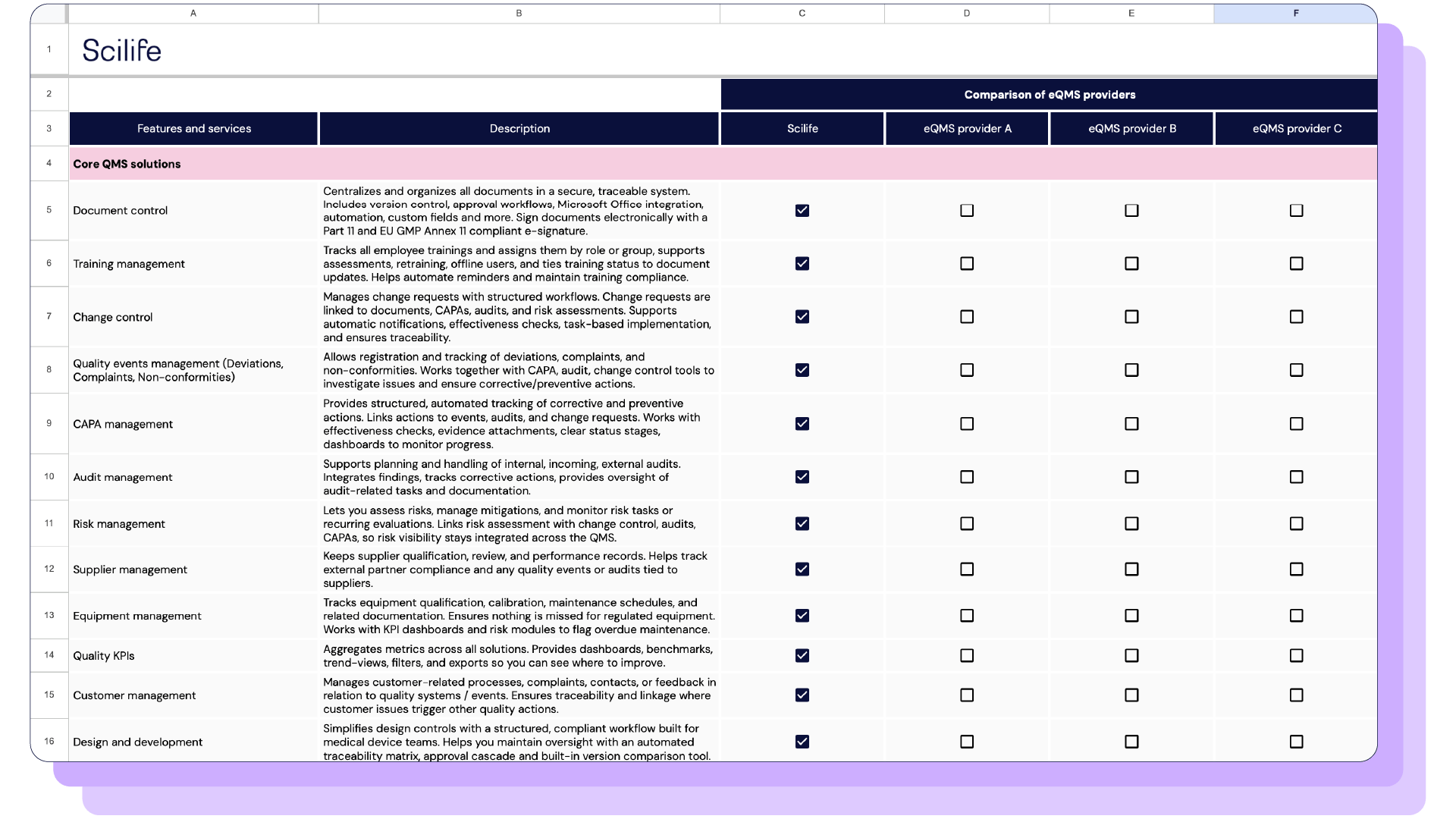
Compare eQMS vendors side by side

Use our QMS software vendor assessment template to fill in the details and find your best-fit solution fast.
QMS software vendor assessment template | Scilife

Our customers don’t just adopt Scilife, they grow with it

Discover how Scilife is helping life science teams simplify validation, speed up audits, and make quality collaboration second nature.

Discover more testimonials

Illustration that shows a switch to symbolize Scilife helping life sciences turn quality into their brightest asset | Scilife

We’re here to help you find your ideal eQMS faster!

Get straight to what matters when evaluating eQMS vendors — ask smarter, save hours, and find your perfect fit faster.

Get the guide

FAQs: What questions to ask when comparing QMS software?

What should I look for when comparing eQMS software?

When you’re comparing eQMS vendors, focus on the factors that will truly impact your day-to-day work. 

Look into how each system handles updates and validation, how long it takes to implement, integration capabilities with other systems, how scalable it is as your business grows, how intuitive and user-friendly it is, and whether the core features actually support your quality processes.

It’s also essential to check if the eQMS meets all your regulatory requirements, keeps your data secure and audit-ready, and the vendor offers reliable customer support when you need it. And of course, make sure the pricing and long-term ROI make sense for your organization’s size and budget. 


Before you start evaluating vendors, we strongly recommend doing a quick software needs assessment. This helps you get clear on your priorities and pain points so you know exactly what you need and can choose an eQMS that truly solves your challenges instead of adding new ones.

What is the difference between a QMS and an eQMS?

A Quality Management System (QMS) is the overall framework a life sciences company uses to maintain product quality, ensure patient safety, and comply with regulatory requirements.

It includes all the policies, standard operating procedures (SOPs), forms, records, and processes that guide how quality is managed across the organization.

This system can be completely paper-based, spreadsheet-based, or managed through basic digital tools.

An electronic Quality Management System (eQMS) is simply the digital version of that same framework, but supported by specialized software.

Instead of juggling paper files, dispersed documents, or manual workflows, an eQMS automates and centralizes everything in one compliant platform. This makes quality processes faster, more reliable, and far easier to maintain as your organization grows.

How to choose the best eQMS for life sciences?

Choosing the right eQMS starts with understanding what your organization truly needs today and what it will need as it grows. The best system should fit your team’s size, processes, budget, and level of quality maturity.

It should be intuitive enough for everyone to adopt quickly, robust enough to support compliance, and flexible enough to scale as your operations evolve.

To help you make an informed choice, we’ve created a guide on selecting the right eQMS for your team. 

Can I migrate from my current QMS system to an eQMS?

Yes, life sciences organizations can successfully migrate from a paper-based QMS or a mix of disconnected digital tools to a modern eQMS.

The key is having a clear migration plan. Factors like the number of documents you need to transfer, the state of your existing workflows, and how your data is currently organized will influence the timeline and complexity.

To ensure a smooth transition, start by defining your project goals, reviewing and cleaning up your current QMS documentation, and assembling a dedicated implementation team. This preparation helps you avoid migrating outdated or unnecessary content and sets you up for a clean, efficient start in your new system.

We cover these steps in more detail in our migration guide, which walks you through best practices and what to expect at each stage.


Is it possible to transition from one eQMS to another?

Yes, transitioning from one eQMS to another is absolutely possible, and many life sciences companies do it when their current system no longer supports their growth, compliance needs, or usability expectations.

The most important first step is conducting a thorough assessment of your existing QMS. This helps you understand which processes and documents are working well, which gaps need to be fixed, and which elements should not be carried over into the new system.

A clear inventory and evaluation will guide your migration roadmap and give you better control over the transition.

What’s the return on investment of having an eQMS?

The ROI of an eQMS can take many forms, cost savings, higher productivity, improved compliance, faster release cycles, fewer errors, and better decision-making, but the exact impact depends on your specific operations.

That’s why we’ve created an interactive ROI Calculator that shows your organization’s potential savings based on your own data.


What’s the typical timeline to go live with an eQMS?

The timeline to go live with an eQMS can vary widely depending on your organization’s size, complexity, and the level of customization or integrations you need. Some providers require several months, or even longer, to fully implement their system.

At Scilife, our onboarding journey takes four months for a core implementation of essential modules such as Document Control and Training, but most customers are live within 90 days. We then add a post-go-live month to ensure everything is running perfectly!

Adding more advanced modules (such as CAPA or Change Control) or integrating with other systems may extend the timeline depending on your needs and internal readiness.

If you’d like to understand what Scilife’s onboarding process looks like in practice, you can read more about it in our dedicated blog post.


What’s the difference between validated and non-validated eQMS systems?

Some eQMS solutions, such as Scilife, provide a full GAMP 5 validation documentation package at no additional cost.

In Scilife’s case, we handle roughly 95% of the validation effort, delivering all key documents, such as the validation plan, IQ/OQ/PQ protocols, and the traceability matrix, so your team only needs to verify suitability.

We follow best-practice CSA methodology, and ongoing software validation and re-validation after updates are included as part of the service.

However, this is not the case for all QMS software vendors. In many cases, you may be responsible for completing the validation and re-validation yourself.

Some providers do offer validation packages, but often as an additional paid service, so it’s important to confirm this upfront when evaluating vendors.

What security and data integrity features should an eQMS include?

A robust eQMS should include security and data integrity features that comply with 21 CFR Part 11, EU Annex 11, and GxP requirements.

This means having secure electronic signatures, complete audit trails, robust user permissions, and full version control to ensure every change is traceable, attributable, and tamper-proof. These controls uphold ALCOA+ data integrity principles and protect sensitive quality data from unauthorized access or manipulation.

Enterprise-grade platforms like Scilife also add encryption, validated cloud hosting, automated backups, and built-in GAMP 5–aligned validation. Together, these features ensure that your quality data remains secure, compliant, and inspection-ready at all times.

Do all QMS vendors offer training and onboarding?

Not all QMS vendors offer the same level of training and onboarding. Some provide only basic setup assistance, while others charge extra for implementation support or leave most of the configuration and validation work to your internal team. This can significantly affect how quickly and successfully you can adopt the system.

Here at Scilife, we've built a structured onboarding program that helps your team get up and running quickly and effortlessly. You receive: 

- Lifetime access to training materials

- Access to the test environment to explore the system before moving to validation and production

- Regular follow-ups to address customer concerns

- Access to validation documentation and templates

- Personalized follow-up meeting notes and support through the service desk 

And much more! 

You can read our blog post to learn more about what Scilife’s onboarding process looks like in practice.