



In highly regulated industries like pharma and biotech, organizations are typically well-versed in compliance and regulations. Yet as they scale, some quality systems begin to show cracks in ways that aren’t immediately obvious.
At first, everything appears to work. Procedures are documented. Training records are complete. Systems are validated. Audits are passed. Then someone traces a file end to end and uncovers unexpected gaps, a deviation reappears six months later, audits and inspections start becoming tricky.
The real question isn’t whether your QMS works today, but whether it can withstand growing complexity, expanding teams, and increasing regulatory scrutiny.
In this blog, we’ll explore why QMS resilience often breaks down as pharma and biotech organizations scale, the warning signs regulators pay attention to, and what resilient quality systems do differently.
Key takeaways
What regulators examine in biotech and pharma QMS in the UK
In the UK pharma and biotech sector, regulators such as the Medicines and Healthcare products Regulatory Agency (MHRA) expect organizations to demonstrate far more than procedural compliance. Quality systems are assessed against frameworks such as UK GMP, GDP, and broader GxP lifecycle requirements, and increasingly strict expectations around data integrity and quality risk management.
Guidance including UK GMP Annex 11 (Computerised Systems), PIC/S recommendations, ICH Q9 (R1) and Q10, and the MHRA’s own GxP Data Integrity Guidance all reinforce the same principle: quality systems must remain controlled, traceable, and effective across the entire organization, not just within isolated departments.
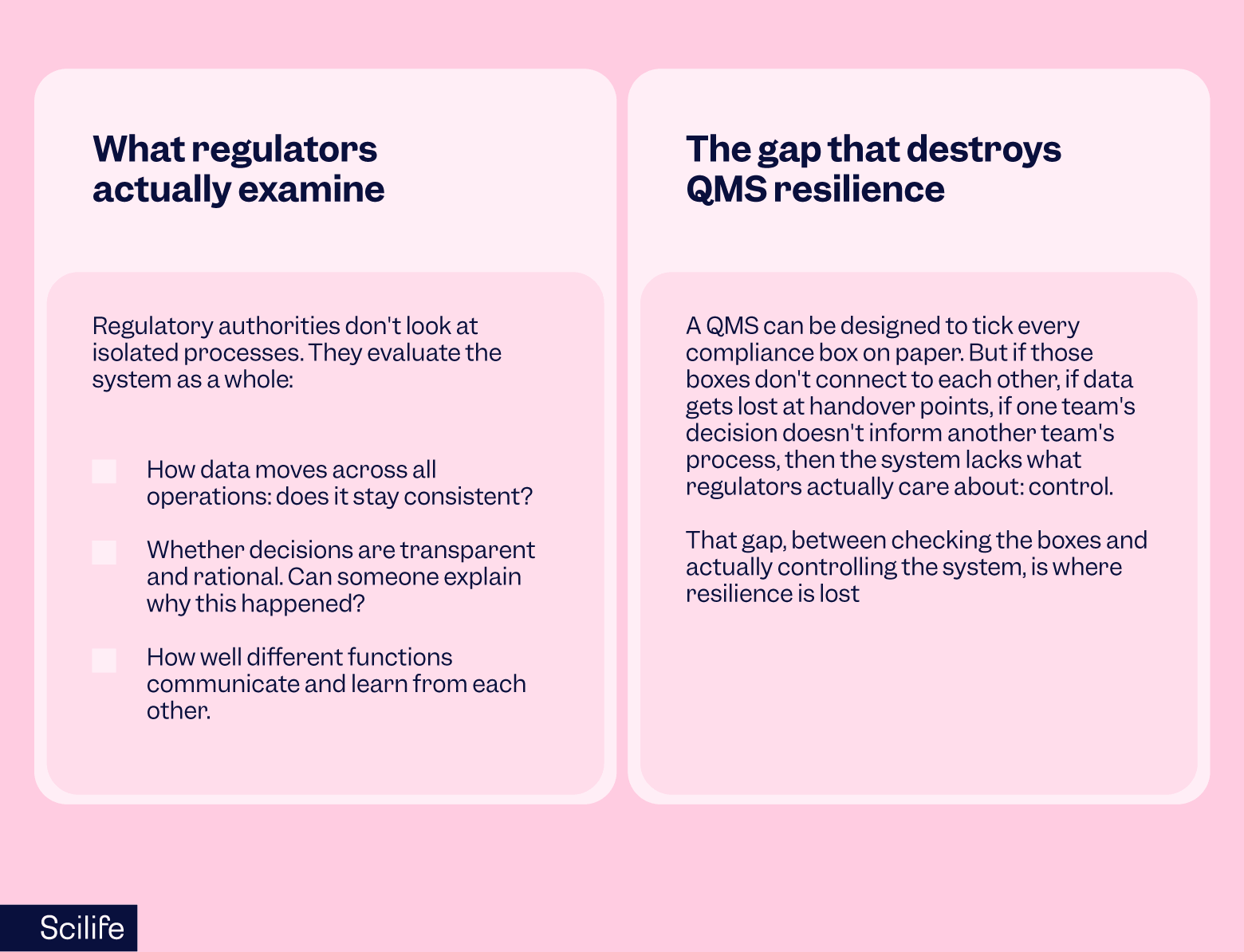
In practice, regulators don’t examine processes in isolation. They evaluate how the quality system functions as a whole:
-
How data moves across operations and whether it remains complete, consistent, and traceable
- Whether decisions are transparent, documented, and scientifically justified
-
How effectively teams, systems, and functions communicate with each other
-
Whether risks, deviations, and changes are managed consistently across sites and departments
-
How leadership maintains oversight of quality system performance
A QMS may appear compliant on paper while still lacking operational control. Procedures exist, records are completed, and audits may be passed, but if processes are disconnected, data is fragmented across systems, or critical information is lost at handoff points, resilience begins to break down.
That gap between documented compliance and true system control is what regulators increasingly focus on. And it’s often where QMS resilience is lost.
Why manual effort doesn't scale with your growing organization
In smaller organizations, quality systems are easier to manage. Teams are closely aligned, processes are easier to trace, and oversight is more direct. Fragmentation is often tolerated because it remains manageable at that scale. In a team of 20 people, misaligned processes can usually be corrected informally. Someone notices the gap. Someone compensates for it.
But as organizations grow, those manual workarounds become increasingly unsustainable. More teams, systems, processes, and handoff points create more opportunities for information to be lost, duplicated, or misinterpreted.
New templates are introduced, teams follow slightly different workflows, and critical information becomes duplicated across spreadsheets, disconnected applications, and siloed records. Deviations may be classified differently across departments, while change control practices vary between sites or functions.
Operational complexity increases quickly: data is entered across multiple systems, records require frequent reconciliation, and alignment depends heavily on individual effort. What once functioned as a practical workaround gradually becomes a structural weakness.
Individually, these inconsistencies may seem manageable. Collectively, they reduce visibility, complicate oversight, and make the QMS increasingly difficult to control. Quality teams are then forced to spend more time reconciling information, aligning records, and maintaining consistency manually.
This is often mistaken for a staffing issue. Organizations assume they need more personnel to maintain quality operations. In reality, the problem is usually architectural: the QMS itself relies on manual intervention to compensate for fragmented processes and disconnected data flows.
As regulatory expectations around data integrity, traceability, and governance continue to rise, this model becomes increasingly difficult to sustain. Manual alignment cannot scale indefinitely across fragmented systems.
Recommended learning:

The operational patterns behind QMS breakdowns
When QMS resilience starts to weaken, the same operational patterns tend to emerge. Not because organizations lack experts, but because increasing complexity gradually introduces fragmentation, inconsistency, and loss of control.
Fragmented systems and processes
Many organizations manage document control, deviations, CAPAs, training, and audits across disconnected systems. Individually, these tools may function well, but together they create fragmented workflows, duplicated data, and heavy reliance on manual coordination.
Data integrity dependent on manual effort
When data must be re-entered, reconciled manually, or verified across spreadsheets and multiple platforms, the risk of human error and inconsistency increases. Over time, maintaining ALCOA+ compliance becomes more difficult because data traceability and lifecycle control depend on people rather than system controls.
Reactive quality management
Some QMS only respond after problems occur. Deviations are investigated and CAPAs are closed, but underlying systemic weaknesses remain unresolved. As a result, similar issues continue to reappear across teams, sites, or processes.
Weak root cause investigations
Shallow investigations often focus on immediate errors rather than the conditions that allowed the issue to occur. Without deeper systemic analysis, corrective actions may resolve the event temporarily without preventing recurrence.
Quality ownership isolated within QA
In less resilient organizations, quality oversight becomes concentrated within the QA department while operational decisions happen elsewhere. This creates gaps between execution and governance, making quality dependent on review processes rather than embedded operational control.
Do our quality systems enforce consistency, or do people compensate for fragmentation?
Many pharma and biotech organizations maintain compliance through manual coordination rather than system-level consistency. Teams reconcile spreadsheets, cross-check records between platforms, and rely on institutional knowledge to keep processes aligned.
That approach may work temporarily, but it becomes increasingly fragile as operational complexity grows.
A resilient QMS reduces dependence on manual intervention by enforcing consistency through process design, connected workflows, and centralized visibility.
Here are five questions that help reveal whether your QMS is structurally resilient.
Can your core quality processes operate consistently across teams and sites?
Processes such as document control, deviations, CAPAs, change control, and training should function consistently across the organization.
When workflows vary between departments or sites, quality oversight becomes dependent on local practices rather than standardized system controls.
Does critical quality data require manual reconciliation?
If teams regularly compare spreadsheets, duplicate records across systems, or manually verify information before inspections, the QMS may lack data integrity resilience.
Resilient systems maintain traceability and consistency without requiring repeated manual intervention.
Are recurring deviations truly being resolved?
Repeated deviations often indicate that investigations are addressing immediate symptoms rather than underlying systemic causes.
Effective CAPA processes identify why the system allowed the issue to occur, not just what happened.
Is quality oversight driven by governance or individual effort?
In resilient organizations, leadership maintains active visibility into quality trends, operational risks, and system performance.
When alignment depends primarily on QA intervention or experienced employees compensating for gaps, resilience becomes difficult to sustain at scale.
Is inspection readiness continuous or event-driven?
A resilient QMS does not require extensive preparation before audits or inspections.
Inspection readiness should reflect the normal operational state of the system, with complete traceability, connected records, and accessible audit trails already in place.
Why connected quality systems become essential at scale
At a certain stage of growth, QMS resilience can no longer depend on manual coordination between teams, spreadsheets, and disconnected platforms.
As operational complexity increases, organizations need quality processes that are structurally connected where deviations, CAPAs, training, document control, and change management operate within the same quality ecosystem.
This is where modern eQMS platforms become critical. Not because digitization alone improves quality, but because connected systems reduce fragmentation, strengthen traceability, and standardize how information flows across the organization.
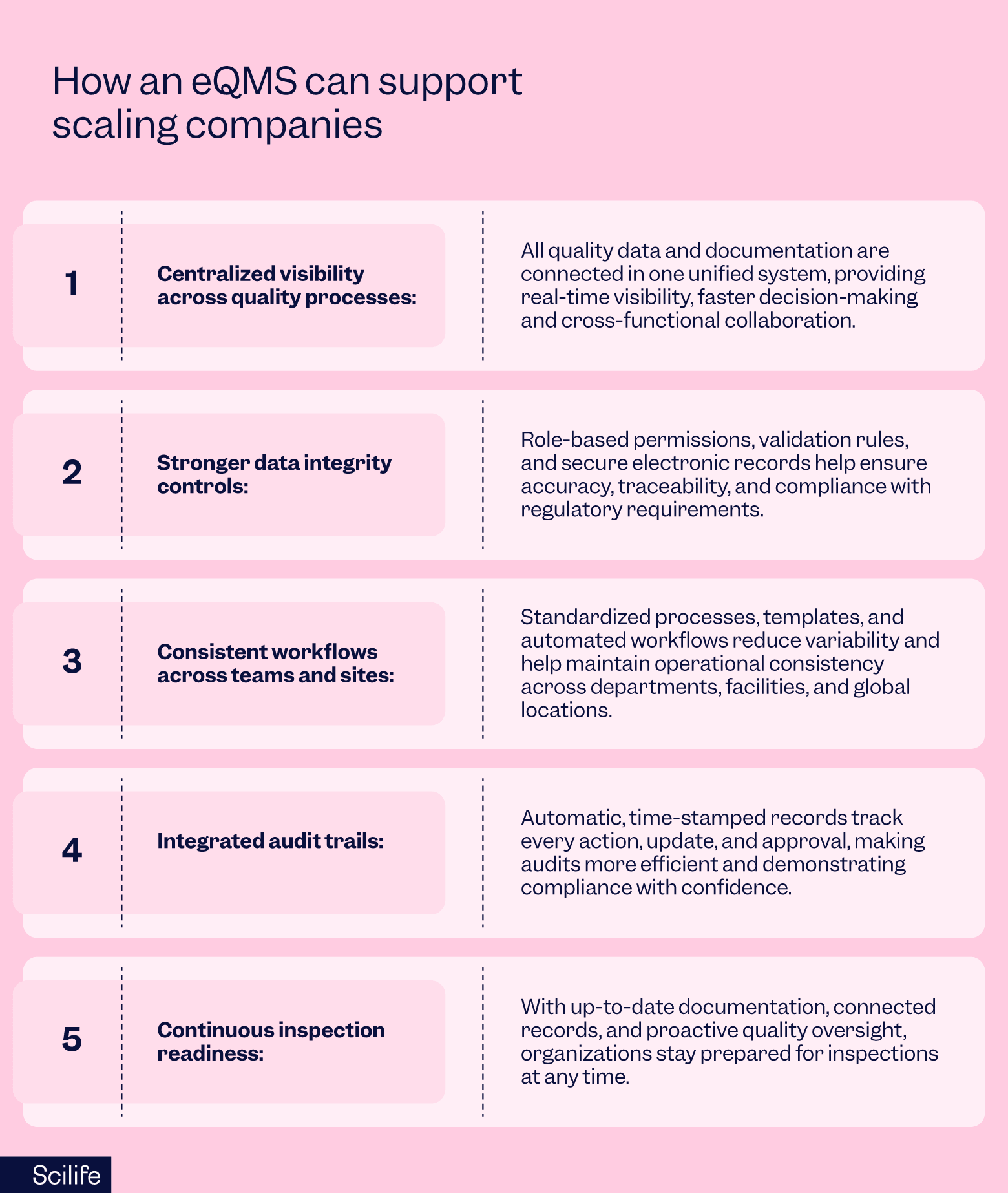
When designed correctly, a cloud-based eQMS supports:
-
Centralized visibility across quality processes
-
Stronger data integrity controls
-
Consistent workflows across teams and sites
-
Integrated audit trails
-
Continuous inspection readiness
The goal isn’t simply to digitize procedures, but to create a quality environment where governance, collaboration, and compliance scale together.
Recommended learning:
Build a more resilient quality system
Understanding where resilience breaks down is only the first step. The bigger challenge is designing quality processes that remain connected, traceable, and scalable as operational complexity increases.
Our guide, Building a resilient quality system for UK pharma and biotech, explores how to evaluate QMS resilience structurally, as well as where fragmentation creates compliance risk. You will also learn how to strengthen governance and traceability and what resilient quality operations look like in practice.
Build a resilient QMS for growing UK pharma and biotech teams!


Most quality systems don’t fail because organizations ignore compliance. They fail because complexity grows faster than the system’s ability to remain connected, consistent, and controlled.
As pharma and biotech companies scale, fragmentation becomes harder to manage manually. Processes diverge, data spreads across disconnected systems, and quality teams spend more time maintaining alignment than improving quality itself.
That’s why QMS resilience matters.
A resilient quality system doesn’t rely on constant reconciliation, individual heroics, or audit preparation cycles. It maintains control through clear governance, connected processes, reliable data integrity, and visibility across the entire organization.
Technology alone won’t create that resilience. But the right eQMS can reinforce it by embedding consistency, traceability, and collaboration directly into daily operations.
At Scilife, we believe quality management should scale with your organization, not slow it down. A modern eQMS should help teams stay inspection-ready continuously, reduce operational fragmentation, and strengthen quality across every process and site.


![CAPA: FDA's #1 Most Cited Inspection Finding [Full Guide]](https://www.scilife.io/hubfs/The-ultimate-corrective-and-preventive-action-%28CAPA%29-guide-every-life-science-professional-needs.png)