



The prime directive of medical device manufacturers is the continued safety of patients through safe and effective medical devices. A critical aspect of medical device safety is ensuring regulatory compliance of any medical device destined for the commercial market.
Design controls play a pivotal role in achieving regulatory compliance by providing a systematic framework for managing the design and development process of medical devices and in vitro diagnostic devices.
This article delves into the intricacies of these design controls for the medical device industry in the United States, exploring their purpose, key components, and regulatory requirements (including what has changed under the Quality Management System Regulation or QMSR), and practical tips for implementation.
If you want to see how design controls fit into the bigger quality management picture, our QARA guide to medical device quality management systems is a great place to start.
Key takeaways
What are design controls in medical devices?
Design controls for medical devices refer to a structured set of processes that guide the design and development of a medical device from concept through commercialization. Their purpose is to ensure that the final device meets user needs, regulatory requirements, and safety expectations.
Scilife streamlines design controls by structuring your entire process, from design inputs and outputs to verification, validation, and traceability, in one centralized system. You can learn more about our smart design control software here.
Design controls under 21 CFR 820 (legacy framework)
Historically, 21 CFR 820 design controls formed the backbone of U.S. medical device regulation. Although the framework was effective, it had a limitation in that the U.S. regulatory approach was not fully aligned with global standards. Meanwhile, the rest of the world increasingly adopted ISO 13485 design and development processes as the primary quality system framework.
That mismatch created inefficiencies for global manufacturers who had to maintain overlapping but slightly different compliance systems.
Design controls under QMSR (most recent framework)
The QMSR was introduced to address exactly that challenge. Effective February 2, 2026, QMSR replaces the legacy QSR and formally incorporates ISO 13485:2016 by reference into U.S. medical device regulations.
This change represents one of the biggest regulatory harmonization efforts in the medical device industry in decades and marks an important shift in how medical device quality systems are regulated in the United States.
As someone who works closely with life sciences regulation and quality topics, I see QMSR primarily as an effort by the U.S. Food and Drug Administration (FDA) to modernize its framework and align it more closely with the international standard ISO 13485.
However, it’s important to clarify one key point: Design controls for medical devices are not disappearing. Instead, they are becoming harmonized with ISO 13485 design and development processes.
Under QMSR, medical device design controls remain central to ensuring that devices are designed, manufactured, and maintained in a way that protects patient safety. These controls span the entire product lifecycle, from design and development through production, post-market monitoring, and corrective action.
In practice, this means companies must maintain robust procedures for design controls, supplier management, risk management, and documentation, ensuring that every stage of development is traceable and auditable.
What is FDA QMSR final rule and how to stay compliant

What changed between FDA 21 CFR 820 (legacy framework) and QMSR (current framework)?
The transition from the legacy 21 CFR Part 820 framework to QMSR is less about removing requirements and more about reframing them within a globally harmonized structure.
Key shifts under QMSR
1. Alignment with ISO 13485: The new regulation eliminates duplication between U.S. and international quality systems, enabling companies to implement a single harmonized QMS.
2. Stronger integration of risk management: Risk management is now embedded throughout the lifecycle, influencing design decisions, supplier management, production, and post-market surveillance.
3. Greater regulatory focus on quality culture: FDA discussions surrounding QMSR emphasize that compliance is not just about documentation—it’s about embedding quality thinking throughout the organization.
In other words, the expectation of QMSR hasn’t become lighter. If anything, it has become more holistic and risk-focused. Most notably, QMSR incorporates ISO 13485 by reference, effectively aligning U.S. quality system expectations with an internationally recognized standard.
In practical terms, this reduces duplication between FDA and ISO compliance, which is something many organizations, in my experience, have long had to manage through parallel systems and overlapping documentation.
What feels different under QMSR is the stronger emphasis on international harmonization. By aligning more closely with ISO 13485, the regulation reduces the need for manufacturers to maintain cumbersome parallel quality systems for U.S. and international markets. From my perspective, this shift is likely to simplify compliance for many organizations while still maintaining the FDA’s focus on rigorous oversight.
Other noticeable changes are the shift in terminology and documentation structure. Several familiar record types still exist conceptually, but the naming now reflects ISO language:
- The term Design History File (DHF) is not used in the QMSR. This has been replaced by the Design and Development File (DDF) used under ISO 13485, which is referenced in the QMSR. But, importantly, the purpose remains the same: documenting how a device design evolved and demonstrating that design controls were followed.
- The term Device Master Record (DMR) effectively aligns with the Medical Device File (MDF) concept under ISO 13485, which contains the information needed to manufacture and control the device.
- The term Device History Record (DHR) is not used in the QMSR and aligns with production and traceability records required under ISO 13485.
Importantly, these changes are largely structural rather than substantive. The FDA still expects rigorous documentation, traceability, and disciplined quality processes across the product lifecycle.
What has not changed
It’s also important to clarify what has not changed. Design controls are not disappearing; rather, they are being harmonized with ISO 13485 design and development requirements. The terminology may shift slightly, but the underlying expectations remain consistent. The FDA still expects clear traceability, robust documentation, and disciplined processes across the product lifecycle.
Ultimately, the goal of medical device controls under QMSR remains the same: creating a structured, transparent system that ensures devices consistently meet safety, quality, and performance expectations.
Design controls vs ISO 13485 design and development
Under the legacy framework, manufacturers often compared 21 CFR 820 design controls with ISO 13485 design and development requirements. But today, the difference between QMSR and ISO 13485 is much smaller.
Both frameworks cover essentially the same core stages:
- Planning
- Inputs
- Outputs
- Reviews
- Verification
- Validation
- Transfer
- Changes
The biggest difference historically was structural rather than conceptual. ISO 13485 organizes these activities under Clause 7.3, while the FDA previously described them as design controls. Under QMSR, however, the ISO lifecycle structure becomes the baseline for U.S. compliance, significantly simplifying global regulatory alignment.
For companies operating internationally, this reduces regulatory duplication and makes it easier to manage the medical device product development process across markets.
How do design controls ensure traceability?
Traceability is one of the most important outcomes of strong design controls for medical devices. Every feature of a medical device should be traceable back to its originating requirement.
That traceability typically links: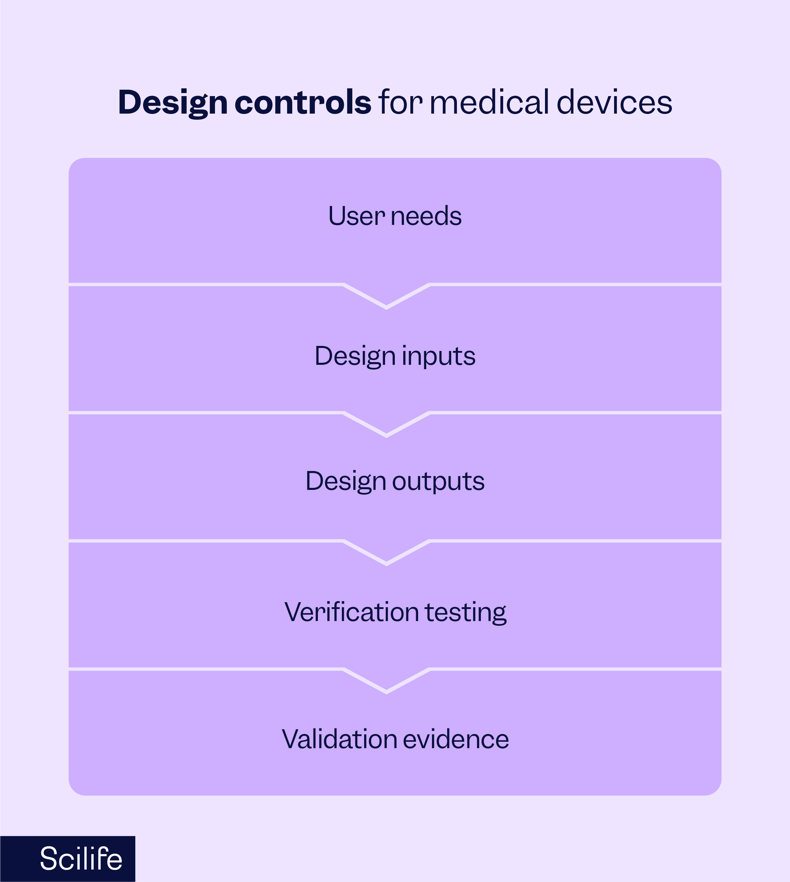
This chain ensures that every requirement is implemented and tested with adequate proof that the device works as intended. This level of documentation is critical for regulatory submissions and inspections.
Under QMSR, traceability remains a core expectation, especially because the FDA is increasingly focusing on risk-based inspection models that follow documentation trails across the entire quality system.
What is a Design Control Traceability Matrix?
A Design Control Traceability Matrix (DCTM) is a structured document that maps design requirements to development and testing activities. The matrix serves several purposes:
- Demonstrates regulatory compliance
- Simplifies impact analysis during design changes
- Supports internal audits and regulatory inspections
Typically, a traceability matrix links user needs, design inputs and outputs, verification tests, validation activities, and risk controls. Each requirement is represented as a row, with columns showing how that requirement is implemented and validated.
Key challenges companies face with design controls
Traceability and version control: One of the most common challenges I see with medical device design controls relates to traceability across the design process. Without centralized document management, teams may struggle to track evolving design specifications. But regulators expect companies to clearly link user needs, design inputs, design outputs, verification, and validation activities.
In FDA inspections, investigators frequently identify gaps in this traceability, particularly when design inputs are poorly defined or when documentation does not clearly demonstrate how requirements were verified.
Fragmented documentation: A second challenge is simply staying organized as documentation grows across the lifecycle. Without a structured system, documentation can quickly become fragmented across spreadsheets, shared folders, and disconnected tools—creating duplication, confusion, and risk during audits.
The transition to QMSR and alignment with ISO 13485 design and development requirements help harmonize expectations globally, but it does not eliminate the need to meet all applicable regulatory requirements across markets. In reality, companies must still maintain documentation that satisfies the FDA, ISO 13485, and the frameworks of any other markets in which they sell products.
This is where a comprehensive electronic QMS becomes particularly valuable. By storing documentation digitally and structuring records around design control processes, organizations can reduce duplication while keeping files organized and easily retrievable. In my experience, this makes it far easier to demonstrate compliance—whether the audit comes from the FDA, an ISO auditor, or another regulatory authority.
Cross-functional misalignment: Engineering, regulatory, and quality teams often operate in silos, which slows decision-making and creates gaps in documentation. These issues can lead to compliance risk, especially as regulators increasingly expect strong documentation and traceability across the full lifecycle.
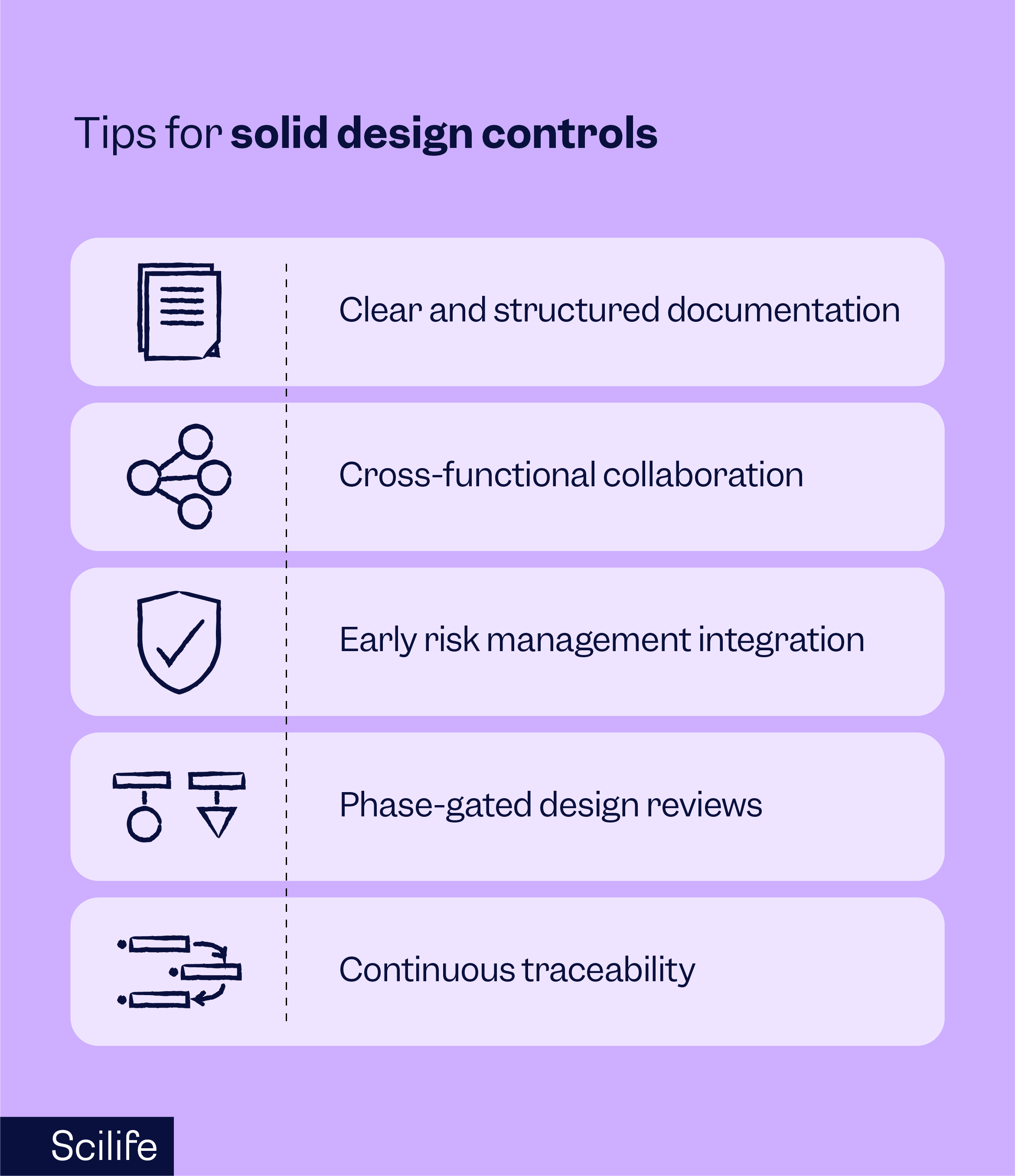
Tips for solid design controls for the medical device industry
Implementing effective design controls for medical devices doesn’t have to be overly complicated. In my experience, the most successful teams focus on a few practical principles.
Maintain clear documentation: Well-structured documentation ensures traceability between design inputs, outputs, verification activities, and validation evidence.
Encourage cross-functional collaboration: Successful design controls involve engineers, clinicians, regulatory specialists, and quality teams working together throughout development.
Integrate risk management early: Risk management should influence design inputs and testing strategies from the start—not appear as a separate process later.
Use phase-gated design reviews: Structured design reviews help identify issues early and prevent costly redesigns later.
Treat traceability as a living process: Traceability documentation should evolve throughout development rather than being assembled at the end.
How an eQMS can help you with design controls
Managing design controls for medical devices manually can quickly become complex. An eQMS can significantly simplify the process by centralizing documentation and automating workflows.
Modern eQMS platforms typically support:
- Document control and version management
- Risk management integration
- Change control workflows
- Validation tracking
- Automated audit trails
- Design history file management
With the introduction of FDA QMSR design controls, digital systems are becoming even more valuable. They help organizations maintain alignment with both ISO 13485 and FDA regulatory expectations while ensuring inspection readiness.
Solutions like Scilife’s Smart QMS allow teams to connect design activities directly with risk management, verification testing, and change control—creating a fully traceable development environment.
Conclusion
Despite regulatory changes, it remains clear that design controls for medical devices are still essential. The transition from the legacy 21 CFR 820 design controls framework to the FDA QMSR design controls model does not eliminate these processes. Instead, it harmonizes them with ISO 13485 design and development requirements, creating a more globally consistent regulatory environment.
Companies that modernize their quality systems early—embracing digital tools, integrated risk management, and harmonized regulatory frameworks—will gain both operational efficiency and compliance confidence.
SciIfe’s Smart QMS can help you modernize your quality system, so that you stay compliant and adaptable. You can find out how here.