

Navigating the complexities of FDA inspections is crucial for QA professionals in the pharmaceutical and medical device industries. The stakes are high, with regulatory compliance directly impacting your organization's ability to operate smoothly, avoid financial penalties, and maintain market trust. Preparation is key to success, ensuring your team is ready to meet stringent FDA requirements with confidence.
In this post, we'll explore why thorough preparation is essential for passing FDA inspections, who within your organization needs to be involved, and what specific strategies you can implement to ensure compliance. We'll cover understanding FDA regulations, preparing your inspection team, conducting internal mock inspections, maintaining document readiness, and effective communication during and after the inspection. By following these strategies, you'll be well-equipped to handle FDA inspections seamlessly, safeguarding your organization's reputation and operational integrity.
Recommended learning: If you're in the medical devices industry and want to adopt best practices tailored to your field and ensure you're always inspection-ready, check out this insightful blog!

FDA pre-inspection best practices
Know the regulations and the inspection types
The most important part of preparing for an FDA Inspection is to understand which cGMP regulations apply, how inspections in your sector are conducted, and what FDA investigators will be looking for.
The FDA publishes two distinct sets of references that often get confused. The Compliance Policy Guides describe the agency's policy on specific compliance matters. The Compliance Program Guidance Manual (cPGM) is the operational manual that field investigators use during inspections. Both are useful, and they cover different things.
The FDA also publishes Inspection Guides by industry. These set out what investigators look at and how they assess it. They're the same references your inspectors will use, so make sure your QA team has read them.
The success originates by fostering a culture of compliance in your organization and adjusting the culture into daily operations at all levels.

Designate the inspection teams
FDA investigators expect to meet a designated lead at the gate. Usually this is your QA or Regulatory Affairs lead. They'll accompany the investigators throughout and have authority to speak to any concern that comes up.
The wider inspection team is your Subject Matter Experts (SME). Each SME owns a specific area: equipment, validation, deviations, lab controls, and so on. They need to be confident enough to engage with the investigators, prepared enough to discuss any concerns in their area, and trained enough to back it all up with records.
Train the team in advance. SOPs only help if people know how to use them under pressure.
Conduct internal mock FDA inspections: perfect comes from practice
Mock inspections are the single most useful preparation tool I know to spot and address compliance gaps before the FDA Inspection.
They surface gaps before the FDA does. They give your SMEs practice answering investigator-style questions, which is a different skill from doing the work. They reveal where the documentation trail breaks. And they tell you who on the team needs more support.
Run them internally where you can, but consider an external auditor for realism. People perform differently when the person across the table isn't a colleague.
Make an inspection plan
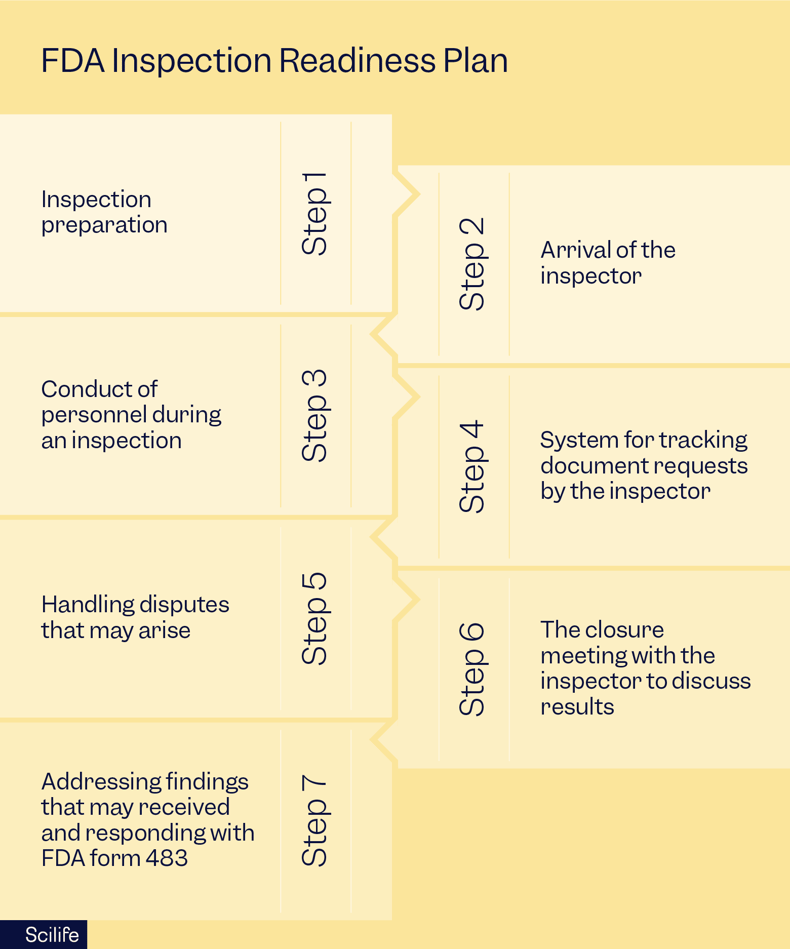
Have an inspection SOP that covers every step: who calls who when an investigator arrives, who escorts them, how documents are requested and tracked, what gets logged, and how communications flow back to senior management.
Most domestic drug CGMP inspections are unannounced. The FDA announced in May 2025 that it would expand unannounced inspections at foreign manufacturing facilities. Either way, your plan needs to work the moment the investigators arrive.
Best practices during an FDA inspection
Document readiness
It will be possible to prepare all documents ahead of time if the inspection is planned. In some cases, the FDA may arrive without notice. When this happens, notify all employees, especially those who might be affected, immediately so they can follow company protocol as outlined in your SOPs.
Whichever is the case, here's the baseline of what you should be able to provide quickly:
- Quality Manual and an overview of the Quality Management System
- Organizational chart
- Job descriptions and training protocol/records
- Product or device listings
- Responsibility matrix
Compile product complaints and CAPAs since your last inspection
Investigators almost always ask about complaints, deviations and CAPAs since the last inspection. It's a reliable way to spot whether your quality system is actually working.
Designate someone who can walk through the complaint handling process clearly. For each complaint, be ready with:
- The product,
- The date received,
- Whether it was reportable (Field Alert Report for drugs, Biological Product Deviation Report for biologics, MDR for devices), and
- A summary of the issue.
If you handle complaints electronically with an eQMS, expect to demonstrate the eQMS system on screen.
Develop an audit dossier
Track everything that's submitted during the inspection. Copies of documents handed over, samples taken, requests made, clarifications given, and any updates from the investigators.
This serves two purposes: It gives you a clear record of what's been provided, and it helps you respond faster to anything that lands on the Form 483.
How to communicate with FDA investigators
The technical content is generally fine. It's the conversation that's problematic. I have seen well-prepared teams undo their own work when it comes to communication.
A few rules that consistently work:
- Be honest, transparent and professional. Always.
- Answer the question that was asked, not the one you wish had been asked. Provide only the documentation requested.
- If you don't know the answer, say so. Then find out and come back quickly.
- Acknowledge known issues if they come up, especially if you already have a remediation plan in place. Far better than the investigator discovering it themselves.
- Be cooperative. Don't interfere. Don't fill silence with idle chatter.
- Be polite. Don't argue with the investigator's interpretation of regulations during the inspection. There's a time and place for that, and it isn't the inspection floor.
Industry guide: Learn the ins and outs of building an inspection-ready Quality Management System (QMS). This guide covers everything from understanding regulatory requirements to insider tips for implementing effective processes
FDA Post-inspection best practices
The closeout meeting
A closeout meeting is held at the end of the inspection. Senior management, the inspection team and the FDA investigators all attend.
If the investigators identified objectionable conditions, they document them on a Form 483. The closeout meeting is where these are reviewed and discussed. Make sure everyone in the room understands each observation: what it means, what evidence supports it, and what the agency expects.
A Form 483 is not a final compliance determination. It's the investigator's record of what they consider objectionable. But it should be treated seriously.
Responding to the Form 483
This is where FDA expectations have shifted most recently. In March 2026, the FDA issued draft guidance titled Responding to FDA Form 483 Observations at the Conclusion of a Drug CGMP Inspection. It's now the most current reference for what a strong response looks like, and it's worth reading in full.
The headline points:
The recommended response timeline is 15 business days. Not calendar days. Submitting a response is voluntary, but if it lands later than 15 business days, the FDA will not ordinarily delay regulatory action, such as issuing a Warning Letter, while it reviews the late response.
The response should be signed by executive management. Specifically, by someone who allocates resources and has the authority to implement commitments. The site head or head of the quality unit may also sign.
It should be structured. The FDA recommends a table of contents, a copy of the Form 483, the identity of the response preparer, an executive summary with a remediation table, and a dedicated section for each observation or grouped set of observations.
It should include a patient- and product-focused risk assessment. This means an assessment of inventory and distributed drugs still within expiry, including effects on safety, identity, strength, quality and purity.
Each observation needs a full investigation. Scope, methodology, the affected drugs and lot numbers, identified root cause(s), any related systemic issues, the CAPA plan, and an effectiveness evaluation that goes beyond routine sampling and testing.
Related observations can be grouped by topic or system. Quality, production, facilities and equipment, packaging and labelling, materials, laboratory control. Each observation must still be individually numbered and listed in the table of contents.
For data integrity findings, the FDA recommends engaging a cGMP consultant. This is explicit in the guidance.
All correspondence should be in English. Foreign-language documents need a verified translation with the translator's name, address and a brief statement of qualifications.
Disagreements go in the response. If there's a scientific or technical disagreement with an observation that wasn't resolved during the inspection, raise it in the response itself with data and references to relevant statutes, regulations or guidance. Formal dispute resolution is a separate, later route through the FDA's CGMP dispute resolution process.
The CAPA plan itself should cover immediate corrective actions, planned actions, preventive actions and any interim measures. And there should be a communication plan with milestone deliverables and follow-up reports until everything is closed out.
Continuous improvement
Every inspection produces data. Observations, near-misses, things investigators noticed that didn't make it onto the Form 483, areas where your team felt under-prepared.
Use it. The inspection isn't over when the investigators leave. It's over when you've closed every CAPA, fed the lessons into your electronic Quality Management System, and updated the procedures that need updating.
The teams that come out of inspections strongest are the ones that treat each one as a structured input to continuous improvement. Not as something to recover from.
How Scilife helps
A connected eQMS makes the difference between an inspection where everything is at your fingertips and one where someone is searching shared drives at 3pm on day two.
Scilife brings document control, training records, deviations, CAPAs, audits, complaints and change controls into one system. When investigators ask, the answer is one query away.
If you're rebuilding your inspection readiness, book a demo and we'll walk you through how it works in practice.
Conclusion
Strong inspections come from strong systems and strong preparation. The FDA isn't trying to catch you out. It's trying to verify that what you say happens in your facility actually happens.
Build the systems that make that easy to demonstrate. Train the people who'll demonstrate it. Run the practice rounds that surface the gaps. And when the Form 483 lands, respond with structure, evidence and clarity within 15 business days.
That's the playbook.