
Pharma audits are not routine checks. They are moments of truth. Whether it’s an internal audit, a supplier audit, a customer audit, or a regulatory inspection, the question is always the same: Can you prove, with evidence, that your Quality Management System (QMS) -aka Pharmaceutical Quality System (PQS)- is under control?
This guide breaks down how audits actually work, what auditors really look for, and how to stay audit-ready every day, not just the week before the inspection opening meeting.
What is a pharma audit?
A pharma audit is a structured evaluation of your quality management system, processes, and records to verify compliance with GMP, regulatory requirements, and internal procedures.
The goal is to confirm that product quality and patient safety are consistently protected.
The person conducting the audit is the auditor, whereas the organisation being assessed is the auditee.
Unlike regulatory inspections, which are conducted by an authority such as the FDA, EMA, MHRA, or ANVISA, a pharmaceutical audit may be:
-
internal (self-inspections)
-
external (supplier or customer audits)
-
independent (third-party audits)
Each serves a different purpose, but all contribute to maintaining control of the QMS, as defined in ICH Q10.
Top 5 questions about pharma audits and inspections
This guide answers the most common questions quality professionals face about pharmaceutical auditing and inspections, including:
-
Why audits are critical
-
How they work in practice
-
How long they take
-
How often they occur
-
What auditors actually look for
Why audits are critical in life sciences
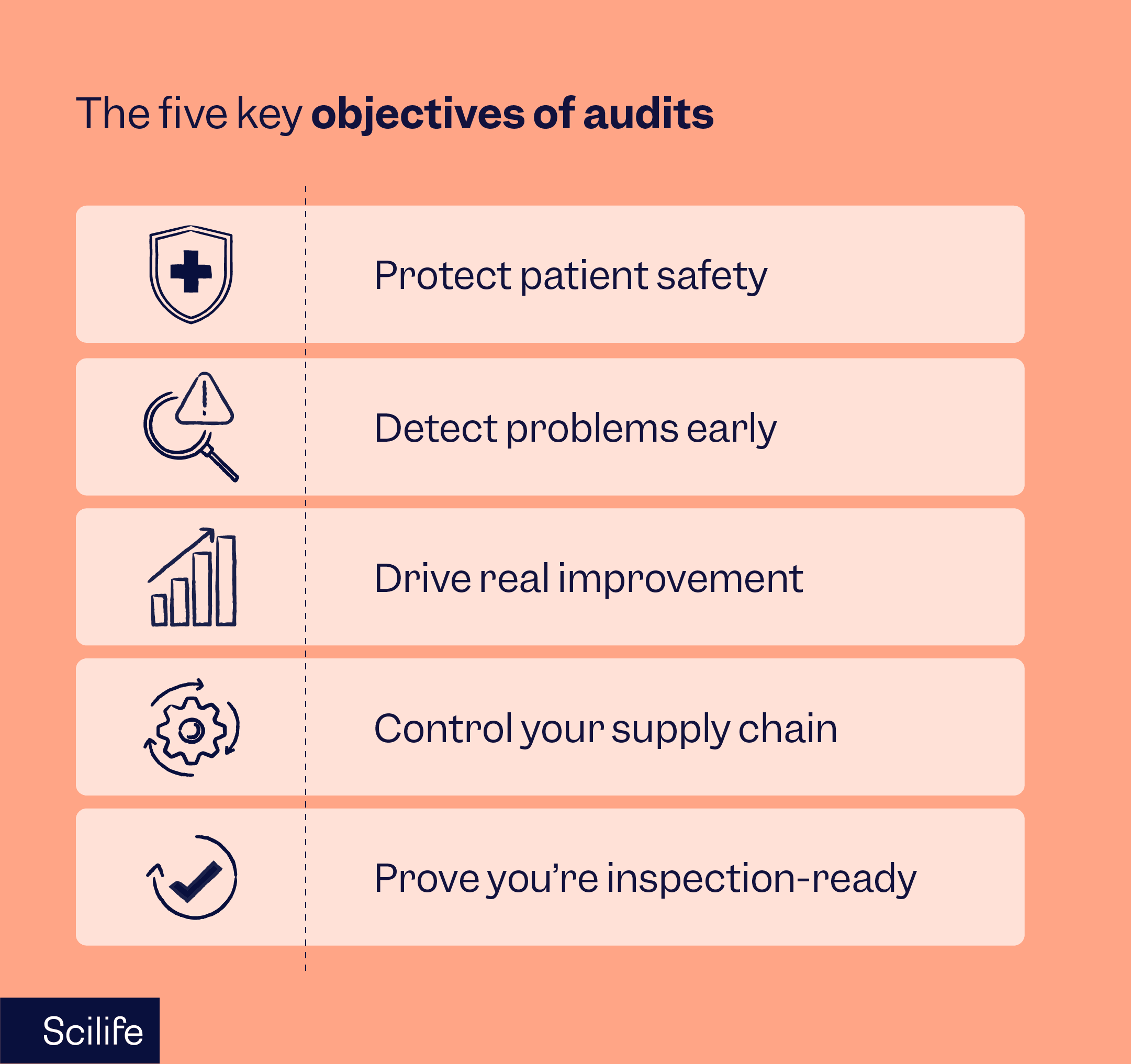
Audits are essential for any effective Quality Management System (QMS), spanning the entire product lifecycle from supplier qualification to distribution. When executed correctly, they achieve five key objectives:
-
Protect patient safety: Audits are essential for verifying adherence to Good Manufacturing Practice (GMP) and internal standard operating procedures. By identifying potential deficiencies and risks, audits ensure compliance and help prevent non-conforming products from entering the market.
- Detect problems early: By identifying weaknesses proactively, internal audits prevent their escalation into more serious issues such as deviations, complaints, or recalls.
- Drive real improvement: Audit findings generate actionable data to strengthen processes over time.
- Control your supply chain: Supplier audits confirm that external partners - CMOS, CDMOs, contract labs- meet required quality standards.
-
Prove you’re inspection-ready: A structured audit program demonstrates control to regulators -FDA, EMA, MHRA, or ANVISA- and reduces inspection risk. Regulators expect clear evidence that audits are planned, executed, documented, and followed up with effective action.
Scilife Tip:
Ultimately, a pharmaceutical audit is not a reactive compliance exercise. It is a strategic mechanism that protects patients, sustains regulatory trust, and drives long-term operational excellence.
How a pharmaceutical audit works
Regardless of its type, a pharmaceutical audit follows a structured, risk-based methodology built on three interdependent steps:
-
Collect evidence: Review documents, observe operations, and interview personnel to understand how work is actually performed.
-
Compare against requirements: Compare evidence against GMP requirements -FDA 21 CFR Parts 210/211, EU GMP guidelines, ICH Q7/Q1-, regulatory standards, and internal procedures.
-
Identify gaps: Document deviations, classify risk, and trigger CAPAs to address identified gaps.
Scilife Tip:
Pharma audits don't test how much documentation you have. They test whether the system actually works as intended.
How long does a pharma audit take?
There is no fixed duration for a pharmaceutical audit. And if you’re looking for one, you’re asking the wrong question.
Timeline depends on scope, site complexity, risk level, audit type, and the organization's ability to retrieve clear, complete evidence without delay.
Below is a practical breakdown by audit type.
Internal audits - 1 to 5 days
A single-system audit — covering CAPA, training, or change control in isolation — can be completed in one to two days. A comprehensive, multi-system audit covering several departments will typically require three to five days on-site. Internal audits tend to move faster because auditors are already familiar with the site, documentation is immediately accessible, and scheduling interviews and facility walk-throughs involves less coordination.
Supplier and third-party audits - 1 to 3 days
Routine supplier qualification or periodic re-evaluation audits generally take one to two days. Audits of critical or high-risk suppliers — those providing APIs, sterile components, or complex biological materials — may extend to three days or more. Additional time is often needed for quality agreement review, technical discussions, and assessment of the supplier's own sub-supplier controls.
Regulatory inspections - 3 days to several weeks:
A reasonable timeframe for a standard regulatory inspection typically ranges from three to five days, though duration may change depending on the complexity of operations, availability of knowledgeable staff, and the nature of observed issues.
Inspections tend to run longer when:
-
The site is large, multi-product, or sterile/biologics-based
-
The inspection is for-cause, triggered by a product complaint, recall, serious deviation, or data integrity concern
-
There is a history of critical or major findings from prior inspections
-
Records are slow to retrieve, inconsistent, or incomplete. Regulators follow the evidence, and documentation gaps naturally extend the timeline.
How often are pharma companies audited?
The exact frequency of pharmaceutical audits is not set in stone; it is determined by a combination of factors, including the specific audit type, regulatory mandates, risk assessment, and the organization's established internal auditing schedule.
In reality, pharmaceutical organizations must manage several distinct and often overlapping audit cycles concurrently.
Internal audits (self-inspections) are performed at least annually. No major GMP regulation prescribes an exact frequency for internal audits, but all require that they be conducted at planned intervals.
ISO audits such as SO 9001:2015 (clause 9.2) and ISO 13485:2016 (clause 6) both mandate a systematic internal audit program. The practical standard across the industry is a full QMS cycle completed within 12 months — meaning every critical system (CAPA, change control, deviations, training, document control, laboratory controls, supplier management) is audited at least once per year.
Risk determines the pace within that cycle. Unscheduled or ad hoc internal audits may also be triggered by significant deviations, regulatory findings, product complaints, or the addition of new processes and products.
Supplier and third-party audits are governed by risk classification. A commonly applied framework works as follows:
-
Critical suppliers (APIs, primary packaging, sterile components, contract manufacturers) are audited every 12 to 24 months
-
Major suppliers (Excipients, secondary packaging, analytical services) are audited every 2 to 3 years
-
Standard suppliers (non-critical materials or services) are audited every 3 years, or managed through questionnaires and documentation reviews
New suppliers are always audited before qualification, regardless of risk level. Suppliers that have received critical or major findings or that have experienced significant quality events may be placed on an accelerated audit cycle until confidence in their system is restored.
-
Regulatory inspection frequency varies significantly by authority and geography: The FDA operates a risk-based Site Selection Model (RBSSM), which scores sites based on factors including time since last inspection, product risk, prior compliance history, and import volume. Routine inspections of domestic drug manufacturers historically occurred approximately every two years, though in practice, intervals have stretched considerably longer for sites with strong compliance records. Foreign sites supplying the US market are inspected less frequently — often every three to five years.
-
The EMA and EU national competent authorities typically inspect marketing authorization holders and GMP-certified sites on a cycle of approximately three years, though this varies by member state and product risk.
-
MHRA (UK), TGA (Australia), Health Canada, and other major agencies follow similar risk-stratified approaches, generally targeting a routine inspection cycle of two to four years.
For-cause inspections that are triggered by serious adverse events, product recalls, whistleblower complaints, or data integrity concerns can occur at any time, with little or no advance notice.
Best practices and soft skills for auditing training with industry expert


What is the difference between an audit and an inspection?
-
An audit is a systematic, independent, and documented evaluation of a process, product, or quality system against defined criteria. It can be done on-site or virtually, and it can cover an entire organization or a specific function or process. In practice, audits are often used to assess how effective the QMS is, not just whether it ticks compliance boxes.
-
An inspection is more narrowly focused on measuring, examining, testing, or gauging specific characteristics of a product or service to confirm they meet specified requirements. Inspections are typically performed by regulatory authorities, can be unannounced, and can trigger regulatory actions (fines, sanctions) if issues are found.
In short, audits prepare you for inspections. Inspections validate whether that preparation was real.
Scilife helps you face every pharma audit with total confidence, keeping all relevant information linked and easily accessible the moment an auditor asks. Discover our audit management use case to find out how we help you stay audit-ready.
Types of audits in pharma industry
Among quality professionals, quality assurance audit refers to everything from an internal self-inspection to a full-scale regulatory visit. That ambiguity is risky because each audit type has a different purpose, different stakeholders, and very different consequences.
Here is a list of different types of audits by who performs them.
First-party audits or internal audits
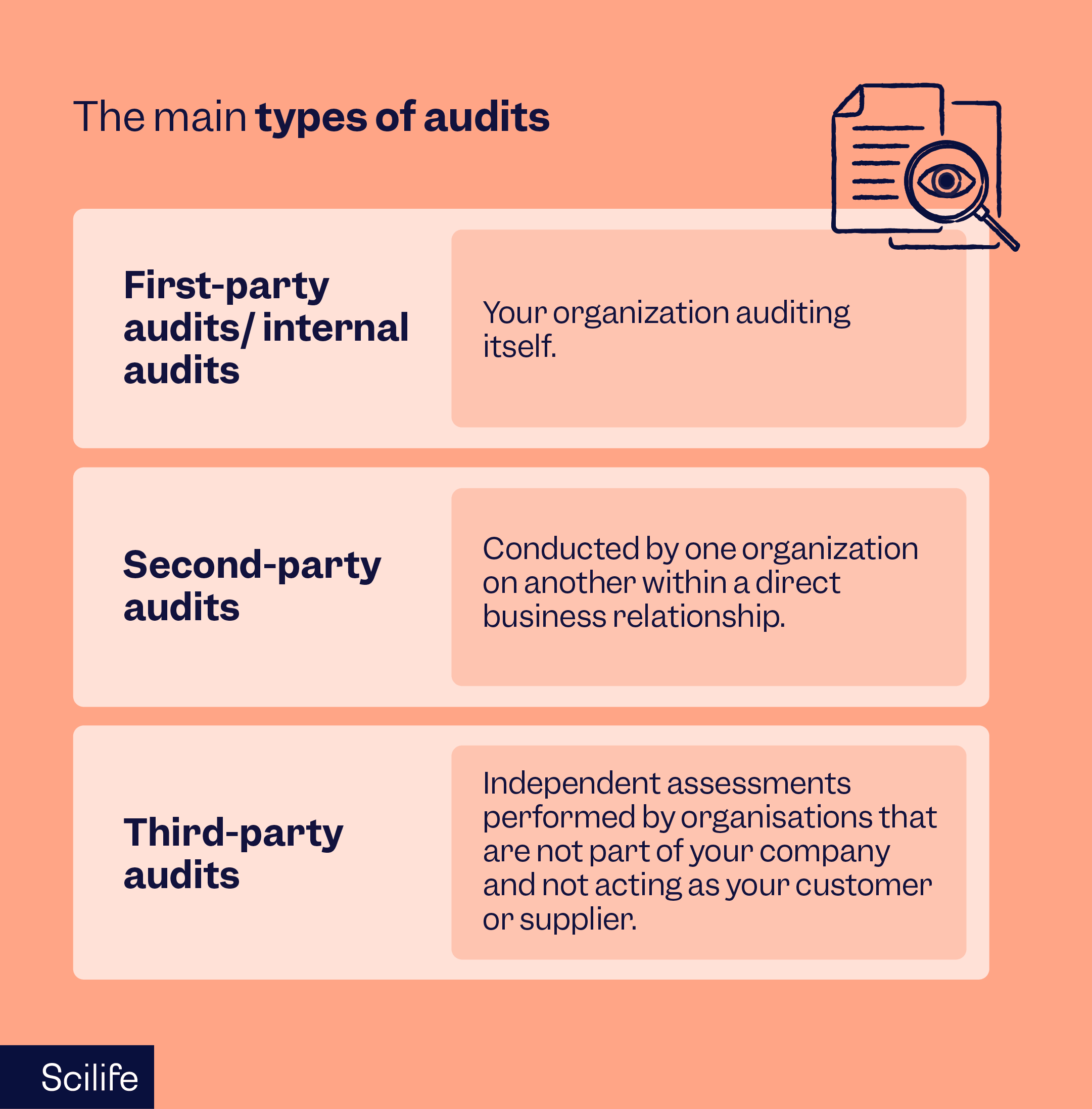
An internal audit is your organization auditing itself. There’s no external party involved. They utilize qualified, trained auditors who are independent of the specific areas they are auditing. Their core purpose is to stress-test the QMS before a regulator or customer does, identifying gaps while the challenges are still manageable.
The goal is to prove that the organization can detect problems early, correct them effectively, and prevent recurrence, which is precisely what regulators and customers will look for when they show up.
Internal audits best practices guide: How to perform an internal audit correctly and build a quality culture

Second-party audits (external)
Second-party audits are conducted by one organization on another within a direct business relationship — a manufacturer auditing a supplier, a sponsor auditing a CRO, or a customer auditing a CMO.
They are external audits, but not regulatory ones. What makes them challenging is their commercial impact: a critical finding can result in supplier disqualification, contract suspension, or loss of a procurement relationship.
In practice, second-party audits are the primary tool for supplier oversight. They verify that outsourced activities and purchased materials are controlled to the standards your product actually requires.
This makes them inseparable from supplier qualification. Qualification is not a one-time event, but an ongoing cycle of audits, periodic reviews, and performance monitoring that maintains confidence in your supply chain over time.
Third-party audits (external)
Third-party audits are independent assessments performed by organisations that are not part of your company and not acting as your customer or supplier. What changes from one third-party audit to another is who mandates it and what power the auditor has.
We've listed all the different types of third-party audits below.
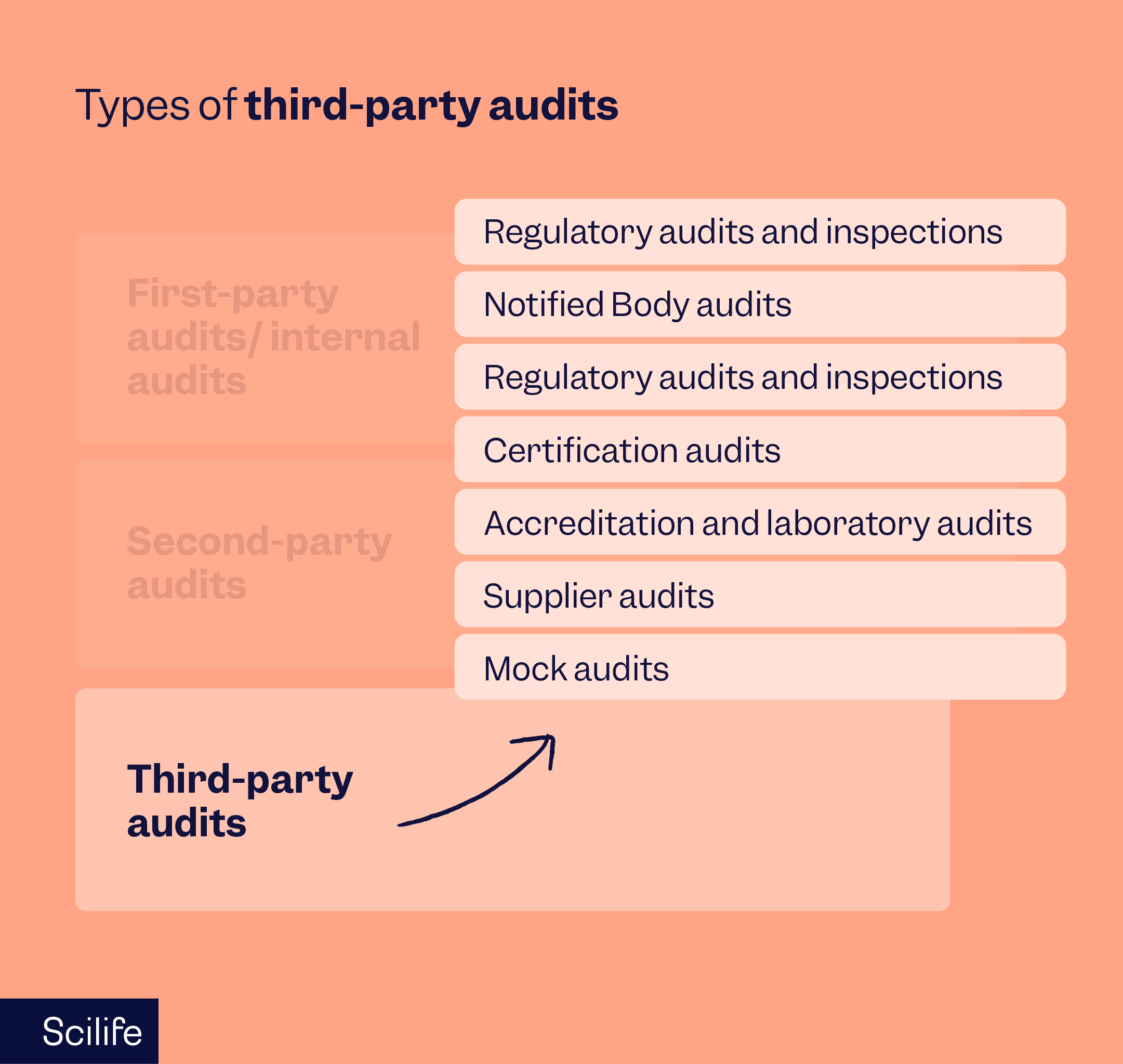
Regulatory audits and inspections
Regulatory audits in pharma are performed by authorities with legal enforcement powers. They are a key step in establishing and maintaining the right to manufacture and supply regulated products.
Regulatory oversight exists for one reason: patient protection. Inspectors verify that products are consistently manufactured and controlled, and that the quality system can detect issues, investigate them properly, and prevent recurrence.
Companies that perform well under regulatory requirements rely on robust internal audit programmes that continuously test whether processes are followed, deviations are well investigated, CAPAs are effective, and evidence is reliable and easy to retrieve.
Inspections may take place during pre-approval activities linked to marketing applications, as part of routine surveillance, or in response to specific risks or signals, such as complaints, quality defects, or significant deviations.
FDA and EMA show similarities and differences concerning regulatory inspections. In the US, the FDA inspects directly as the US regulator. In the EU, GMP inspections are typically performed by national competent authorities within the EU regulatory network, with the EMA coordinating GMP inspection activities for centrally authorised products.
Expectations are broadly aligned around GMP, but legal frameworks, inspection outputs, and follow-up pathways differ:
-
FDA inspections (US): FDA inspections verify compliance with applicable GMP requirements and can lead to formal observations and escalation if systemic failures are identified.
-
EU GMP inspections (EMA network): In Europe, GMP inspections are performed by national inspectorates and support EU marketing authorisations, with coordination through the EU regulatory network.
-
MHRA audits (UK): MHRA inspections verify compliance with UK GMP and GDP expectations and can affect licences and ongoing market access.
Notified Body audits
Notified Body audits are another form of third-party assessment, particularly relevant for medical devices and IVDs under EU MDR/IVDR.
Notified Bodies are independent third-party organizations designated by an EU member state to assess the conformity of medical devices and in vitro devices, before they are placed on the market. Their inspections ensure the auditee’s QMS and technical documentation actually comply with the EU MDR/IVDR and standards like ISO 13485.
These audits evaluate the QMS and selected technical documentation to determine whether a manufacturer can obtain or maintain certification required for CE marking. The outcome is not a fine, but it can still stop medical device sales if certification is suspended or withdrawn.
Certification audits
Certification audits are performed by accredited certification bodies to confirm conformity with standards such as ISO 9001 or ISO 13485. These audits are typically delivered as an initial certification cycle followed by surveillance audits. Their purpose is to provide independent confirmation that the QMS meets a defined standard, which often supports customer requirements and procurement decisions.
If you’d like to learn more about ISO audits and the most common pitfalls to avoid audit, check out our complete ISO audit article.
Accreditation and laboratory audits
Accreditation audits apply mainly to laboratories and testing organisations, commonly against standards such as ISO 17025. These audits focus on technical competence, method control, traceability, and data integrity, because the credibility of test results is the product.
Supplier audits
Some companies use independent third-party auditors to support supplier oversight, for example, in supplier qualification or contract manufacturing. Supplier audits are still independent, but the purpose is to generate credible evidence that outsourced activities are controlled and fit for your GMP expectations.
Mock audits
Mock audits simulate a real external audit or regulatory inspection, but without regulatory consequences. They follow the same structure as a formal inspection, including a defined scope, interviews, facility walkthroughs, and record review, ending with documented observations.
Their purpose is to stress-test inspection readiness by identifying gaps in GMP compliance, evidence quality, and system control before a regulator, customer, or certification body finds them.
Done well, mock audits focus on high-risk areas. The findings are managed through CAPA like any real audit outcome.
System, process, and product audits
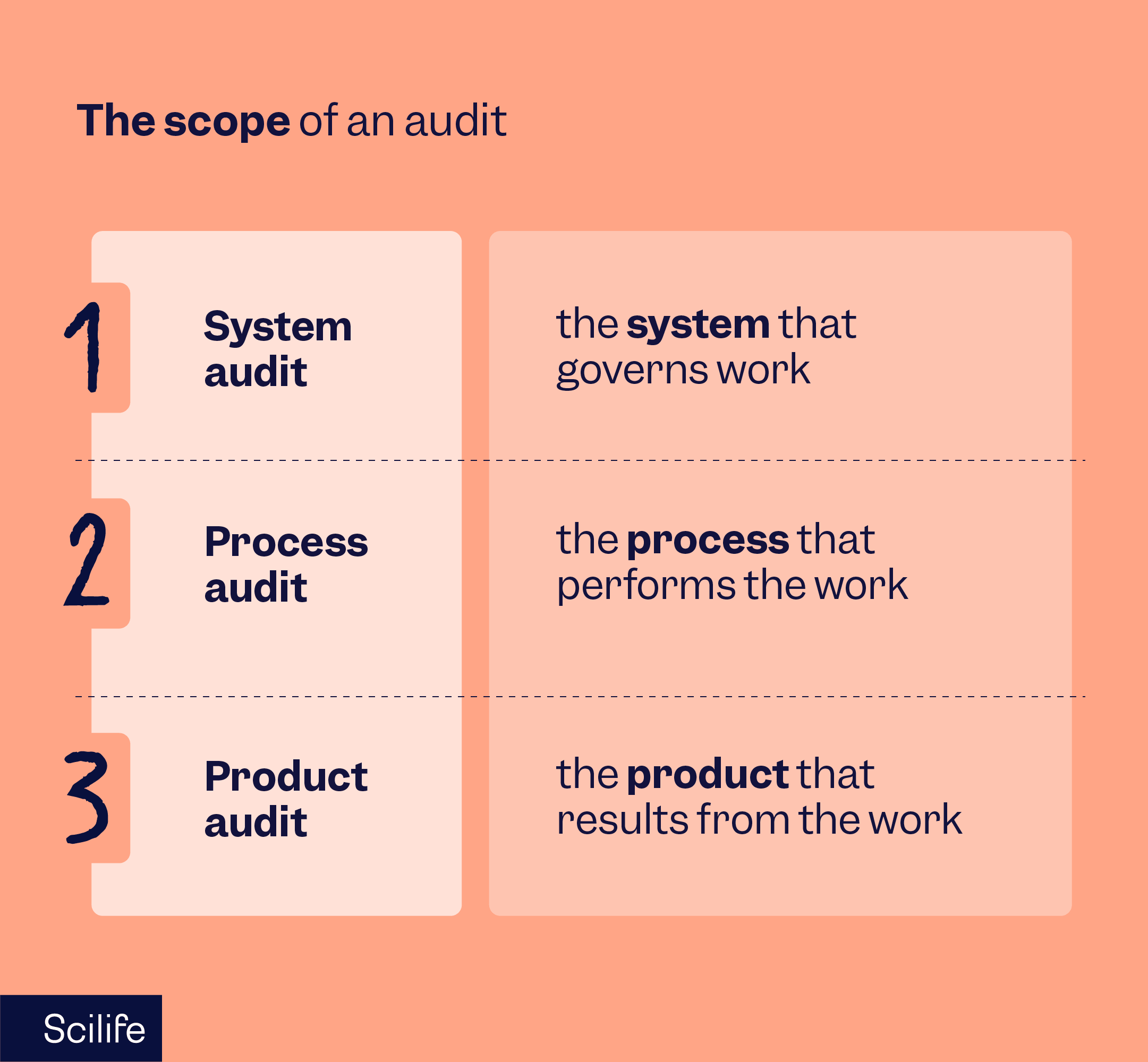
System, process, and product audits are three ways to classify audits based on their scope, or what is being evaluated:
-
the system that governs work,
-
the process that performs the work, and
-
the product that results from the work.
System audits
System audits evaluate if the QMS is designed, documented, and implemented properly, and if governance, responsibilities, procedures, and controls work together effectively. This often means reviewing how the QMS manages document control, deviations, CAPAs, change control, training, document control, supplier oversight, and management review. The point is to confirm the system is capable of maintaining GMP compliance consistently, under control, not just during inspections.
Process audits
Process audits focus on how a specific process is executed in practice and whether it remains under control. It verifies that the process follows approved procedures, operates within defined parameters, and includes the right checks and records. The goal is to confirm the process produces consistent outcomes and that deviations are detected and handled properly.
Product audits
Product audits evaluate whether the final product meets its predefined requirements and specifications. It focuses on outputs rather than the system or process. This typically means checking batch documentation, test results, release criteria, labeling accuracy, and traceability to confirm the batch meets quality, safety, and regulatory expectations before or after release.
7 essential skills that every GMP internal auditor should develop

What are the different formats of audits?
Pharma audits are not all run the same way. Beyond the audit type, the format matters because it determines how evidence is collected, what can be verified with confidence, and how disruptive the audit will be for operations.
Understanding the main pharma audit formats helps quality teams choose the right approach for the risk, the scope, and the level of regulatory scrutiny.
Choosing the right format is a risk and scope decision: the more an audit depends on direct observation of facilities, behaviours, or physical controls, the more you need on-site presence. When the scope is mainly documentation, system performance, and data review, remote approaches can be effective and efficient.
In practice, most organizations use a mix of formats to balance oversight, cost, and operational disruption.
On-site audits
On-site audits place the auditor physically at the facility. It is the right audit format whenever the scope depends on direct observation: personnel and material flows, equipment condition, cleanroom behaviour, warehousing practices, and real-time process controls. When a document review raises a question, the auditor can walk to the floor and verify on the spot.
On-site audits remain the gold standard for initial supplier qualification, sterile and aseptic manufacturing environments, for-cause investigations, and any situation where physical presence is the only way to obtain objective, reliable evidence.
Remote (virtual) audits
Remote or virtual audits are audits conducted without the auditor being physically present at the auditee’s site.
Instead of an on-site visit, the auditor reviews objective evidence and interviews personnel using digital tools, including a secure eQMS software, video conferencing, and screen sharing. In some cases, live video walkthroughs are used to provide limited visibility of facilities and operations.
However, remote audits are not a like-for-like substitute for on-site audits. Their effectiveness depends on the audit scope and the type of evidence needed. They work well for documentation- and system-based reviews, but they are less reliable when the audit requires direct observation of behaviours, physical controls, or facility conditions.
Remote audits also change the workload distribution. Unlike on-site audits, they often require more advanced preparation:
-
Agreeing on the agenda
-
Agreeing on the technology used. Tools must be tested in advance: eQMS, video conferencing, camera capabilities, etc
-
Prepare all key documents in advance
-
Train and prepare your team in the audit process, and the digital tools that will be used
-
Making sure the auditee can retrieve evidence fast. Having a robust eQMS is a must. Slow or selective document retrieval during a remote audit raises exactly the same concern as it would on-site
For more info, read this step-by-step guide to remote audits. Used appropriately, remote audits extend audit coverage, reduce costs, and maintain supplier oversight across complex global supply chains.
Hybrid audits
Hybrid audits combine a remote document and data review with a focused on-site visit. Auditors typically start by reviewing key records, trends, and quality system evidence remotely, then come on site for a shorter, targeted verification of what cannot be confirmed remotely, such as facility controls, equipment condition, material and personnel flows, and critical shop-floor behaviours.
This is often the most practical format for higher-risk scopes. It reduces operational disruption and travel time, while still keeping the audit credible because the on-site portion is used where it matters most.
Scheduled vs unannounced audits
Announced and unannounced audits differ in one key factor: notice. That single detail changes how the audit runs, what it can realistically verify, and whether it tests planned readiness or everyday GMP control.
Announced audits are scheduled in advance. They are the default for most audits because they make the audit efficient: the right Subject Matter Experts (SMEs) are available, records can be retrieved quickly, and the audit can follow a defined agenda.
The predictable downside is having personnel in "audit mode." A competent auditor counters this by intelligent sampling, end-to-end traceability, and verifying evidence reflects routine practice, not staged performance.
Unannounced audits happen with little or no notice. This format tests whether GMP control is maintained day to day, not just when everyone has time to prepare. That is why it is closely associated with regulators. The FDA has expanded the use of unannounced inspections at foreign facilities to reduce the “double standard” created by advanced notice abroad.
Scilife Tip:
The practical takeaway for quality teams is simple: build an FDA-inspection ready QMS. If you only look good when the calendar invite arrives, your system is not in control.
A step-by-step guide to the pharmaceutical audit
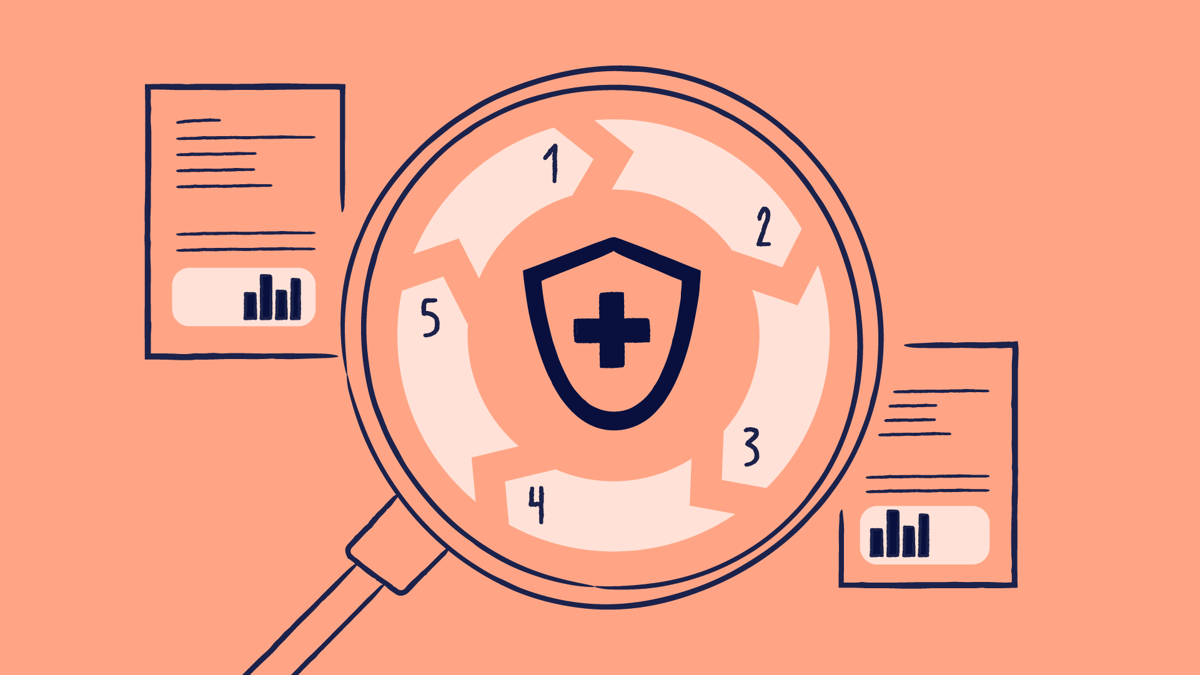
The pharma audit process follows six well-defined stages, each with a specific purpose and set of deliverables.
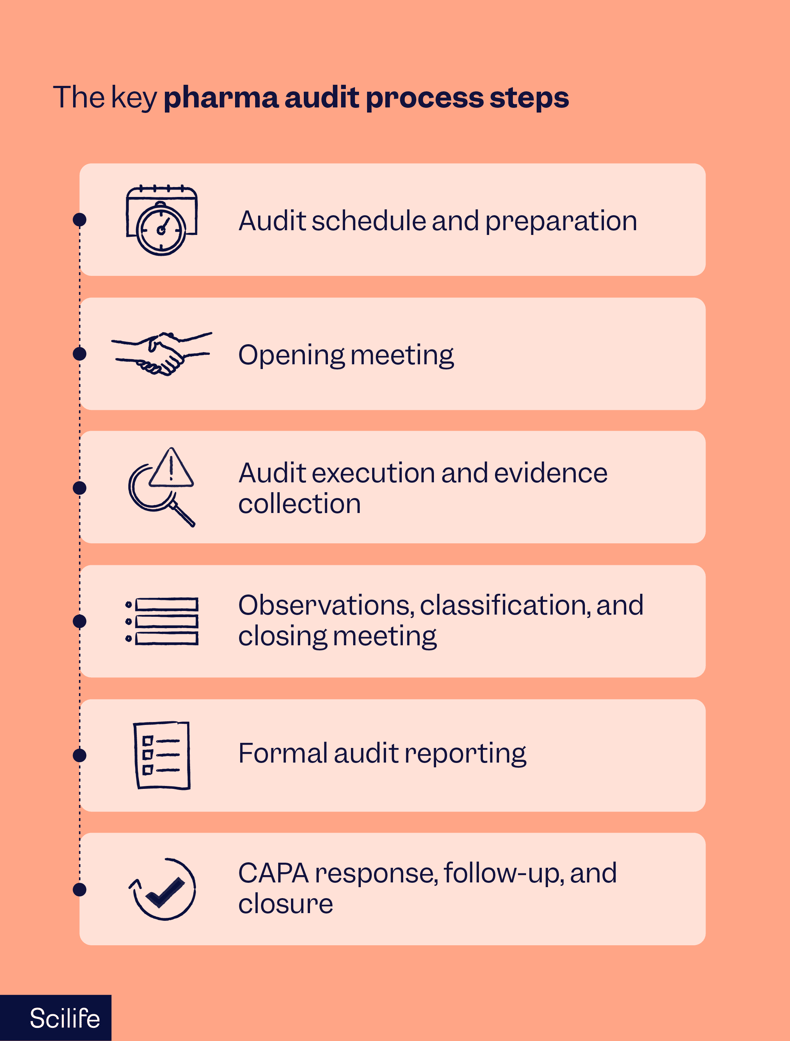
1. Audit schedule and preparation
Every pharma audit begins long before the auditing team steps on-site. The lead auditor identifies the areas, departments, or processes that need auditing and determines audit frequency based on risk. Here are some topics that need attention:
-
Auditors define scope, objectives, and criteria
-
The audit team is selected based on expertise in the relevant GxP area
-
An audit plan is developed outlining activities, timelines, and specific areas to be assessed
-
An audit calendar is created and distributed to the auditee to ensure consistency and complete coverage
2. Opening meeting
The auditors conduct an opening meeting to communicate the purpose, scope, and expectations of the audit with the auditees. They align on timelines and logistics. This sets expectations for both parties, confirms logistics, and clarifies how information will be requested and provided.
3. Audit execution and evidence collection
After the opening meeting, this is the operational core of the pharma audit. Audit methodologies typically include the observation of how processes work, facilities, and equipment; interviews with process participants; and review of procedures and records.
In practice, auditors will:
-
Walk through facilities during live operations to observe manufacturing, storage, and laboratory environments
-
Review batch records, deviation logs, CAPAs, validation files, change control records, and training documentation
-
Evaluate critical systems, including quality management, production, materials, packaging and labeling, laboratory controls, and equipment qualification
-
Interview personnel at all levels to assess process understanding, role clarity, and training effectiveness
-
Verify data integrity in line with ALCOA+* principles. Records must be attributable, legible, contemporaneous, original, and accurate.
The auditor determines whether procedures meet regulatory requirements and whether actual practices follow written procedures, confirming not just that SOPs exist, but that they are consistently followed.
Auditors take detailed notes throughout and may hold daily debriefs to surface emerging concerns in real time. This prevents surprises at the closing meeting and keeps communication transparent throughout.
3. Observations, classification, and closing meeting
Auditors confirm findings against applicable standards and requirements, and each observation is categorized by risk level as Critical, Major, Minor, or Opportunity for Improvement.
The auditors meet with the auditee's involved quality and operations personnel to present the findings, clarify issues, and discuss preliminary conclusions.
The meeting helps mutual understanding and agreement on required follow-up actions and expected timelines.
In some cases, the auditee may provide missing information that eliminates a potential finding before it is formally recorded.
5. Formal audit reporting
The auditor compiles an audit report detailing the scope, purpose, methodology, positive observations, any gaps, findings - critical, major, and minor observations, plus any opportunities for improvement, a final compliance classification, and conclusions.
Audit reports and response plans are typically issued within 30 days of the audit date.
6. CAPA response, follow-up, and closure
The audit process does not truly end until the findings are resolved. CAPAs play an important role in pharma. The auditee must provide a response within a predefined timeline. This response must include the complete set of findings with their categorization, the impact on products in distribution, root cause analysis, specific Corrective And Preventive Actions (CAPAs) with responsible persons, milestones, expected completion dates, and measurable effectiveness checks.
The auditor reviews the response for completeness, adequacy, and timeliness. If deemed adequate, the auditor approves the action plan and issues an audit completion notice.
All actions, unless related to critical observations, are reviewed and verified at the subsequent audit. The auditee must demonstrate effectiveness with objective evidence. Once verification is complete, the audit is officially closed, confirming that the organization meets the required quality and regulatory standards.
Common pharma audit findings
Any QA professional who has spent time reading pharma audit reports will notice the same pattern: most findings are not new. They are the same basics, repeated across sites, companies, and inspection cycles.
Recent FDA warning letters from 2025 make the underlying message impossible to ignore — systemic GMP weaknesses persist, and the FDA is consistently tracing them back to the same root causes: poor process control, inadequate documentation, and data integrity gaps.
These are some key recurrent issues from the FDA:
-
Inadequate response to audit observations
-
Inadequate quality control oversight and missing procedures
-
Data integrity failures
-
Weak supplier qualification
-
Inadequate process validation
-
Weak CAPA effectiveness
FDA 483 Observation + Warning Letter response template
!

What are the most common GMP audit findings?
In general, the most common GMP failures usually point to the same underlying problem: the quality system is documented, but not consistently controlled, executed, and followed in day-to-day execution.
-
Documentation and good documentation practice issues are frequent because records are the primary evidence of GMP compliance. Auditors often find incomplete or late entries, uncontrolled corrections, or a mismatch between what the SOP says and what people actually do. This loss of alignment quickly undermines confidence in the process.
-
Deviation management is another recurring weak spot. The issue is not that deviations happen, but that investigations often stop at the surface. Auditors frequently see incomplete impact assessments, weak risk evaluation, and root causes that default to “human error” without addressing the system conditions that allowed the error. When deviations recur, it signals that the investigation did not solve the real problem.
-
CAPA performance is closely linked. Auditors commonly observe CAPAs that close on paper but are not clearly tied to verified root cause, do not prevent recurrence, or lack meaningful effectiveness checks. Overdue CAPAs, especially without escalation, are a red flag for weak management oversight.
-
Data integrity findings tend to escalate fastest because they cast doubt on product and release decisions. Typical issues include shared logins, insufficient access controls, audit trails that are not reviewed, uncontrolled spreadsheets, and manual transcriptions without verification. If the data cannot be trusted, neither can the decisions based on it.
-
Training findings often reflect a gap between “training completed” and “competence demonstrated.” Auditors look for role-based training, timely training after changes, and evidence that training is effective. Repeated errors in the same tasks suggest that training and qualification processes are not working.
-
Equipment and facility control findings are also common, especially around overdue calibration, incomplete maintenance, unclear qualification status, and weak oversight of critical utilities. These gaps signal potential impact across multiple batches, not just one event.
-
Change control and validation frequently appear in findings when changes are implemented faster than assessments and validation can keep up. Auditors expect clear traceability between change, risk assessment, validation evidence, and training.
-
Finally, supplier oversight remains a consistent source of audit observations because outsourced activities still carry full GMP responsibility. Common issues include weak supplier qualification, missing or outdated quality agreements, insufficient oversight of CMOs and CROs, and poor control of incoming materials and supplier changes.
Scilife Tip:
Most GMP audit findings are not isolated issues. They are repeatable signals of weak system control.
How to ensure audit readiness in the pharmaceutical industry
Audit readiness in the pharma industry is the result of quality systems and habits that function the same way every day, whether an auditor is present or not. Here is a list of the non-negotiables that define a genuinely inspection-ready pharmaceutical organisation.
Keep the QMS current and functional
Regulators not only observe whether procedures exist, but they also assess if your QMS is consistently applied and effective at preventing quality issues.
That means SOPs must match real operations. Records must be complete, attributable, and easy to retrieve without detective work. And CAPAs must have clear ownership, realistic timelines, traceability to a verified root cause, and objective evidence that they actually prevented recurrence.
Run a rigorous internal audit program
An internal audit program should serve one clear purpose: identify where your system is likely to fail before a regulator does.
Start by making it risk-based. Focus on the systems that directly protect product quality and patient safety, such as CAPA, deviations, change control, training, laboratory controls, supplier management, and validation. Do not rely on checklist confirmation alone. Sample records, trace decisions end to end, and verify that processes work in daily practice, not just on paper.
Findings should be graded according to risk and documented with precision. Each one must link to a verified root cause and to a CAPA that includes a meaningful effectiveness check. Results should be trended over time and formally reviewed by management. If leadership does not see recurring patterns, systemic weaknesses will remain hidden.
If your audits consistently report no significant findings, reassess the program. Increase sampling depth, rotate auditors to preserve independence, and test assumptions more critically. An audit program that never finds issues is unlikely to be examining the system closely enough.
Control your documentation and data integrity
Documentation and data integrity failures remain among the most cited findings in FDA warning letters and EU GMP reports. Regulators do not accept reconstructed stories. They expect real-time, reliable evidence.
Records must be completed at the time the activity occurs, properly version-controlled, and retrievable without delay. If it takes excessive time to locate a batch record, an investigation file, or an audit trail, confidence in the system drops immediately.
ALCOA+ principles, attributable, legible, contemporaneous, original, accurate, complete, consistent, enduring, and available, must be part of daily execution. They are not an inspection-day reminder. They are the baseline for every GMP decision.
Keep your CAPA backlog clean
An overdue or ineffective CAPA backlog is a visible sign that the quality system is losing control. Open actions without clear ownership, realistic timelines, or measurable progress quickly accumulate risk.
Every CAPA must have a defined owner, a justified due date, and documented evidence that actions are being implemented as planned. Most importantly, closure requires a verified effectiveness check. Without proof that the issue will not recur, closing a CAPA is not compliance; it is an administrative task.
Prepare your people
Auditors do not audit documents alone. They interview people at every level, from operators to senior management. They want to hear clear, consistent explanations of what is done, how it is done, and why it matters.
Staff should understand the procedures they follow, the risks behind their tasks, and how deviations or issues are escalated. Hesitation, contradiction, or over-rehearsed answers signal weak control.
Preparation is about building real competence through role-based training, clear responsibilities, and a quality culture where people understand that compliance is part of the job, not a performance for inspection day.
Conduct mock inspections
A mock inspection simulates an FDA, EMA, or MHRA visit under realistic conditions. It should be made by independent, experienced, and experts willing to challenge the site. It tests how quickly documents can be retrieved, how confidently staff respond under pressure, and whether the organisation can manage a multi-day inspection without losing control of daily operations.
Run mock inspections at least annually, and always after significant changes to processes, products, systems, or site layout. Treat the findings as real. If gaps appear during a rehearsal, they would appear during the real inspection as well.
Manage inspection logistics
The first hour of an inspection shapes the tone of the entire visit. Disorganisation, delays, or confusion signal weak control before a single document is reviewed.
Assign a dedicated inspection coordinator with authority to manage the flow of requests and communication. Establish a back-room support team responsible for retrieving documents, tracking commitments, and reviewing records before they are handed over. Define escalation pathways in advance so critical issues are handled consistently and without panic.
Document retrieval must be fast and controlled. Delays raise suspicion and often lead to deeper sampling. A clear request log, version-controlled documents, and defined handover procedures prevent unnecessary exposure.
Inspection readiness is the visible result of a quality system that is organised, current, and practiced daily.
The role of eQMS in pharma audits
A pharma audit is won or lost on evidence. Do you have the right records, the right approvals, and a reliable traceability of when and why things changed?
An eQMS does this by centralizing quality processes, linking related records, and giving real-time visibility so you're always audit-ready.
Here are key quality processes that make you stay in control with a digital audit management system:
-
Document control that makes evidence easy to find
It keeps audit-critical documentation organised and accessible so teams can retrieve what auditors request without chasing files across folders and ditools.
-
Reliable audit trail
It provides a secure, computer-generated, time-stamped record that reconstructs the creation, modification, and deletion of electronic records, so you can demonstrate data integrity and traceability during inspections.
-
Change control with real traceability
It manages changes so they’re properly evaluated, planned, approved, executed, and fully implemented, with detailed, chronological records inside the eQMS.
-
CAPA-linked follow-ups
Linking audit findings directly to CAPAs helps you show root cause analysis, action tracking, and effectiveness checks as one coherent story.
-
Audit management across the full lifecycle
It supports the four practical stages auditors care about: preparation, execution, reporting, follow-up, and closure, including scheduling, role assignment, and accountability for actions.
-
Real-time visibility
It keeps teams aligned across different audit types and stakeholders while tracking progress in real time, so nothing slips past due.
-
One single source of truth for end-to-end audit readiness
It strengthens audit readiness by keeping audits integrated with related quality processes, including Events, CAPAs, and Change Control, so evidence stays consistent and ready for inspection.
“Doing an audit with Scilife at your fingertips was amazing… The auditors were just blown away at how easily we could navigate everything. It was so transparent.”
Keryn Davies, Quality Manager at Helius Therapeutics

Conclusion
Nothing in a pharma audit is new. Auditors follow the same logic every time: show me your system, show me the evidence, show me it’s under control.
And yet, the same issues keep coming up.
Not because teams don’t know GMP, but because the QMS often looks fine on paper and breaks down in daily use. That’s the gap audits expose.
If you take one thing from this guide, make it this:
You don’t prepare for audits. You either operate in control, or you don’t.
-
If your documents don’t reflect reality, it shows
-
If your data isn’t reliable, it shows
-
If your CAPAs don’t fix root causes, it shows
-
If your team doesn’t fully understand what they do, it shows
Audits don’t cause problems. They make them visible.
Most issues come from fragmented systems, manual workarounds, and disconnected records. An eQMS like Scilife removes that friction by connecting processes, linking data, and keeping evidence accessible and traceable.
So when an auditor asks a question, you don’t dig. You answer. And that changes everything.
And tools alone are not enough. Audit readiness also depends on people. With Scilife Academy, teams build the skills to audit, respond, and improve with confidence.
You can build practical audit readiness with courses like:
✔️ Foundational Quality Management Systems
✔️ Auditing Basics
✔️ Fundamentals of Data Integrity and Data Governance
In the end, audit readiness comes down to three things: systems, processes, and people.
Get those right, and audits stop being stressful. They become proof that your system works.
If your QMS only works when you prepare for an audit, it doesn’t really work.