


In 2026, the life sciences sector operates in a state of high-precision oversight, where even the most established partnerships require constant, data-driven verification.
I recall a situation involving a critical component manufacturer who had maintained excellent performance scores for several years. During a scheduled supplier audit, we noticed a subtle but consistent trend in bioburden levels that, while technically within the specification, were beginning to drift toward the upper control limit.
By reviewing the environmental monitoring logs on-site, we discovered they had slightly reduced the frequency of their cleanroom sanitation cycles as an efficiency measure. A move that did not trigger an automatic change notification but created a significant risk for our sensitive manufacturing process. That experience taught me that auditing suppliers is a survival skill for protecting your product and your patients.
Understanding the vendor compliance audit and risk management
In the life sciences sector, whether you are in medical devices, biotech, or pharmaceuticals, your quality is only as strong as the weakest link in your supply chain.
In this post, we will explain why a robust supplier quality audit is a huge support of a modern Quality Management System. We will also walk through the specific types of audits you should consider, provide a guide on how to conduct a supplier audit, and offer suggestions on how to use digital tools to make sure your oversight stays effective as your vendor list grows.
Key takeaways
What is a supplier audit?
In its simplest form, a supplier audit is a systematic, independent examination of a vendor's quality system and manufacturing capabilities. The goal is to verify that the supplier can consistently provide materials or services that meet your predefined requirements. We often see teams confuse a simple questionnaire with a full audit. A true audit involves looking at the actual evidence on the factory floor. It is about checking if the Standard Operating Procedures they showed you on paper are actually being followed by the operators in the cleanroom.
The need for this oversight stems from the shared responsibility of product quality. If a component fails in the field, the regulatory authorities will hold the manufacturer of the finished device or drug accountable, regardless of who made the sub-component.
An audit acts as a preventative measure to identify potential points of failure before they enter your warehouse. It provides a baseline of confidence that allows your procurement and quality teams to work together without constant fear of a recall or a sudden supply shortage.
Why are supplier quality audits important in a QMS?
Integrating a supplier quality audit into your wider Quality Management System is so important because it creates a closed-loop of information. When your internal data shows a trend of incoming material defects, the audit becomes the tool to find the root cause at the source. It is important to get this right because a weak audit process leads to a false sense of security.
I have seen companies that performed surface-level audits for years, only to face massive regulatory penalties when a deeper investigation revealed that their primary supplier was falsifying environmental monitoring data.
Beyond simple compliance, these audits create a partnership of continuous improvement. When you walk a supplier's floor and offer feedback on their quality controls, you are helping them become a better partner for you. This collaborative approach reduces the total cost of quality by lowering the frequency of deviations and rework. It guarantees that both parties are aligned on what “good” looks like, which is the only way to uphold a high-quality operation in the long term.
Scilife Academy: Supplier Management according to ISO 9001:2015


What are the types of supplier audits?
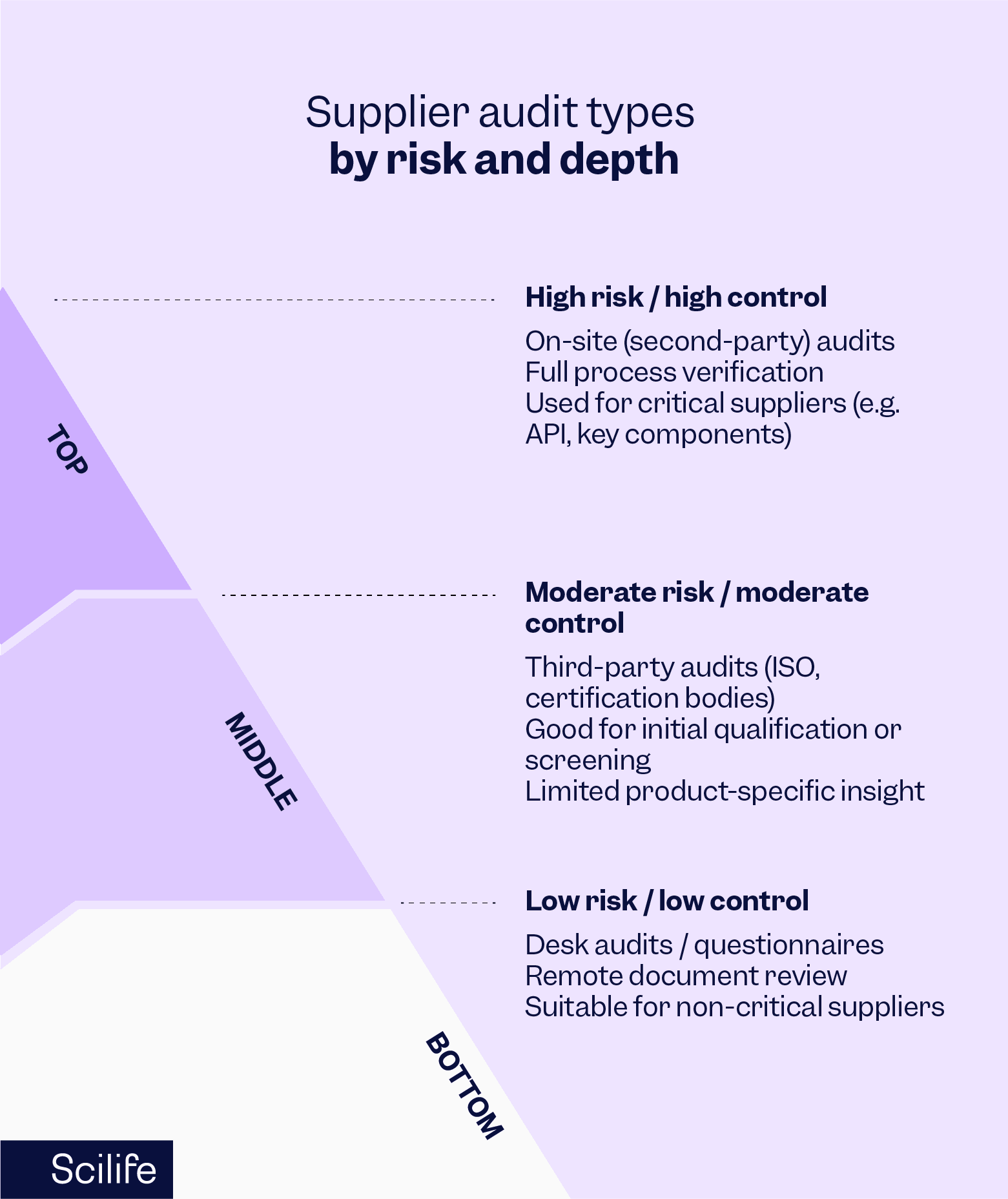
There are several ways to approach this task, and the method you choose should match the risk level of the vendor. A desk audit or a questionnaire might be sufficient for a supplier of low-risk office supplies, but for a critical API or a specialized microchip, you need something much more rigorous. Most quality professionals categorize these into three main types.
The most common is the second-party audit, where you or a hired representative visit the supplier directly. This provides the most granular control and allows you to ask the specific questions that matter to your unique product. Then there are third-party audits, where an independent body, like an ISO registrar or a specialized auditing firm, evaluates the vendor against a general standard.
While these are helpful for screening, they often lack the product-specific focus that a life sciences company needs. And some organizations are moving toward virtual or hybrid audits, which use video technology to inspect facilities when travel is restricted, though these require very high levels of trust and technical support.
Regulatory requirements and industry standards for supplier audits
The regulatory expectations for supplier auditing are clear across both US and European frameworks. Under FDA 21 CFR Part 820 and ISO 13485:2016, manufacturers are required to establish and keep procedures to verify that purchased or otherwise received products and services conform to specified requirements. This includes the evaluation and selection of suppliers based on their ability to meet those standards.
The authorities expect to see a documented record of these evaluations and a clear rationale for the frequency of your audits based on the risk and performance history of each vendor.
ISO 13485 audit checklist


The key steps to conduct a supplier audit
To make sure your audit yields actionable results, you must follow a structured vendor audit process. I have found that the more work you do before you arrive at the site, the more successful the actual inspection will be.
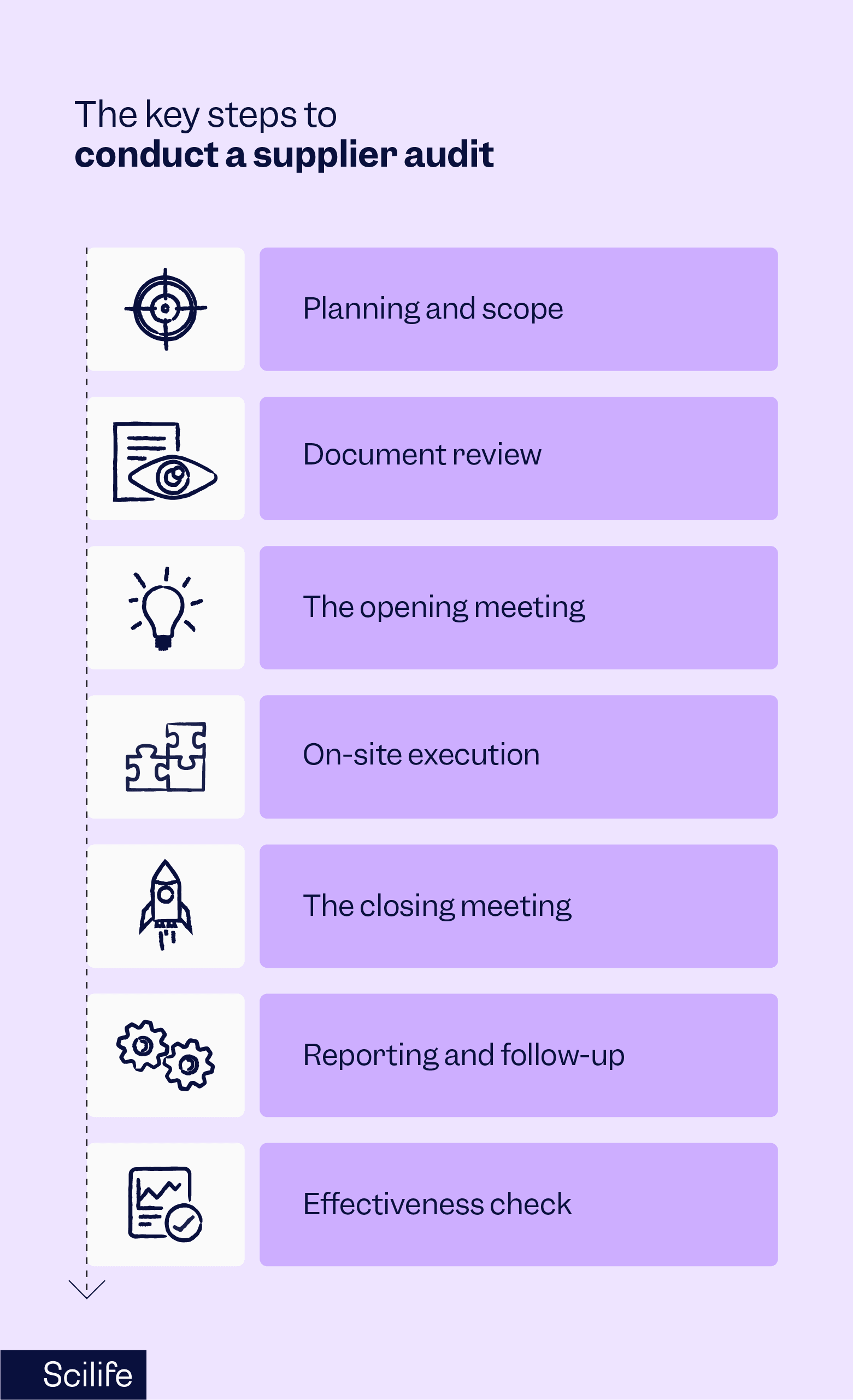
- Planning and scope: Define exactly what you are going to audit, whether it is a specific production line or the entire quality system, and notify the supplier well in advance.
- Document review: Request and review their quality manual and key SOPs before the visit to identify potential areas of concern that require deep diving onsite.
- The opening meeting: Set the tone by explaining the purpose of the supplier audit and confirming the schedule with the vendor's leadership team.
- Onsite execution: This is the most important step in how to conduct a supplier audit process. It is where you walk the floor, interview staff, and review batch records to see if reality matches the documentation.
- The closing meeting: Share your findings, both positive and negative, so there are no surprises when the final report is issued.
- Reporting and follow-up: Document your observations clearly and set firm deadlines for the supplier to address any non-conformances or observations.
- Effectiveness check: Verify that the corrective actions taken by the supplier actually fixed the problem.
Leveraging data for predictive supplier oversight
The future of supplier auditing is moving from reactive checking to predictive scoring. According to a study on Supplier risk scoring models, companies that leverage advanced data analytics for their supply chain see measurable improvements. Within one year of implementing such a model, a medical device company achieved an 18% decrease in defect rates from critical suppliers and a 22% improvement in on-time delivery.
Most impressively, their predictive system flagged a supplier in Southeast Asia for financial instability three months before bankruptcy was declared. This early warning allowed the manufacturer to switch to a secondary source, avoiding production delays and potential regulatory non-compliance that could have been catastrophic.
Recommended learning:

Conclusion: How does QMS software support supplier audit management?
Handling a growing list of vendors through manual methods eventually leads to a breaking point where signals are missed. Honestly, the real strength of your supplier audit program lies in how you manage the data after the audit is finished. If your reports are buried in a drawer, they can't help you predict the next supply chain risk.
Scilife takes that weight off your shoulders by centralizing your vendor data and making sure that your audit schedules are always up to date. When you keep all your supplier risk ratings compliance audit history access in one digital location, you can finally move away from the spreadsheets. You can then start using your data to drive better business decisions.
We guarantee that your vendor compliance audit results are directly linked to your CAPA and deviation systems, creating the kind of connected quality ecosystem that inspectors love to see. We are here to help you turn your audit process from a burdensome task into a strategic advantage, so you can keep your production lines moving and your patients safe.