
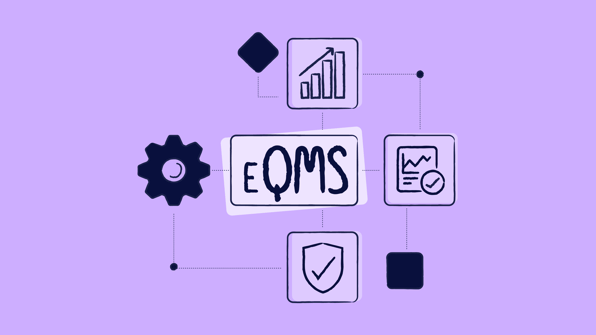

An eQMS supports strategic quality management by centralizing controlled quality data, connecting quality events and actions, standardizing workflows, and making trends, risks, and process performance easier to evaluate. It does not replace QA judgment. It gives QA managers the traceability and context needed to guide better operational and strategic decisions.
Key takeaways
What is strategic quality management?
QA professionals have always been at the center of maintaining compliance, protecting product quality, and ensuring patient safety. But as organizations grow and regulations become more complex, the demands on QA continue to increase. Teams are expected to manage more documentation, more stakeholders, more audits, and more risk, all while keeping operations running smoothly.
For years, QA managers have effectively been expected to do two jobs at once.
One is operational: keeping documents updated, workflows moving, audits ready, training completed, deviations followed up, and compliance evidence under control.
The other is strategic: spotting quality risks early, guiding better decisions, improving processes, and helping the business grow without compromising patient safety or regulatory confidence.
This broader responsibility is what strategic quality management is all about. Rather than focusing solely on maintaining compliance, it involves using quality information to reduce risk, improve operational performance, strengthen collaboration across departments, and help leadership make better business decisions.
The challenge is that the operational workload often consumes the strategic one. As organizations scale, quality work becomes more complex. More teams become involved, more documentation is created, more data is generated, and more decisions require context. Too often, QA managers end up spending valuable time chasing information instead of using it.
Making quality strategic doesn't require QA to become something different. It requires giving experienced quality professionals the visibility, evidence, and time they need to apply their expertise where it creates the greatest value.
What role does an eQMS play?
An eQMS gives QA leaders the visibility, structure, and evidence they need to move from managing quality activities to influencing quality strategy. Processes become automated, workflows move out of spreadsheets, and dashboards start showing what previously lived in someone's head, inbox, or carefully colour-coded tracker.
An eQMS centralizes information, streamlines repetitive tasks, and surfaces trends that are difficult to identify when quality data is scattered across disconnected systems.
However, the real value lies in what QA managers can do once the operational noise is reduced. With better visibility and connected data, QA leaders can identify recurring risks faster, understand where processes are breaking down, and support decisions with stronger evidence. Perhaps most importantly, they can help leadership see quality not simply as a compliance requirement, but as a business-critical function.
An eQMS also creates something that manual systems struggle to provide: real-time visibility.
Instead of quality information being locked inside disconnected documents or scattered across multiple systems, critical activities become connected through a single source of truth. Compliance status, deviations, CAPAs, training records, document approvals, and audit readiness can all be viewed together and understood in context.
This visibility benefits the entire organization, but particularly the QA department. It gives quality professionals greater authority because conversations are supported by complete, traceable, and accessible information rather than manually assembled reports.
In that sense, an eQMS makes QA expertise less relevant AND gives that expertise more room to lead.
Recommended learning:

How an eQMS strengthens QA decision-making
Good QA managers have always made evidence-based decisions, whether they work with paper records, spreadsheets, or digital systems. What an eQMS changes is the visibility, consistency, and accessibility of the information behind it.
Centralized quality data, automated reporting, and real-time KPIs help QA move conversations beyond isolated observations toward a clearer understanding of operational performance, risk, and release readiness.
Consider a discussion about a delayed product release.
Without reliable, connected data, QA can easily be perceived as the function holding things up, especially when it's QA raising the final questions, requesting missing evidence, or confirming that release criteria haven't yet been met.
But the delay rarely begins during QA review. The underlying causes may include incomplete batch documentation, deviations identified too late, pending change controls, missing supplier information, unclear ownership, or training requirements that weren't addressed early enough.
When this information is fragmented across spreadsheets, emails, and disconnected systems, these dependencies often remain hidden until the release is already under pressure.
With centralized metrics and traceable workflows, QA managers can demonstrate exactly where the process began to drift, which dependencies remain unresolved, and what risks they introduce. This can help the organization understand the conditions affecting release readiness and recommend targeted improvements much earlier in the process.
The conversation changes from:
"Quality is delaying the release."
to:
"Here's what's driving the delay, here's the associated risk, and here's what we can do to improve the process."
That's a much stronger position.
Not because the technology made the decision (it didn't) but because it made the evidence easier to access, understand, and communicate.
“Scilife has made our life easier in so many ways. One of the things I like the most is how it integrates different processes. It gives a bigger picture of everything and allows us to keep track of deviations and see opportunities for improvement."
Daniele Scalco, Quality Assurance and Regulatory Affairs Manager, Idevax
How an eQMS supports trend detection and recurrence reduction
One of the greatest advantages of connected quality data is the ability to identify patterns before they become recurring problems.
Imagine you're in the weekly operations meeting. A new deviation has been raised, and leadership wants to know whether it's an isolated event or part of a broader trend.
Answering that question requires more than finding a similar record.
QA may need to look across products, processes, equipment, suppliers, or manufacturing sites to determine whether the events are genuinely related and whether they indicate an emerging quality signal.
When this information is spread across spreadsheets, emails, and disconnected records, teams may need to review previous investigations manually, compare root cause classifications, check whether related CAPAs remain open, and assess whether earlier corrective actions were actually effective… It can take hours!
An eQMS dramatically simplifies that process.
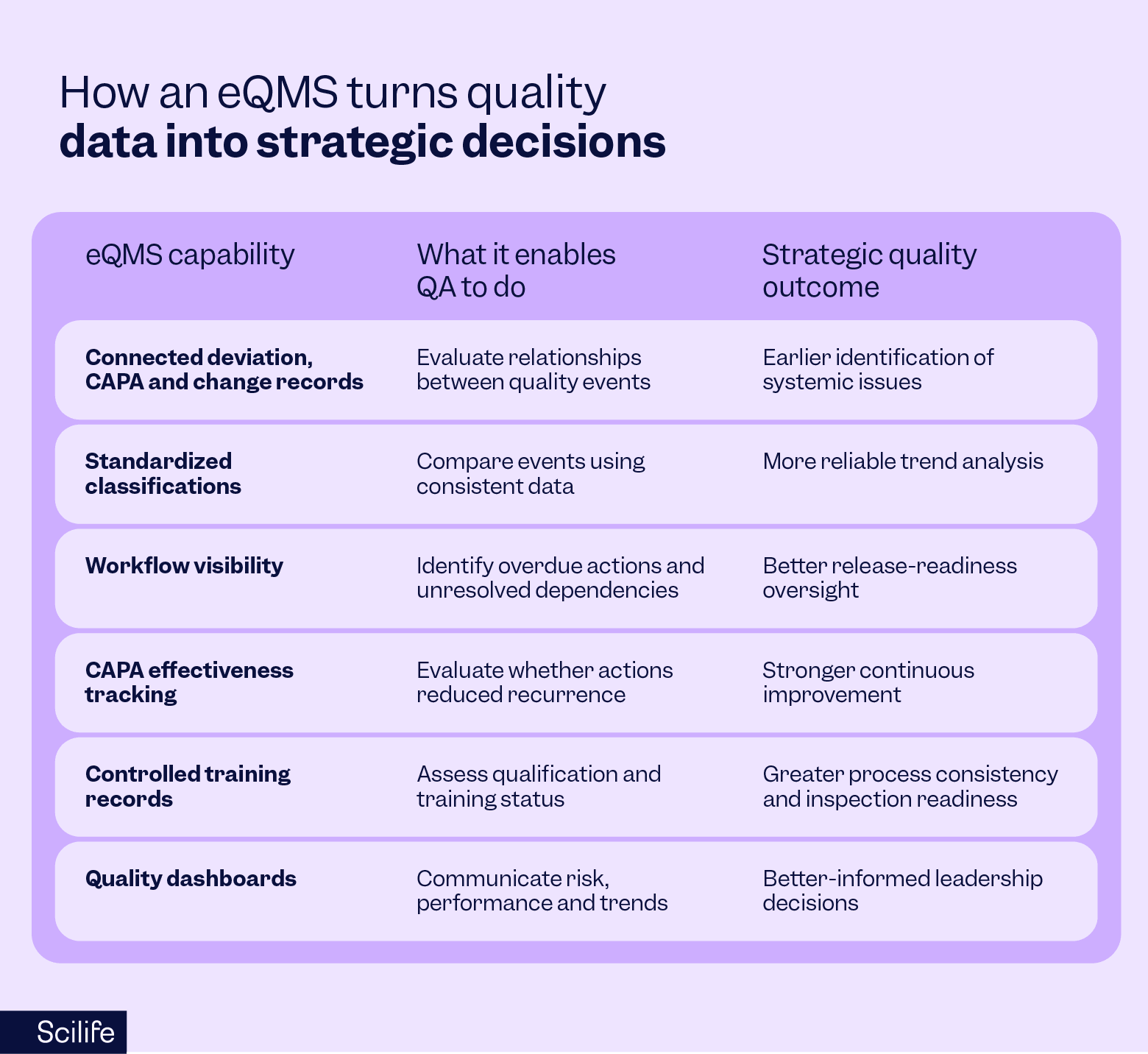
Instead of manually gathering evidence from multiple sources, QA teams can access deviation history, related CAPAs, investigation status, root causes, effectiveness checks, and closure trends through connected, traceable records.
That doesn't mean every answer is available at the click of a button, since a deviation that's still under investigation may not yet have a confirmed root cause, and professional judgment is still required to determine whether apparently similar events are genuinely connected. However, QA enters the conversation with a much clearer understanding of what's already known, what remains uncertain, and where further investigation is needed.
Instead of saying:
"I'll look into it and get back to you."
QA professionals are often able to explain what's happening, support their conclusions with evidence, and recommend the next course of action during the meeting itself.
The system is, once again, giving QA expertise the visibility, context, and traceability needed to influence decisions at exactly the right moment.
How an eQMS improves release-readiness visibility
Every delayed document approval, overdue training record, unresolved deviation, pending CAPA, incomplete change control, or missing supplier record contributes to the overall readiness of a product for release.
The challenge is that these dependencies often exist across multiple departments and disconnected systems. Without centralized visibility, they may only become apparent when release timelines are already under pressure.
An eQMS brings these quality activities together into a single source of truth. Document control, training completion, deviations, CAPAs, audits, approvals, and quality metrics can all be viewed in context, allowing QA managers to assess release readiness based on complete and current information rather than manually assembled reports.
This gives leadership greater confidence in quality data, enables earlier identification of bottlenecks, and allows teams to resolve issues proactively rather than reactively.
Rather than acting as the final gatekeeper at the end of the process, QA becomes a strategic partner that helps the organization understand what's affecting release readiness long before products reach the final approval stage.
How QA translates quality data into business context
One of the most valuable aspects of an eQMS is its ability to translate quality information into business language.
Quality professionals naturally think in terms of deviations, CAPAs, training completion, document control, audit findings, and change controls. Leadership, however, tends to think in terms of operational risk, production efficiency, business continuity, customer confidence, and growth.
An eQMS helps bridge that gap by connecting quality signals to the business outcomes executives are responsible for. Rather than simply reporting compliance metrics, QA can explain what those metrics mean for the wider organization.
For example, instead of reporting the number of overdue CAPAs, QA can explain how unresolved corrective actions increase operational risk and may affect production performance. Rather than highlighting overdue training records, they can demonstrate how competency gaps could affect inspection readiness or manufacturing consistency.
- Recurring deviations become indicators of process stability.
- Audit findings become indicators of organizational maturity.
- Supplier issues become indicators of supply chain resilience.
Basically, quality data stops being a collection of compliance metrics and becomes information that supports strategic business decisions. When leadership understands how quality performance connects to broader business outcomes, QA naturally becomes part of conversations that extend far beyond compliance.
What an eQMS can do, and what still requires QA judgment
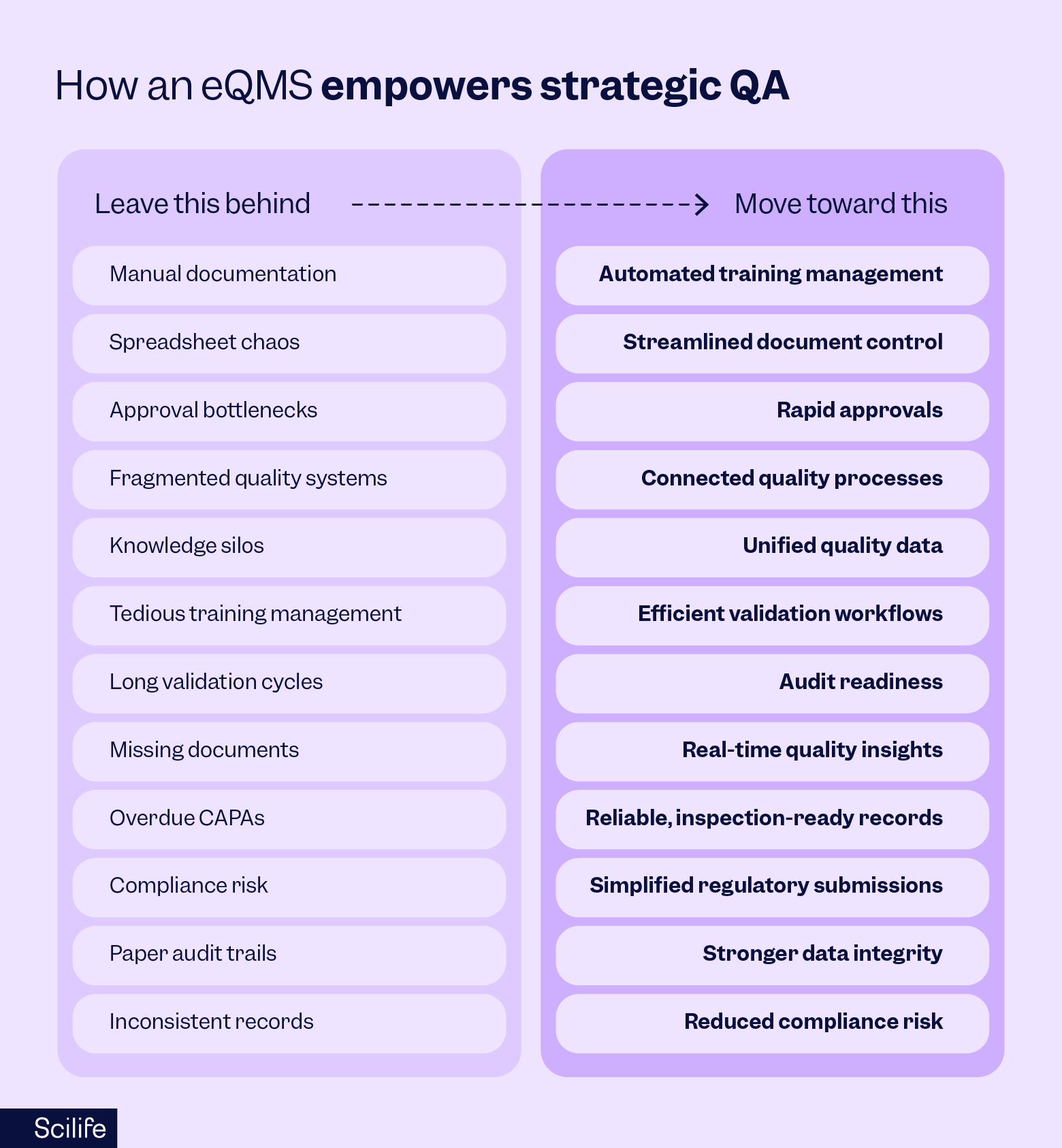
An eQMS can automate repetitive administrative tasks, centralize information, standardize workflows, provide real-time dashboards, and make quality data easier to retrieve, analyse, and share across the organization. It can connect documents, deviations, CAPAs, audits, training, supplier management, and change controls into a single, traceable quality ecosystem.
It can surface trends that might otherwise remain hidden, improve collaboration across departments, and provide leadership with timely visibility into quality performance.
What it cannot do is replace professional judgment, as no software can investigate a deviation, assess patient or product risk, interpret regulations, determine the appropriate corrective action, or decide whether available evidence is sufficient to release a product.
Those decisions continue to rely on the knowledge, experience, and critical thinking of quality professionals. Technology supports those decisions by providing better information, but QA professionals make those decisions.
This distinction becomes increasingly important as organizations adopt more digital technologies and AI-powered capabilities.
Whether insights come from dashboards, automation, or artificial intelligence, human oversight remains essential. Quality decisions must always be supported by evidence, professional expertise, and regulatory accountability.
Successful digital transformation depends on QA expertise. Because technology can automate administrative work, but it cannot replace the experience required to make informed quality decisions.
Instead, the right eQMS gives QA managers better visibility, stronger data, and more time to focus on the work that creates the greatest value.
Why QA should lead implementation
Digital transformation initiatives are most successful when they're led by the people who understand quality processes best.
QA managers know where bottlenecks occur, where compliance risks exist, and which processes genuinely need improvement. They understand not only what regulations require, but also how those requirements translate into day-to-day operations.
That perspective makes QA uniquely qualified to lead eQMS implementation.
Rather than simply digitizing existing processes, QA leaders can design workflows that reflect how quality should operate. They identify inefficiencies before they're embedded into new systems, ensure regulatory expectations remain integrated throughout implementation, and help teams adopt new ways of working without compromising compliance.
An eQMS doesn't determine how quality should operate (This is still QA’s job). The technology simply provides the framework that allows those processes to run more consistently, transparently, and efficiently. When QA leads implementation, digital transformation becomes less about replacing existing ways of working and more about strengthening them.
One of the biggest challenges for QA professionals isn't the work itself, but making that work visible. Much of quality's value comes from preventing problems before they happen. When everything works as intended, nothing dramatic happens. Audits run smoothly, products remain compliant, risks never materialize… And success often stays invisible.
Traditional quality systems make this even harder by scattering information across spreadsheets, emails, and paper records, leaving QA teams spending more time gathering evidence than demonstrating the strategic impact of their work.
An eQMS changes that: as adoption matures, leadership no longer depends exclusively on manually assembled reports to understand quality performance. Instead, they have access to dashboards, trend analysis, workflow status, and risk indicators that provide a clearer picture of what's happening across the organization.
However, those dashboards didn't create themselves. Instead. The workflows, KPIs, risk categories, reporting structures, and quality processes behind them were designed by QA professionals who understood what information the organization needed and how quality should operate.
That's where the real leadership opportunity lies. Rather than being seen primarily as the team responsible for reviews and approvals, QA becomes the team that provides clarity, foresight, and direction.
Successful implementation can fundamentally change how other departments engage with quality:
- Teams adopt more standardized processes.
- Cross-functional collaboration improves because everyone works from the same information.
- Leadership gains greater confidence in quality data.
- And most importantly, QA becomes increasingly associated with continuous improvement rather than administrative oversight.
For many QA managers, leading an eQMS implementation becomes one of the defining moments of their careers. Not because they introduced new technology, but because they helped make quality more visible, more connected, and more influential across the organization.
What QA managers should look for in an eQMS
Not every eQMS delivers the same experience, since the best platforms will empower quality teams to work more effectively while maintaining ownership of their processes.
When evaluating an eQMS, usability should be one of the first considerations. Even the most feature-rich system won't deliver value if employees find it difficult to use. An intuitive platform encourages adoption across departments, resulting in more consistent data, smoother workflows, and greater confidence in the information QA relies on to make decisions.
Configurability is equally important. Quality processes evolve as organizations grow, regulations change, and products become more complex. Your eQMS should adapt alongside those changes without forcing teams to redesign established processes around software limitations.
Visibility should also be built into the platform: dashboards, reporting, and real-time insights shouldn't exist solely for audits. They should also help QA managers identify trends, monitor performance, communicate quality's impact to leadership, and support better decision-making before issues become larger risks.
Collaboration is another essential consideration, since quality doesn't happen in isolation, and neither should your quality system. An effective eQMS connects QA with manufacturing, operations, regulatory affairs, suppliers, and other stakeholders through shared workflows and centralized information. When everyone works from the same source of truth, communication becomes clearer, decisions happen faster, and accountability improves across the organization.
“Scilife has definitely helped improve our communication and collaboration within our quality team and between other departments as well."
Cianna Sera, QA Specialist, Pendulum
Finally, think beyond today's requirements. As your business grows, your quality system should scale with it, supporting additional users, sites, products, and regulatory requirements without creating unnecessary administrative complexity.
This is where the right technology partner makes a difference. Rather than simply delivering software, your eQMS should help your team build sustainable quality processes, support user adoption, and ensure the platform evolves alongside your organization.
The goal isn't just to make compliance easier, but to give QA the tools, visibility, and confidence to lead quality more strategically.
Evidence and customer results
The impact of a great eQMS extends well beyond digitizing documentation. Organizations that implement connected quality processes often experience measurable improvements in efficiency, visibility, and compliance performance.
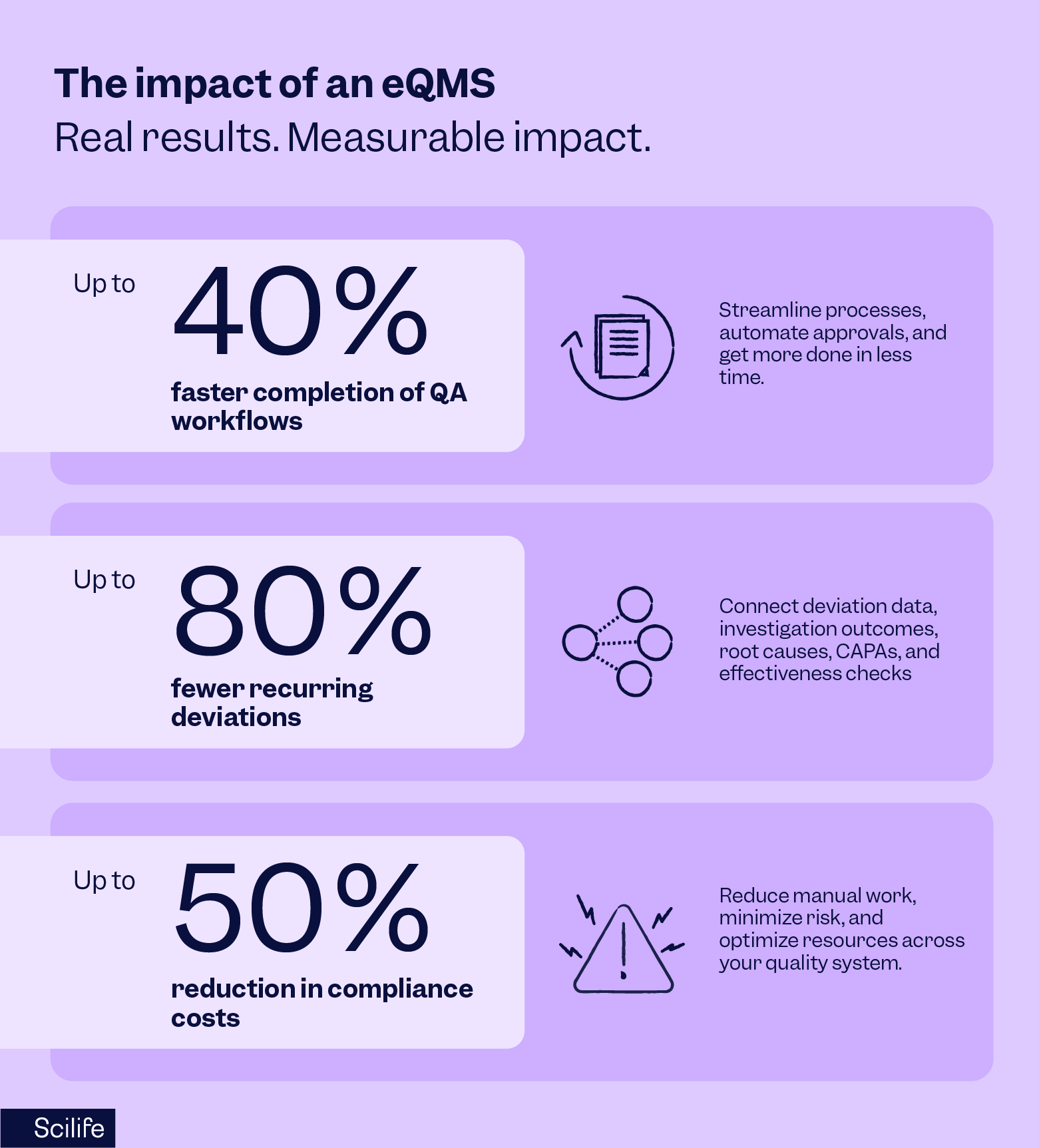
The benefits aren't only reflected in operational metrics. Customers also report stronger collaboration, greater visibility, and improved decision-making.
“Scilife has made our life easier in so many ways. One of the things I like the most is how it integrates different processes. It gives a bigger picture of everything and allows us to keep track of deviations and see opportunities for improvement."
Daniele Scalco, Quality Assurance and Regulatory Affairs Manager, Idevax
At Scilife, we believe digital transformation should strengthen the role of QA. That's why our eQMS is designed to help quality teams move beyond disconnected systems and administrative overhead, giving them the visibility, collaboration, and flexibility they need to lead with confidence.
From configurable workflows and real-time quality insights to intuitive user experiences that encourage adoption across the organization, Scilife supports QA professionals in turning compliance into a strategic advantage.
The smart guide to eQMS selection and implementation


Because when quality leaders have the right tools, they help shape the future of their organization.
Conclusion
As organizations continue to digitize quality processes, the role of QA is evolving alongside them.
The most successful quality transformations aren't driven by technology alone. They're driven by quality professionals who use technology to make better decisions, improve collaboration, and demonstrate the value quality brings to the business.
An eQMS doesn't replace experience, judgment, or expertise.
It removes the administrative barriers that often prevent those qualities from being seen.
By making quality work more visible, connecting teams through reliable data, and enabling more informed decision-making, an eQMS allows QA managers to spend less time chasing documentation and more time driving meaningful improvements across the organization.
Ready to make quality more visible? Discover how Scilife's Smart eQMS helps QA teams lead with confidence.
Ready to make quality more visible? Discover how Scilife's Smart eQMS helps QA teams lead with confidence.