


.jpg)
If you're in pharmaceutical development, Quality by Design (QbD) is a term you know well. It represents an advancement in how we develop and manufacture medicines, and at its heart is the ICH Q8 guideline.
This is the framework for a systematic, science-based approach to development. Getting ICH Q8 right helps build robust processes and wins confidence from regulatory agencies.
This applies to everyone, from small biotechs to large pharma. In this blog, we’ll break down why ICH Q8 matters, explain its core principles, and share some practical tips on implementation.
Key takeaways
What is ICH Q8?
ICH Q8 is a guideline from the International Council for Harmonization. Its purpose is to provide harmonized guidance on the pharmaceutical development section of a regulatory submission.
What it really does is outline a systematic, scientific, and risk-based approach to developing drugs, moving away from the older "quality by testing" model. What is ICH Q8? In short, it's the official blueprint for Quality by Design.
Scope of ICH Q8 pharmaceutical development
The scope of the ICH Q8 pharmaceutical development guidance is broad, covering drug substances and drug products throughout their lifecycle. It involves defining the quality target product profile (QTPP), identifying critical quality attributes (CQAs), and determining the critical process parameters (CPPs) and material attributes that impact those CQAs. The guidance applies to both new drug products and post-approval changes, forcing a holistic view of the product and process from the very beginning.
How to get FDA drug approval - launch your product in the market compliantly


What is ICH Q8 Q9 Q10?
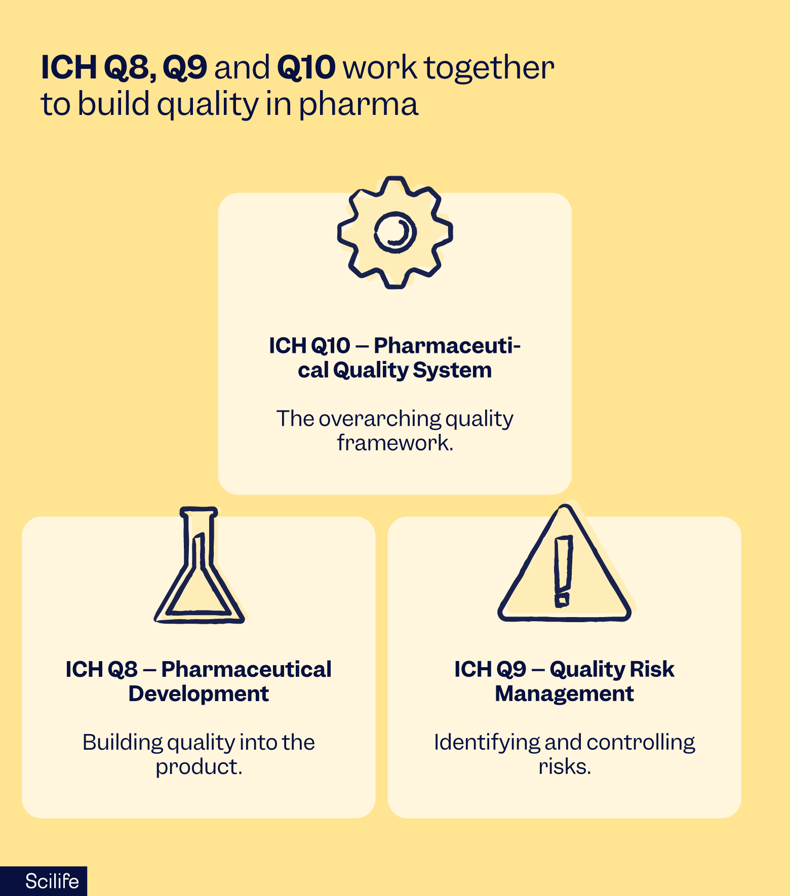
ICH Q8 doesn't work in isolation; it’s part of a trio of guidelines that modernize pharmaceutical quality. People often ask, "what is ICH Q8 Q9 Q10?" Here’s how they connect:
- ICH Q8 (Pharmaceutical Development): Focuses on building quality into the product through enhanced understanding (QbD).
- ICH Q9 (Quality Risk Management): Provides tools for assessing and managing risks, which you use to identify and prioritize the CQAs and critical process parameters mentioned in Q8.
- ICH Q10 (Pharmaceutical Quality System): Describes the overarching quality system needed to support development and manufacturing, integrating Q8 and Q9 principles.
In short, Q8 is the "what" (product understanding), Q9 is the "how" (risk assessment), and Q10 is the "framework" (the quality system) holding it all together.$
The difference between ICH Q8 R1 vs Q8 R2
The guideline evolved from its original version to ICH Q8 R1 and then to the current ICH Q8 R2.
The main difference is the addition of Annex II in ICH Q8 R2. This annex provides practical examples of how to apply QbD concepts like Design Space and control strategy. When the first versions came out, there was a lot of confusion.
I remember teams struggling to translate the theory into a submission. The examples in the ICH Q8 R2 revision made the ICH Q8 guidance much clearer for development teams trying to put these ideas into practice.
Core principles of ICH Q8 you need to know
To really get ICH Q8, you need to grasp its core concepts. These are the building blocks of the Quality by Design approach.
Quality by Design (QbD)
QbD is the central theme. The guideline defines it as "a systematic approach to development that begins with predefined objectives and emphasizes product and process understanding and process control."
Instead of testing for quality at the end of the line, you design it into the product from the start. This ICH Q8 QbD approach requires a much deeper understanding of how your formulation and process variables affect the final product.
It moves development from trial-and-error to a more predictive science.
Critical Quality Attributes (CQAs) and Critical Process Parameters (CPPs)
These are fundamental QbD terms defined in ICH Q8.
- CQAs, or critical quality attributes are the physical, chemical, or biological characteristics of the final drug product that must be controlled to guarantee safety and efficacy. Think of things like the tablet's hardness, its dissolution rate, or its level of impurities.
- CPPs, or critical process parameters are the parameters in your manufacturing process whose variability directly impacts a CQA. These are the dials you need to watch, like blending time, compression force, or coating temperature.
Identifying CQAs and CPPs requires using risk assessment tools (from ICH Q9) and experimental data to prove the relationships between process inputs and product outputs.
Improve your risk management process with ICH Q9 Quality Risk Management in action with Scilife


The concept of Design Space
This is one of the most powerful ideas in ICH Q8. A Design Space is the multidimensional combination and interaction of input variables and process parameters that have been demonstrated to assure quality.
It’s the operating range for your CPPs where you have proven that your product will always meet its quality targets. Working within this approved Design Space gives manufacturing flexibility, meaning adjustments within the space don't require new regulatory submissions.
Defining a Design Space requires a lot of experimental work, but the payoff in operational agility is huge.
Implementing ICH Q8 in practice: Best practices to follow
Understanding the concepts is one thing; putting them into practice effectively is another. It requires a structured approach.
How to identify CQAs and CPPs
This process starts with defining your Quality Target Product Profile (QTPP). What does the ideal drug product look like?
From the QTPP, you identify potential CQAs based on their potential impact on safety and efficacy. Then, using risk assessment tools (like FMEA from ICH Q9) and prior knowledge, you brainstorm potential CPPs and material attributes that could affect those CQAs.
The next step is all-important: designing experiments (like Design of Experiments, DoE) to actually confirm which parameters are truly critical and quantify their impact.
I remember early in my career, I saw a team jump straight to defining CPPs based only on assumptions from literature, and they ended up tightly controlling parameters that didn't really matter for their specific formulation, while missing ones that did. It was a tough lesson learned. Doing the experimental work, guided by risk assessment, is absolutely necessary to truly understand your process.
Recommended learning:

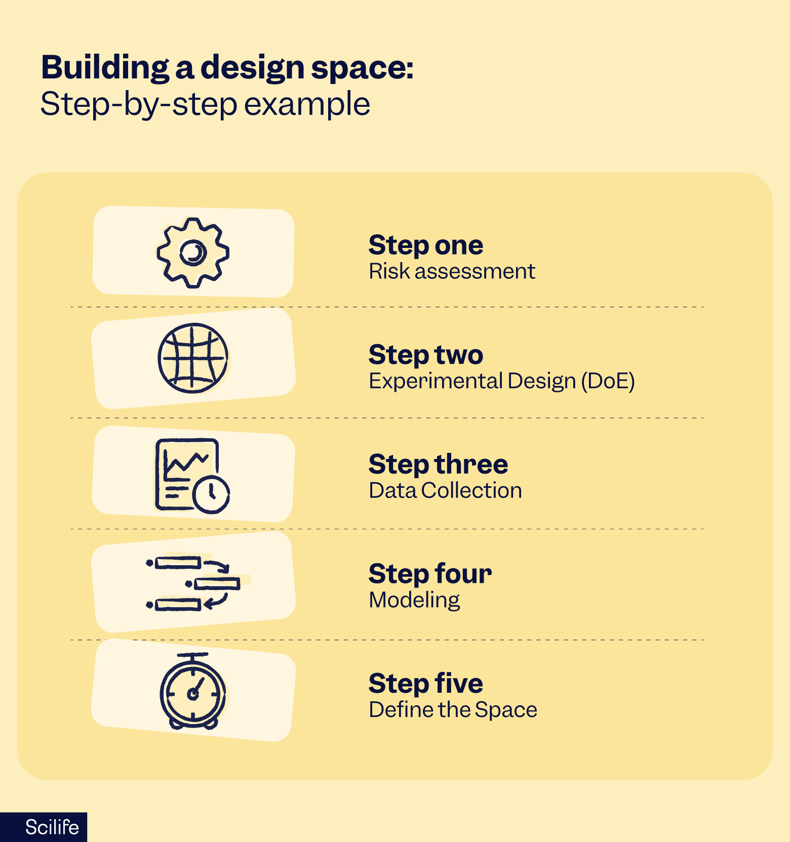
Building a Design Space: step-by-step example
Let’s use a simplified example, defining a Design Space for tablet hardness (a CQA), where compression force and press speed are potential CPPs.
- Risk Assessment: Identify both force and speed as high-risk parameters impacting hardness.
- Experimental Design (DoE): Design experiments systematically varying both compression force and speed.
- Data Collection: Manufacture small batches under these conditions and measure the resulting tablet hardness.
- Modeling: Use statistical software to create a mathematical model describing the relationship between force, speed, and hardness.
- Define the Space: Based on the model, define the specific ranges for force and speed where you can reliably predict that the tablet hardness will meet the specification. This is your proven Design Space.
Documenting pharmaceutical development according to ICH Q8
The ICH Q8 pharmaceutical development section of your regulatory submission needs to tell a clear, data-driven story.
Describe your QTPP and CQAs, then explain how you used risk assessment and experimental data to identify CPPs and establish a control strategy. Your documentation must clearly link process parameters to product quality attributes. Demonstrating robust control over critical quality attributes requires validated analytical methods with clear acceptance criteria.
For instance, the Ghizzani et al. study on icIEF for monoclonal antibodies highlights the validation of method accuracy across a range of concentrations, requiring that the measured results for key isoforms fall within an 80–120 % range of the target value to demonstrate acceptable performance.
Documenting this level of quantitative analytical control provides regulators with confidence in your overall control strategy, a core principle of the ICH Q8 guidance. An FDA analysis previously found that applications incorporating QbD principles often had smoother review cycles.
Conclusion
Getting ICH Q8 guidances right is vitally important for pharmaceutical development today. Quality by Design leads to better processes and more regulatory flexibility, but it generates a lot of complex information.
Managing all the pharmaceutical development documentation, risk assessments like FMEAs, and potential Design Space changes effectively really requires a modern electronic Quality Management System.
An eQMS designed for life sciences, like Scilife, helps keep everything organized and connected. Scilife provides the tools to manage your documents, integrate risk management, and handle change control smoothly.
Discover how Scilife eQMS can help make your ICH Q8 implementation efficient and compliant.