

.jpg)
Finding the best compliance tools for pharmaceutical companies is now a survival requirement for any QARA professional overseen by increasing regulatory complexity and global supply chains.
In this post, we’ll explain why pharmaceutical regulatory compliance is no longer manageable manually. We will provide clarity on how specialized pharmaceutical compliance software fits into a connected eQMS.
With the global pharmaceutical industry expected to hit a $1.6 trillion valuation this year, the average cost of non-compliance has reached roughly $14.8 million, nearly 2.7 times the cost of upholding a proactive system. We will guide you through the pharmaceutical compliance and regulatory solutions you need to stay audit-ready and transition toward a smart quality mindset.
Key takeaways
Compliance at risk: Why manual systems fail under pressure - how many non-conformities are hiding in your spreadsheets?


The traditional manual way of doing quality management will become a liability over time
Let’s be honest, the days when quality meant a team sitting in a back office with a mountain of binders are over.
I’ve spent years in and around this industry, and I’ve seen the same story play out dozens of times. A company starts small, manages everything through spreadsheets or SharePoint, and suddenly finds itself drowning in manual chaos as it grows toward a product launch or a major audit.
Scilife Tip:
The real win with pharmaceutical compliance software is getting rid of the manual grind and the panic that comes with inspections. Through automating these processes, you can cut out about 80% of the repetitive admin tasks that burn out your team.

I once spent two hours helping a client dig through boxes of paper logs for one single training record while an inspector sat there waiting. It was incredibly stressful and made our whole system look unreliable. Moving to a digital platform turns that two-hour nightmare into a two-second search, giving you the confidence that your records are exactly where they need to be.
That’s why investing in the best compliance tools for pharmaceutical companies is no longer a “nice to have,” but a foundational requirement for staying audit-ready and competitive.
The best compliance tools for pharmaceutical companies
So what actually qualifies as the best compliance tools for pharmaceutical companies today? The answer isn’t a single feature but rather a connected pharmaceutical quality management ecosystem.
A modern pharmaceutical Quality Management System (QMS) such as Scilife is a group of tools that work together as a single ecosystem. When these modules are connected, they do the heavy lifting for you, making sure that data flows from one area to another without manual entry.
Based on the Scilife platform, here are the modules that form a solid regulatory foundation:
-
Document management: This guarantees only the most current, approved versions of SOPs are used. It handles electronic signatures to meet 21 CFR Part 11 and EU Annex 11 rules, making sure every sign-off is real and traceable.
-
Training management: Since human error causes about 54% of compliance failures, this tool automates alerts and tracks qualifications so you never have a gap. It supports continuous learning across the team.
-
Quality events management: This reduces compliance issues by centralizing deviations and complaints. It saves time by catching issues early before they become systemic failures.
-
CAPA management: This module streamlines workflows to find the real root cause of issues. It proves to regulators that your company is committed to a quality culture and continuous improvement.
-
Change control management: In this industry, you can't just change a process on a whim. This tool helps you implement changes faster by making sure that every update is risk-assessed and approved before it happens.
-
Risk management: Instead of waiting for a mistake to happen, this tool takes away the dread by helping you find weak spots in advance.
-
Audits management: This acts as your early warning system, removing stress by keeping all findings and answers in one place for easy reporting.
-
Equipment management: This supports consistent maintenance and calibration, which is important for laboratory and manufacturing integrity.
-
Quality KPIs: You can't improve what you don't measure. This tool improves performance by giving you the quality metrics needed to make data-driven decisions.
-
Design and development: Specifically for those in the medical device sector, this simplifies design controls to make sure your product meets all safety requirements from day one.
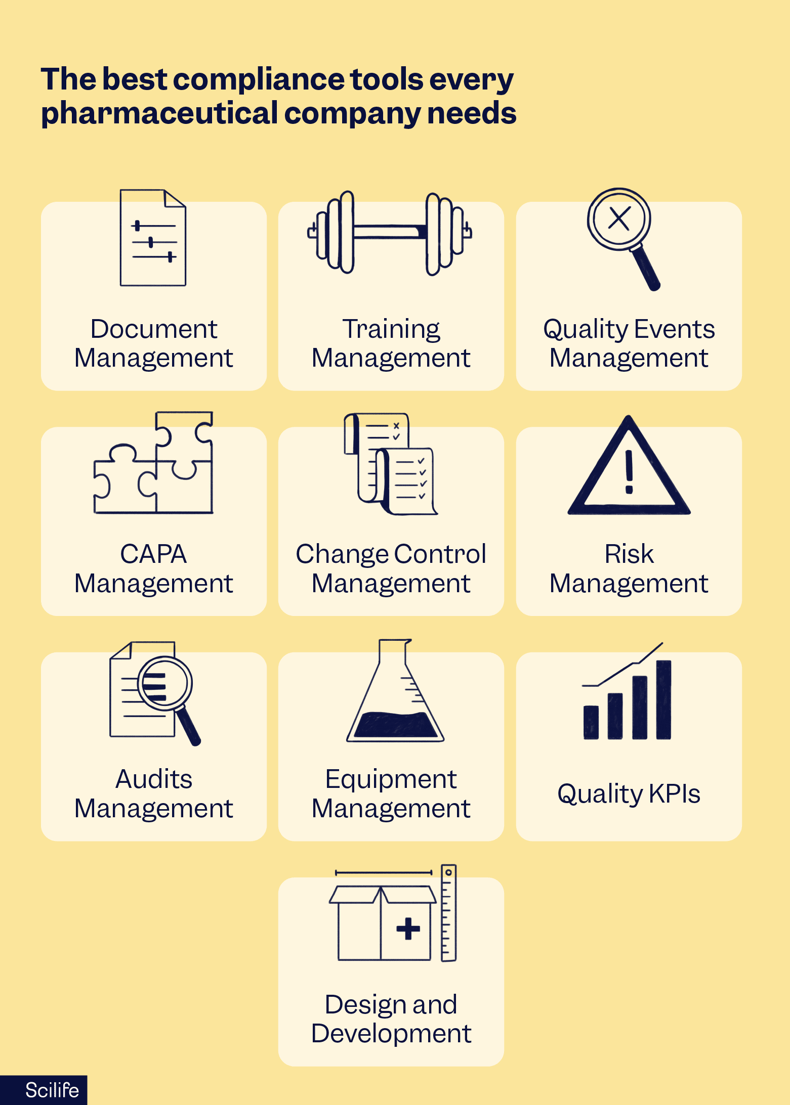
How these compliance tools work together as one connected pharmaceutical compliance ecosystem
The real benefit happens when these tools aren't separate point solutions, but are part of one connected ecosystem. In a manual system, data is stuck in different places. In a smart system, the info flows naturally:
-
Document management to training: When you approve a new version of an SOP, the training module automatically assigns a task to everyone who needs to read it.
-
Quality events to CAPA: If a deviation occurs, it can be linked directly to a CAPA, so no information is lost, and the investigation starts immediately.
-
Audit to change control: If an internal audit finds a process flaw, you can launch a change request right from the audit finding to fix it.
This connection means you don't have to enter the same data twice and gives management a central compliance dashboard to see the health of the whole system at a glance.
Recommended learning: How to choose the right eQMS for life sciences.

How to choose the right compliance tools for your pharma company
Choosing a vendor is a big deal that affects your team's daily life for years. Don't just look at a list of features, but look at how the software actually works for you:
-
GxP and 21 CFR Part 11 compliance: This is the baseline. The software must be built specifically for the strict rules of life sciences.
-
Ready for validation: Validating a new system can be a nightmare. Look for a vendor that provides thorough validation documentation (IQ/OQ/PQ) to get you up and running faster. Here at Scilife, we take care of 95% of the validation burden with our pre-validated GAMP 5 eQMS.
-
Usability and adoption: If the software is clunky, your team will avoid it. You want a specialized but lightweight alternative that people actually enjoy using.
-
Scalability and configurability: Can the system grow with you? It should be able to handle your needs today and whatever you need three years from now.
-
Support, onboarding, and vendor expertise: You aren't just buying software, you're picking a partner. You need a vendor that actually understands the pharma world and can guide you through the setup and onboarding process with real regulatory expertise.
-
Total cost of ownership: Think about the setup time, the onboarding support, and the vendor's expertise in pharma, not just the initial price.
When searching for the best compliance tools for pharmaceutical companies, it’s important to remember that compliance isn’t just about passing audits. It’s about reducing operational risk, protecting patients, and giving your teams the confidence to move faster without cutting corners.
Key considerations when choosing an eQMS for pharma:
-
GxP and 21 CFR Part 11 compliance
-
Validation ease
-
Usability and adoption
-
Scalability and configurability
-
Support, onboarding, and vendor expertise
-
Total cost of ownership
When looking for the best compliance tools for pharmaceutical companies, it’s worth remembering that risk management is about more than just avoiding a fine. According to PharmUni, using a proactive risk strategy allows a team to find and resolve inefficiencies before they have a chance to escalate.
This type of oversight is important for keeping products safe for patients and avoiding the high costs of recalls or legal trouble. Using digital tools to stay aligned with ISO standards builds the kind of trust with regulators that keeps an operation running smoothly.
What to ask your potential eQMS vendor - all the questions you can’t miss and tips for choosing the right eQMS


How Scilife helps pharma companies stay audit-ready
We know that quality management shouldn't feel like a drag that gets in the way of your real work.
Most of our customers come to us because they’re simply tired of the manual chaos and need a system that actually handles GxP requirements from day one.
Whether you’re a small team trying to win back some of your time or a larger company that needs to give inspectors a clear, confident story during an audit, we provide a fast path to staying compliant.
We take over roughly 80% of those repetitive tasks, so you can get back to the science and the patients, with the peace of mind that your compliance is rock-solid.