

.png?width=1200&height=675&name=Cover-Device%20History%20Record%20(DHR).png)

If you work in medical devices, chances are you’ve heard at least one version of this question over the past year: “Wait… does the device history record still exist under QMSR?”
The short answer is yes.
But the terminology and regulatory framing around it are evolving.
With FDA’s Quality Management System Regulation (QMSR) aligning more closely with ISO 13485, many manufacturers are reassessing how they structure manufacturing records, traceability documentation, and batch release evidence.
If your company is already working globally, good news: this shift can actually simplify your documentation processes!
But it also creates understandable confusion around legacy FDA terminology like the Device History Record (DHR), Device Master Record (DMR), and Design History File (DHF).
In this post, we’ll break down what a device history record is, what changes under FDA QMSR in 2026, what stays the same in practice, and how manufacturers can adapt their documentation systems without creating unnecessary disruption.
Key takeaways
What is a Device History Record?
Your device history record (DHR) is the collection of records demonstrating that a specific medical device, batch, lot, or unit was manufactured in accordance with approved specifications and procedures.
Under the legacy FDA Quality System Regulation (21 CFR Part 820), the device history record is explicitly required under §820.184.
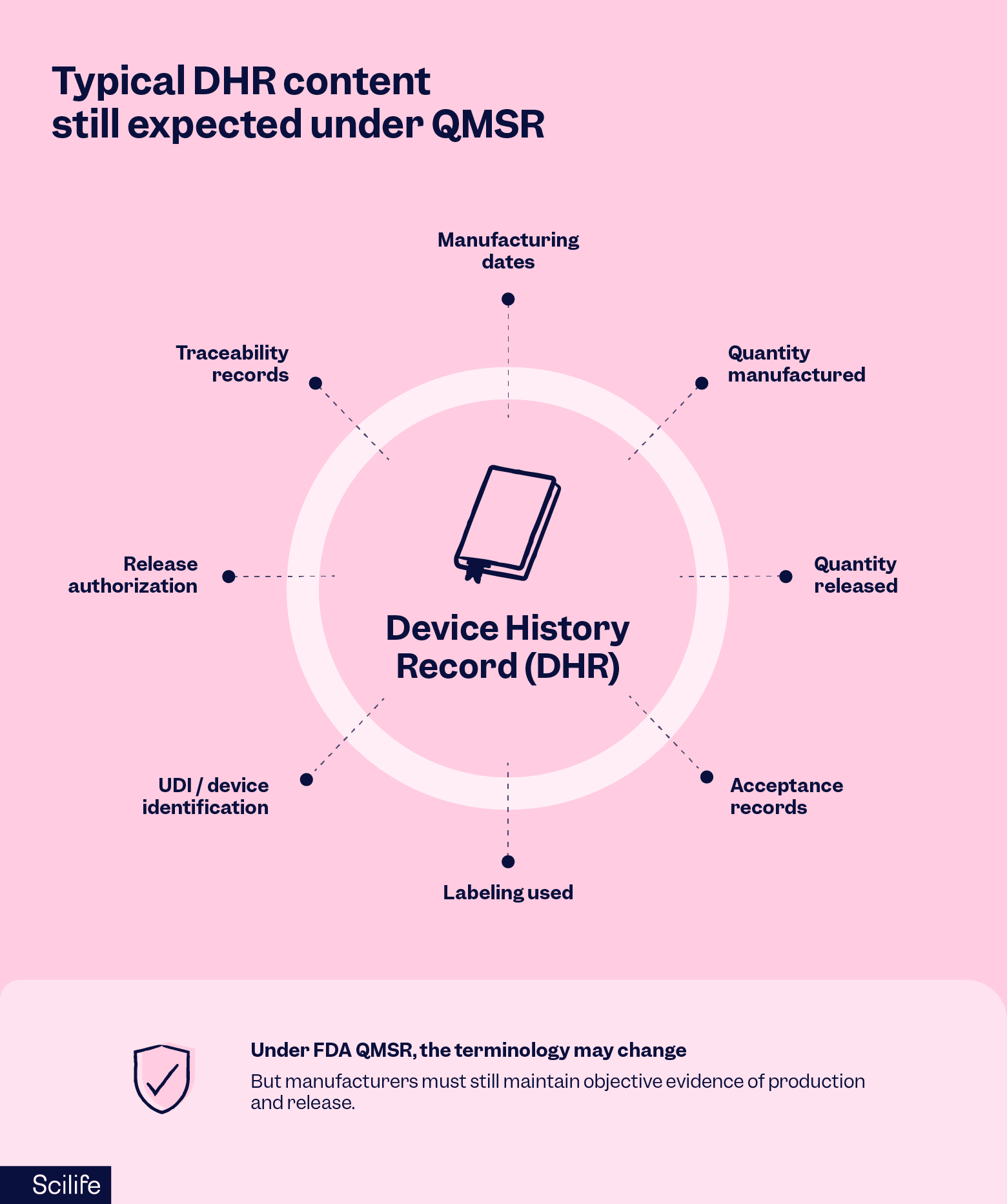
Traditionally, a DHR includes records such as:
- Manufacturing dates
- Quantity manufactured
- Quantity released
- Acceptance records
- Labeling used
- Device identification and traceability information
- Production operator or inspection records, where applicable
In practice, the device history record serves as the documented evidence that a finished device was manufactured correctly, met release requirements, and was approved for distribution
I often explain it to clients as the “manufacturing story” of a device. If a complaint, audit finding, nonconformity, or recall occurs, the device history record is one of the first places investigators and auditors will look.
Documentation issues remain one of the most common FDA inspection findings. FDA warning letters routinely cite incomplete or missing production and acceptance records as a recurring compliance problem, so your DHR is far more than just an administrative formality.
How FDA QMSR changed the device history record
FDA’s QMSR final rule aligns Part 820 more closely with ISO 13485:2016 by incorporating the standard by reference. This is one of the biggest structural changes to the FDA quality system requirements in decades.
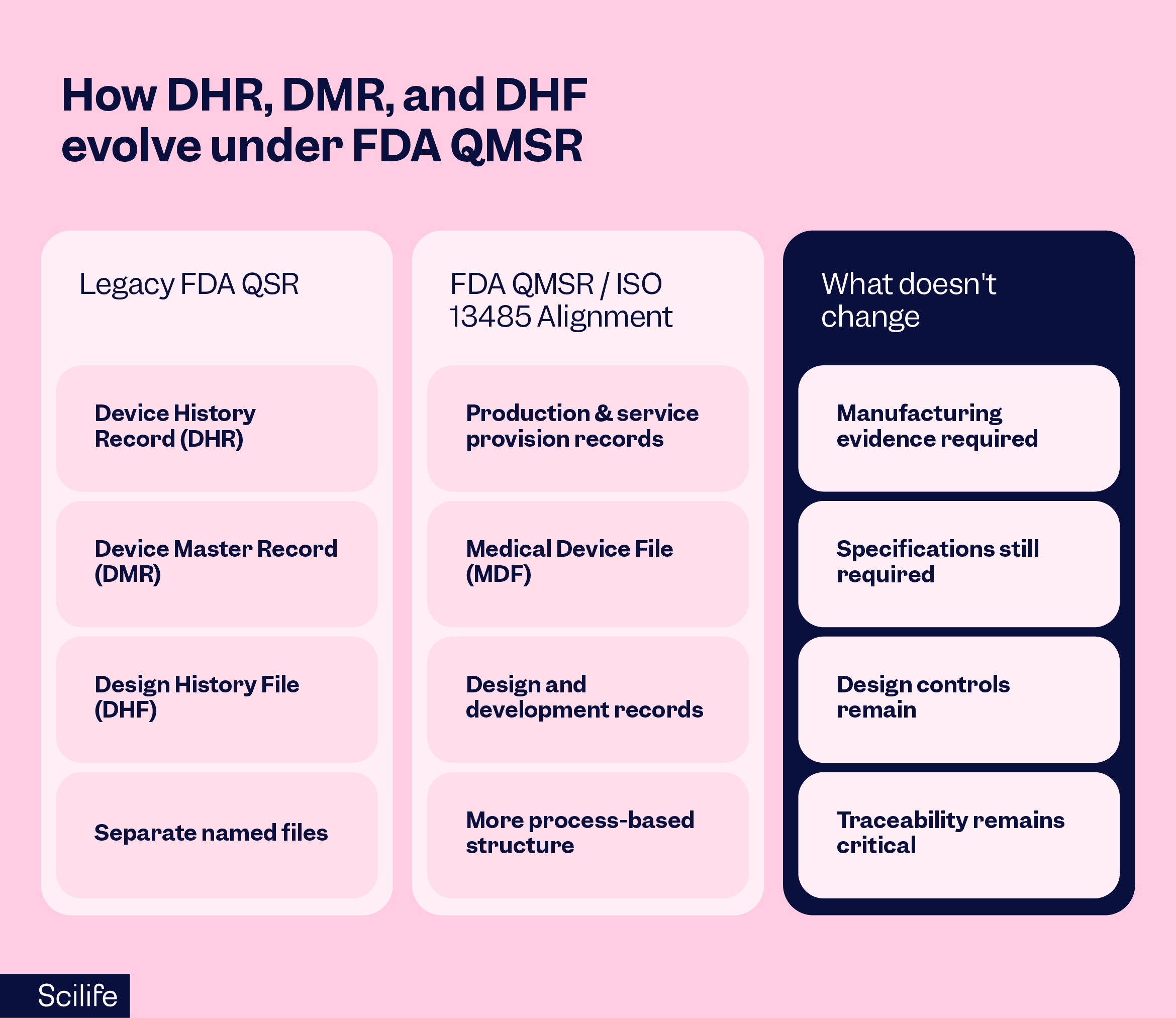
Under the previous QSR framework, FDA used highly specific terminology such as:
- Device History Record (DHR)
- Device Master Record (DMR)
- Design History File (DHF)
ISO 13485 approaches these concepts differently. Instead of prescribing separate named files, it focuses more broadly on documented procedures, records, traceability, and evidence of conformity.
That’s why many manufacturers are now seeing discussions around:
- DHR → production and service provision records
- DMR → medical device file (MDF)
That does not mean the underlying documentation disappears.
This is the important part many teams initially misunderstand.
The FDA is not saying:
“You no longer need manufacturing evidence.”
It is essentially saying:
“We are aligning with ISO 13485 terminology and structure while still expecting equivalent objective evidence.”
So, while the phrase device history record may appear less prominently in the future regulatory landscape, the actual operational expectation remains very much alive.
Understanding the DHR terminology change under QMSR
Under ISO 13485, manufacturers are expected to maintain records demonstrating that product realization processes were completed according to requirements.
In practice, that means companies still need:
- Production records
- Inspection records
- Acceptance evidence
- Traceability documentation
- Release authorization records
- Device identification records
The biggest change is often organizational rather than operational.
In practice, this might mean renaming your procedures, consolidating legacy DHR forms into broader production record systems, moving from static PDFs to integrated electronic QMS workflows, or mapping FDA terminology to ISO 13485 terminology within your internal documentation.
For companies already certified to ISO 13485, the transition is often less dramatic than expected.
Honestly, many manufacturers I’ve spoken with are relieved once they realize they do not need to reinvent their entire documentation structure. In most cases, it’s more about harmonization and terminology cleanup than rebuilding the quality system from scratch.
That said, companies that historically maintained highly siloed “FDA-only” documentation structures may need to rethink how records are organized and linked together.
The key question is no longer:
“Do we have a separate DHR?”
Instead, auditors and inspectors are increasingly asking:
“Can you demonstrate complete production and release evidence clearly, consistently, and traceably?”
Best practices to adapt your documentation to QMSR
Don’t panic and rebuild everything immediately
One of the biggest risks right now is overcorrecting.
There’s no need to rename every procedure, redesign every template, and restructure every file hierarchy all at once. That only creates more confusion, version control issues, and training gaps.
Start with a gap assessment first.
Map your current device history record structure against:
- ISO 13485 requirements
- QMSR expectations
- Internal manufacturing workflows
You may discover that much of your existing documentation already meets the intent of the new framework.
Focus on traceability
The relationship between manufacturing evidence and traceability is becoming increasingly important.
Your device history record process should clearly connect:
- Incoming materials
- Production activities
- Inspection results
- Device identifiers
- Labeling
- Release decisions
This becomes especially critical for higher-class devices (such as implantables), software-driven devices, and combination products.
Standardize documentation naming conventions
You might expect documentation naming conventions to already be standardized across departments, but in practice, mixed terminology is still extremely common.
For example:
- Manufacturing says “batch record”
- QA says “DHR”
- Regulatory says “production release records”
- Software teams call everything “execution logs”
That may seem harmless internally, but during audits it can create confusion fast.
Create a controlled terminology strategy so teams understand:
- Which records exist
- What purpose they serve
- Which regulations they support
Evaluate digital systems carefully
As documentation requirements grow more interconnected, many manufacturers are reassessing whether spreadsheets and disconnected folders are still sustainable.
Modern device history record software can help centralize:
- Batch records
- Approval workflows
- Electronic signatures
- Traceability links
- Audit trails
- Training records
- Nonconformance investigations
Especially under QMSR, where harmonization and consistency matter more than ever, integrated systems can significantly reduce administrative overhead.

Conclusion: How device history record software helps manage device documentation
The transition to FDA QMSR does not eliminate the need for the device history record. It reframes it within a more globally aligned quality management approach centered around ISO 13485 principles.
For medical device manufacturers, the real challenge is not simply changing terminology. It’s ensuring that documentation remains clear, traceable, inspection-ready, and scalable as regulatory expectations evolve.
That’s where connected digital quality systems make a major difference.
With Scilife, you can manage production records, traceability documentation, training, approvals, CAPAs, and change control within one integrated platform. Instead of maintaining disconnected records across spreadsheets, PDFs, and shared drives, teams gain a centralized system designed to support both FDA and ISO 13485 expectations.
And honestly, that alignment is becoming increasingly valuable as global regulatory frameworks continue moving closer together.