



The European Medicine Agency’s (EMA’s) 3-year “Work Plan” for the Quality Domain is a strategic roadmap set by the Good Manufacturing and Distribution Practice (GMDP) Inspectors Working Group (IWG).
At its heart, it focuses on enhancing supply chain integrity and resilience, safeguarding product quality, and assessing/embracing new manufacturing technologies across Europe’s biopharmaceutical landscape.
It’s also closely aligned to the wider EMA network strategy, which has a much broader scope—covering public health as well as medicines development for both human and veterinary use.
The GMDP IWG Quality Domain Work Plan is refreshed every three years, and the latest covers 2025–2027. From my conversations with QA teams, I know how vital it is to keep pace with these updates, especially since the current work plan includes planned revisions to GMP and GDP guidelines and more harmonized guidance on key topics like data integrity and emerging technologies.
These shifts don't just shape quality regulation and guidance; they shape how companies operate day to day.
Key takeaways
What is the GMDP Inspectors Working Group?
The GMDP IWG is a group within the EMA made up of senior inspectors from GMP and GDP inspectorates across Europe. It’s been around since 1996, created with one clear purpose: to harmonize and strengthen quality inspection practices for biopharmaceutical manufacturing and distribution throughout the region.
Group members represent a wide network, including European Economic Area member states, the European Commission, the European Directorate for the Quality of Medicines & Healthcare (EDQM), and the inspectorates of countries accessing the EU and MRA (Mutual Recognition Agreements).
The group meets four times a year to discuss areas of common interest concerning GMDP inspections, develop new GMDP-related guidance, and other GMDP issues, all in collaboration with other organizations such as the EMA, Quality Working Party (QWP), GMP/GDP Steering Committee, PIC/s (Pharmaceutical Inspection Co-operation Scheme), and EDQM (European Directorate for the Quality of Medicines & HealthCare) and national authorities.
Here's a brief explanation of each of these groups:
- The Quality Working Party (QWP) advises scientific committees within the EMA on all aspects of quality for medicines. Its purpose is to provide recommendations by reviewing existing guidance, identifying areas for revision, or offering input on new legal frameworks or specific product guidelines.
- The GMP/GDP Steering Committee is an advisory body that provides strategic guidance and oversight for the GMDP IWG to produce a 3-year quality domain work plan.
- PIC/s (Pharmaceutical Inspection Co-operation Scheme) is an informal, non-binding scheme where regulatory authorities cooperate to harmonize pharmaceutical inspection standards.
- EDQM (European Directorate for the Quality of Medicines & HealthCare) is an organization that protects public health by enabling, supporting, and monitoring the application of quality standards for medicines.
The GMDP IWG collaborates with the EMA, QWP, and GMP/GDP Steering Committee to produce work plans, guidance documents, and assessment tools, such as GMP and GDP guidelines.
Recommended learning:
Why regulators are focusing on data integrity, and why you should step up your game now.

What is the Quality Domain Work Plan?
Every three years, the GMDP IWG, along with its partner groups, publishes the Quality Domain Work Plan, a roadmap that guides the EMA's direction and activities to uphold product quality over the next three years.
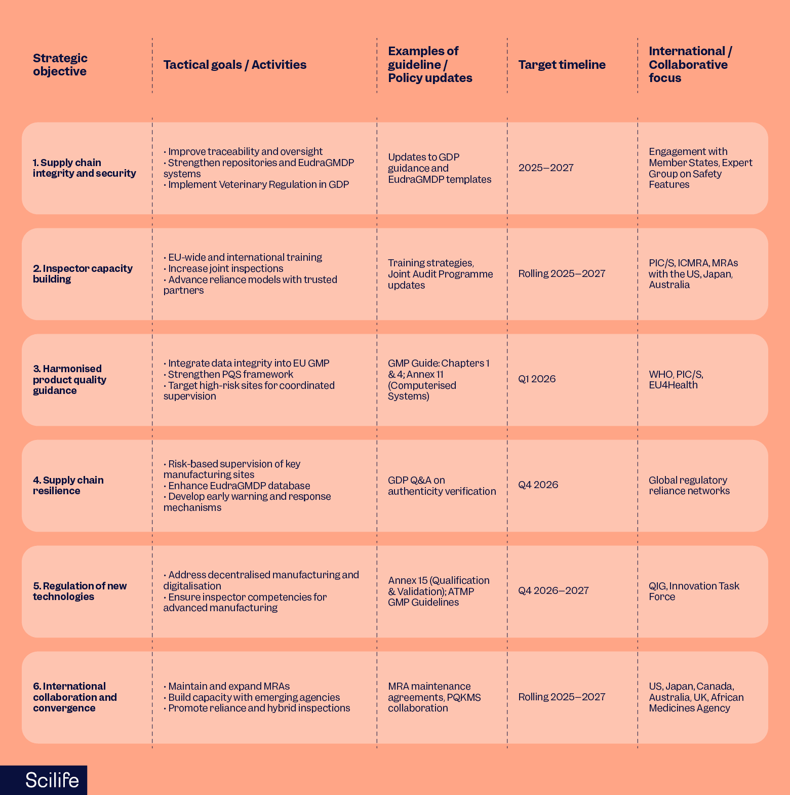
The strategic objectives within the 2025-2027 Quality Domain Work Plan are aligned with the broader EMA’s overarching Network Strategy, focusing on supply chain security, manufacturing, and distribution. These strategic objectives then translate into more granular tactical goals, which is where the plan really comes to life.
The tactical goals outline how the strategy will be delivered in practice — through a combination of guideline updates, training, international collaboration, and inspection planning.
Key priorities in the 3-Year Work Plan (2025–2027)
The Quality Domain Work Plan for 2025-2027 has been aligned with the EMA’s six network strategy objectives (access to medicines, data and digital technologies, regulatory science, antimicrobial resistance, availability and supply, and sustainability).
Key priorities of the Quality Domain Work Plan for 2025-2027 include:
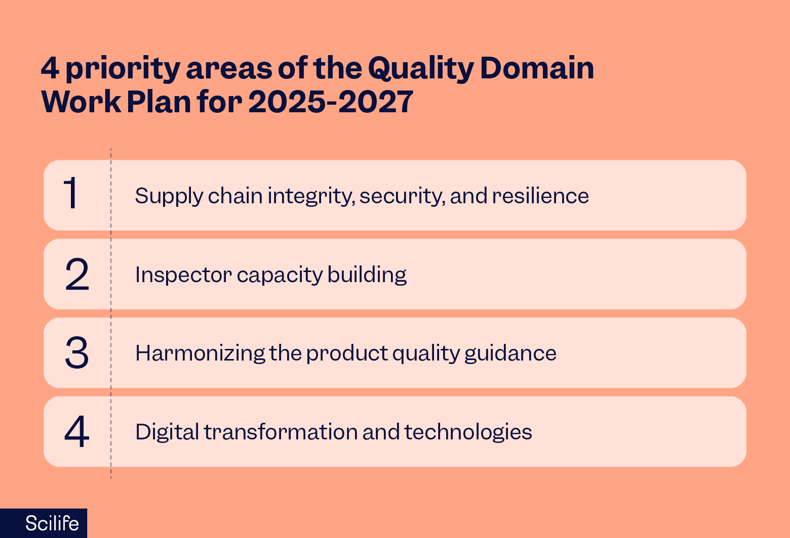
- Supply chain integrity, security, and resilience: Another priority is supply chain resilience. The plan sets out work to improve the EudraGMDP database and inspection coordination, ensuring that weak links in the global supply chain can be identified early. It also highlights how regulators will increasingly engage with emerging technologies — from digitalisation to decentralised manufacturing — to keep pace with scientific innovation.
- Inspector capacity building: There’s also a strong emphasis on capacity building for inspectors, both within the EU and through international partnerships with trusted authorities like the US and Japan. This includes rolling out shared training programmes, joint inspections, and inspection reliance models — practical steps that aim to make oversight more consistent, efficient, and globally aligned.
- Harmonizing the product quality guidance: A major focus is on modernising the regulatory framework, with revisions planned for key parts of the GMP Guide (including Chapters 1 and 4) and Annexes 3, 4, 5, 6, 11, 14, and 15. These updates will strengthen data integrity, reflect technological change in manufacturing, and align EU guidance with international standards.
- Digital transformation and technologies: It also reflects the network’s overarching digital transformation and data strategies through the evaluation of new technologies like AI across the medicines lifecycle.
See the table below for further details.
What this means for pharmaceutical and biotech companies
Any company that manufactures medicines or pharmaceutical ingredients needs to follow the quality standards set by the EMA if they want to sell their products in EU countries.
In practice, that means staying on top of any changes or updates to requirements when submitting applications for marketing authorization to the EMA and making sure the relevant monographs are referenced in the quality section of their dossier.
From what I've seen, the companies that navigate these changes most smoothly are the ones that prepare early and build adaptability into their quality systems. One smart way to do that is by taking a few solid steps to reduce the risk of noncompliance.
Pharmaceutical and biotech companies can prepare for evolving quality domain work plans by establishing:
- Robust regulatory intelligence: To stay ahead of regulatory changes, tools and processes to monitor local and regional regulations and emerging guidelines in real-time should be implemented, along with effective compliance management as part of a QMS, where documentation, reporting, and auditing take place ahead of the changes to reduce the risk of non-compliance.
- Implementing bespoke digital solutions: A modern, cloud-based Quality Management System (QMS) platform built specifically for life sciences organizations with configurable workflows, electronic signatures, audit trails, and integration with document control can greatly help with change management and efficiency.
- Embracing a risk-based approach to change management: A risk-based framework can be used to categorize any updates or changes that are taking place. Multidisciplinary teams should then evaluate the potential impact of changes on product quality, safety, and compliance, focusing on changes with the highest risk or impact.
- Conduct audits: Once systems have been updated and new data collection, reporting, and documentation procedures are in place, conduct internal audits to reduce the risk of compliance issues.
- Prioritizing workforce education: Companies should invest in training to ensure that personnel are trained to use new technologies, understand new quality guidelines, and plan for inspections.
Conclusion
The Quality Domain Work Plan doesn't just set strategic objectives that are aligned with the EMA's broader goals; it lays out a roadmap for achieving those strategies.
These are the actions and timelines that will shape inspections, guidance, and industry expectations over the next three years.
For companies, the changing quality landscape in the EU means staying ahead of evolving guideline updates. A robust, flexible QMS platform like Scilife can make a real difference here — by streamlining change management processes, centralizing documentation, and enabling internal audits.
By automating workflows, tracking regulatory updates, and supporting risk-based approaches, Scilife’s QMS software for pharma and biotech can help teams stay compliant, agile, and fully inspection-ready as the new framework takes shape.