


If you’ve worked in medical devices for a while, the term Device Master Record or DMR probably feels like muscle memory. It’s been part of the regulatory vocabulary for decades, especially if you’ve worked with U.S. Food and Drug Administration (FDA) requirements.
But in February 2026, something shifted.
With the introduction of the new Quality Management System Regulation (QMSR) the term “Device Master Record” is being phased out in the United States.
And naturally, that raises a lot of questions:
-
Is the Device Master Record still required?
-
What replaces it?
-
How does this affect ISO 13485-aligned systems?
Let’s walk through it without the fluff.
Key takeaways
What is a Device Master Record?
At its core, the Device Master Record is the complete set of instructions and specifications needed to manufacture a medical device.
Under the old FDA 21 CFR Part 820 framework, the Device Master Record included:
-
Device specifications (drawings, formulations, software)
- Production process specificationsQuality assurance procedures
-
Packaging and labeling specifications
-
Installation, maintenance, and servicing procedures
Simply put, the Device Master Record is the blueprint for consistently building your device the same way, every time.
That hasn’t changed.
Even though the terminology is evolving, the concept behind the Device Master Record is still essential.
Manufacturers still need:
-
Controlled manufacturing documentation
-
Clear production instructions
-
Traceability between design and production
-
Evidence that devices are built consistently and safely
In other words, the Device Master Record is not disappearing.
It is being reframed.
If you’ve worked with a Design History File (DHF), some of this will look familiar. That’s expected. The DHF captures your design outputs, and those outputs often feed directly into the Device Master Record.
The difference is purpose.
The DHF shows how the device was designed, while the Device Master Record defines how it is manufactured.
.png?width=1560&height=2258&name=What-is-a-Device-Master-Record-(DMR).png)
Recommended learning:
Differences between DHF, DMR, DHR, and QMSR for medical devices.

What changed for the Device Master Record under FDA QMSR?
The key shift comes from the FDA aligning its quality system regulation with ISO 13485.
The new QMSR incorporates ISO 13485 by reference. That changes how documentation is structured.
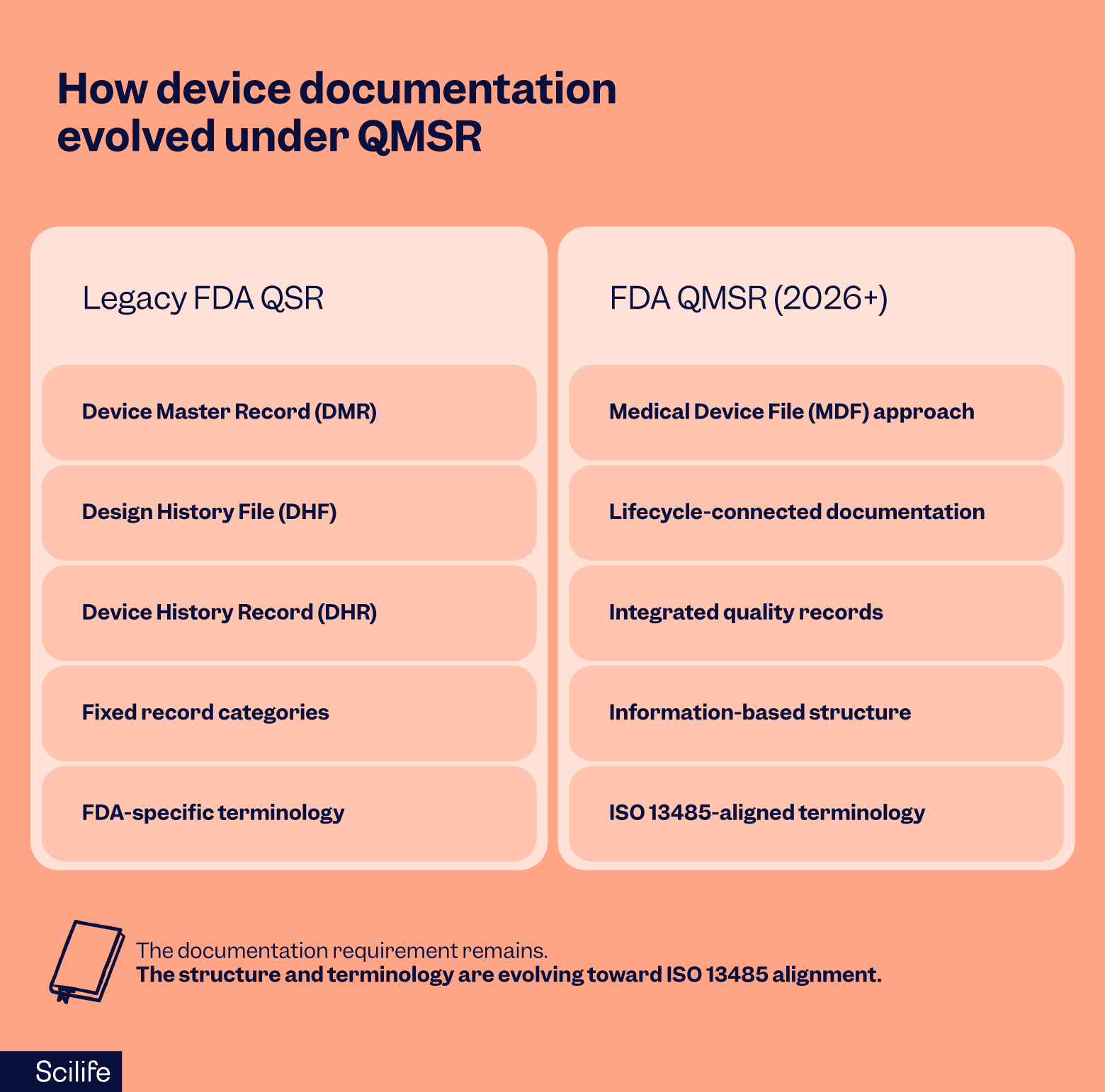
Under the previous QSR framework, documentation was organized into specific record types like DMR, DHF, and DHR. Each had a clearly defined scope and purpose.
ISO 13485 takes a different approach. Instead of fixed record categories, it focuses on ensuring that the right information exists, is controlled, and is connected across the product lifecycle.
And here is the key point. ISO 13485 does not use the term Device Master Record.
That is why the term is being phased out in U.S. regulatory language. The requirement itself has not disappeared, but it now sits within a more integrated documentation structure rather than a standalone record.
Fun fact: ISO 13485 adoption continues to grow globally, with over 30,000 certificates issued worldwide based on recent ISO survey data.
It’s part of a larger industry shift toward globally aligned systems, which is exactly what’s driving changes like the move away from the Device Master Record.
Enter the Medical Device File (MDF)
So, if the Device Master Record is fading as a term, what replaces it?
The answer is the Medical Device File (MDF).
The MDF is an ISO 13485 concept that consolidates information about a device throughout its lifecycle.
It includes:
-
Product specifications
-
Manufacturing processes
-
Quality controls
-
Risk management documentation
-
Post-market information
This should sound familiar. The MDF essentially absorbs the role of the Device Master Record while also extending beyond it. The Device Master Record focuses on manufacturing. The MDF connects design, production, and post-market activities into one structured framework. So, while the Device Master Record is not invalid, it is no longer the language the US FDA prioritizes.
What this means for your QMS
This is where things get practical.
If your system is already aligned with ISO 13485, you are likely closer to the MDF concept than you think.
If your system is heavily structured around legacy FDA terms like Device Master Record, you may need to:
-
Reorganize documentation structures
-
Map Device Master Record content into MDF sections
-
Update terminology across procedures and records
-
Train teams on the new framework
A quick reality check
When teams hear that the Device Master Record is going away, there tends to be a lot of concern.
But when we map their documentation, we usually find:
-
Most of the content already exists
-
It is just stored in different places or under different names
That is the real transition: not rewriting documents but reorganizing them and how we think about them.
I’ve had more than one conversation where someone says, “So… does this mean our DMR is gone now?” And the answer is always the same. No, not really. What you have is still valid. It just needs to be reframed in a way that aligns with ISO 13485.
Should you still use the term Device Master Record?
Short answer, it depends.
You might still use “Device Master Record” internally if:
-
Your team is familiar with it
-
You are maintaining legacy documentation
-
You are transitioning gradually
For external communication and regulatory alignment, it is better to shift toward:
-
Medical Device File (MDF)
-
ISO 13485 terminology
This reflects where the industry is heading.
How an eQMS helps manage device documentation
Whether you still call it a Device Master Record or are transitioning toward a Medical Device File, one thing is clear. Device documentation is not getting simpler.
You are no longer managing isolated records. You are managing connected information across design, manufacturing, and post-market activities, all of which need to stay consistent, controlled, and audit ready.
This is exactly where an eQMS starts to make a real difference.
With Scilife, you can bring your documentation into one structured system where:
-
Product and process documentation are connected instead of siloed
-
Changes are tracked and controlled across the lifecycle
-
Teams work from a single source of truth
-
You are always prepared for audits without last-minute scrambling
In practice, that means less time chasing documents and more confidence that your system actually reflects how your devices are designed and manufactured.
And when terminology shifts again, because it will, you are not rebuilding your system. You are simply adapting how it is structured and presented.