

Most companies think quality is a cost. In reality, poor quality is the actual expense.
In the pharmaceutical industry, poor quality comes with a significant and measurable cost. It can range between 15% and 40% of total sales revenue, as found by different studies. That means a significant portion of your company’s resources may already be lost to deviations, rework, batch failures, and inefficiencies.
I’ve seen teams focus heavily on meeting GMP requirements without fully realizing how much money is lost due to inefficiencies, rework, and failures. And the reality is: if you’re not measuring your Cost of Quality, you’re almost certainly underestimating it. And you’re not helping management understand the financial impact of a strong quality unit.
Rather than a quality problem, what most companies have is a visibility problem. They don’t see what poor quality is costing them.
In this article, we’ll break down what Cost of Quality is, how to calculate it, what metrics to track, and how to reduce it using real-world examples from pharmaceutical and biotech environments.
Key takeaways
What is Cost of Quality (CoQ)?
Cost of Quality refers to the total cost associated with ensuring products meet quality standards, and the cost incurred when they do not.
In practice, CoQ includes:
- Costs of preventing defects
- Costs of evaluating quality
- Costs resulting from failures
In regulated industries like pharma, this definition becomes even more critical. Poor quality is not just a financial issue, but it also can become a huge compliance and patient safety risk.
For example, a study analyzing drug quality across multiple countries found that 15% of drug samples failed at least one quality test. This has a direct implication for companies: poor quality increases internal costs, also eroding trust, brand reputation, and future sales.
Why most quality teams don’t translate quality into cost (and why this matters)
When I first started looking at quality metrics in pharma environments, most discussions were centered around deviations, CAPAs, or audit findings. Rarely did teams translate these into actual cost.
That’s where Cost of Quality becomes powerful. It acts as a bridge between quality operations and financial impact.
Organizations that actively measure CoQ:
- Reduce waste and rework
- Improve process efficiency
- Align QA and finance teams under the same language
And this is where many quality units get stuck.
Most operate in one of two modes:
- Compliance-focused: ensuring audits are passed. This is where most QA teams naturally lean.
- Process improvement-focused: driving efficiency.
The goal should be both.
A mature quality unit:
- Ensures compliance
- Drives continuous improvement
- Quantifies impact
That mindset is consistent with broader quality management principles, where continuous improvement, training, and cross-functional ownership help reduce poor quality costs over time.
Scilife guide: Create an effective CAPA form


The four Cost of Quality types
The most widely used model is the PAF concept (Prevention, Appraisal, and Failure).
To make this more intuitive, it helps to visualize how these costs are distributed:
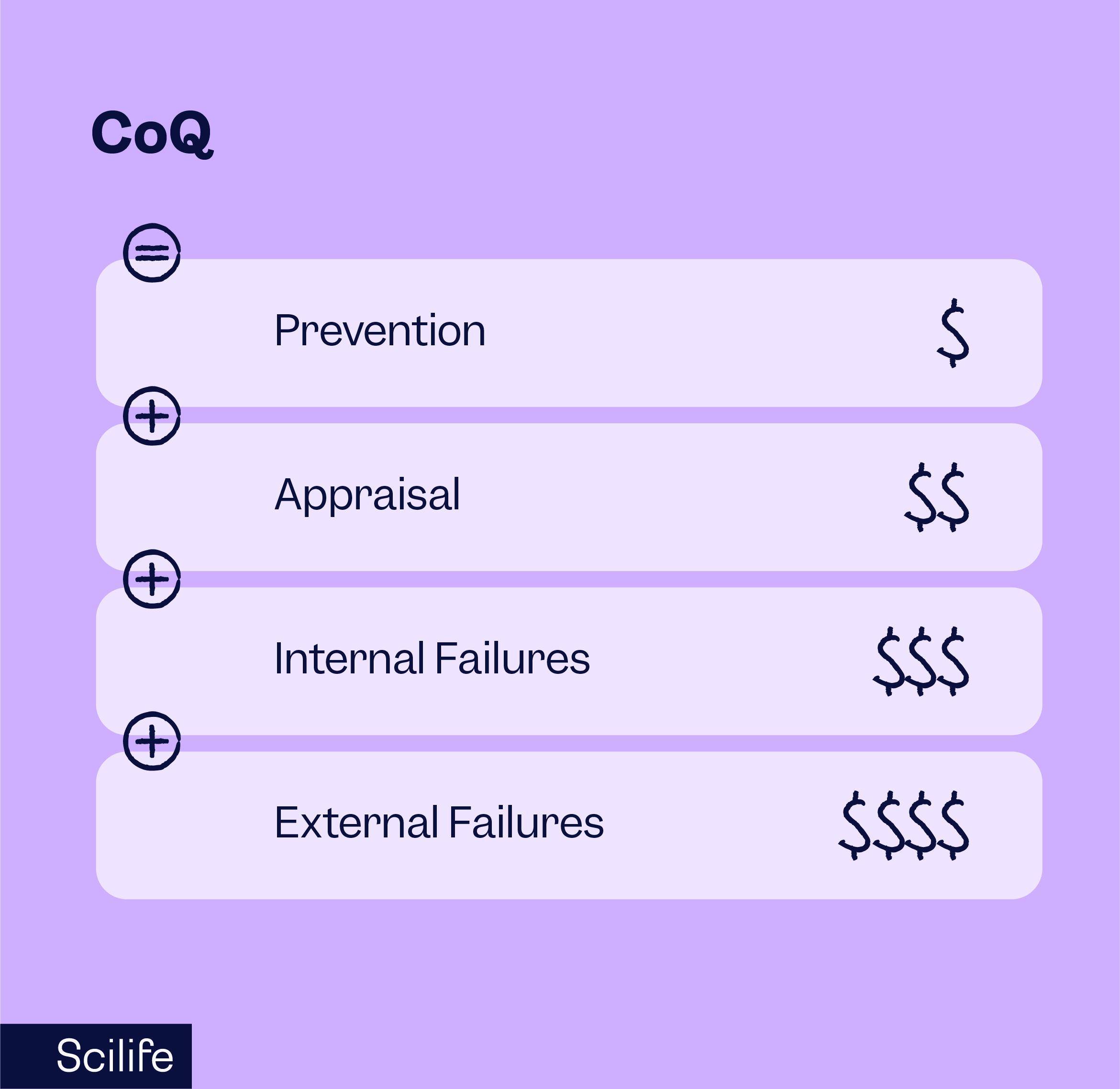
As the diagram illustrates, not all quality costs are equal. Failure costs (especially external failures) are disproportionately higher, often representing the majority of total quality costs. This is why investing earlier in prevention and appraisal can dramatically reduce overall costs.
1. Prevention costs
These are costs incurred to avoid defects before they happen.
Examples include:
- GMP training
- Process validation
- Supplier qualification
- QMS implementation
These are usually the most strategic investments.
2. Appraisal costs
These are costs of evaluating whether quality requirements are being met.
Examples include:
- QC testing
- Batch record review
- Environmental monitoring
3. Internal failure costs
These are costs from defects detected before release.
Examples include:
- Batch rejection
- Rework
- Deviations and investigations
4. External failure costs
These are costs from defects detected after release.
Examples include:
- Product recalls
- Complaints
- Regulatory actions
These are usually the most expensive and damaging costs.
The aim is not to eliminate the Cost of Quality, but to optimize it by reducing failure-related costs through focused investment in prevention and appraisal.
If Cost of Quality metrics are so valuable, why isn’t everyone using them?
Despite its benefits, CoQ is still underutilized.
A literature review on CoQ implementation found that measurement and improvement, return on investment, and management support were among the most frequently cited barriers to successful adoption.
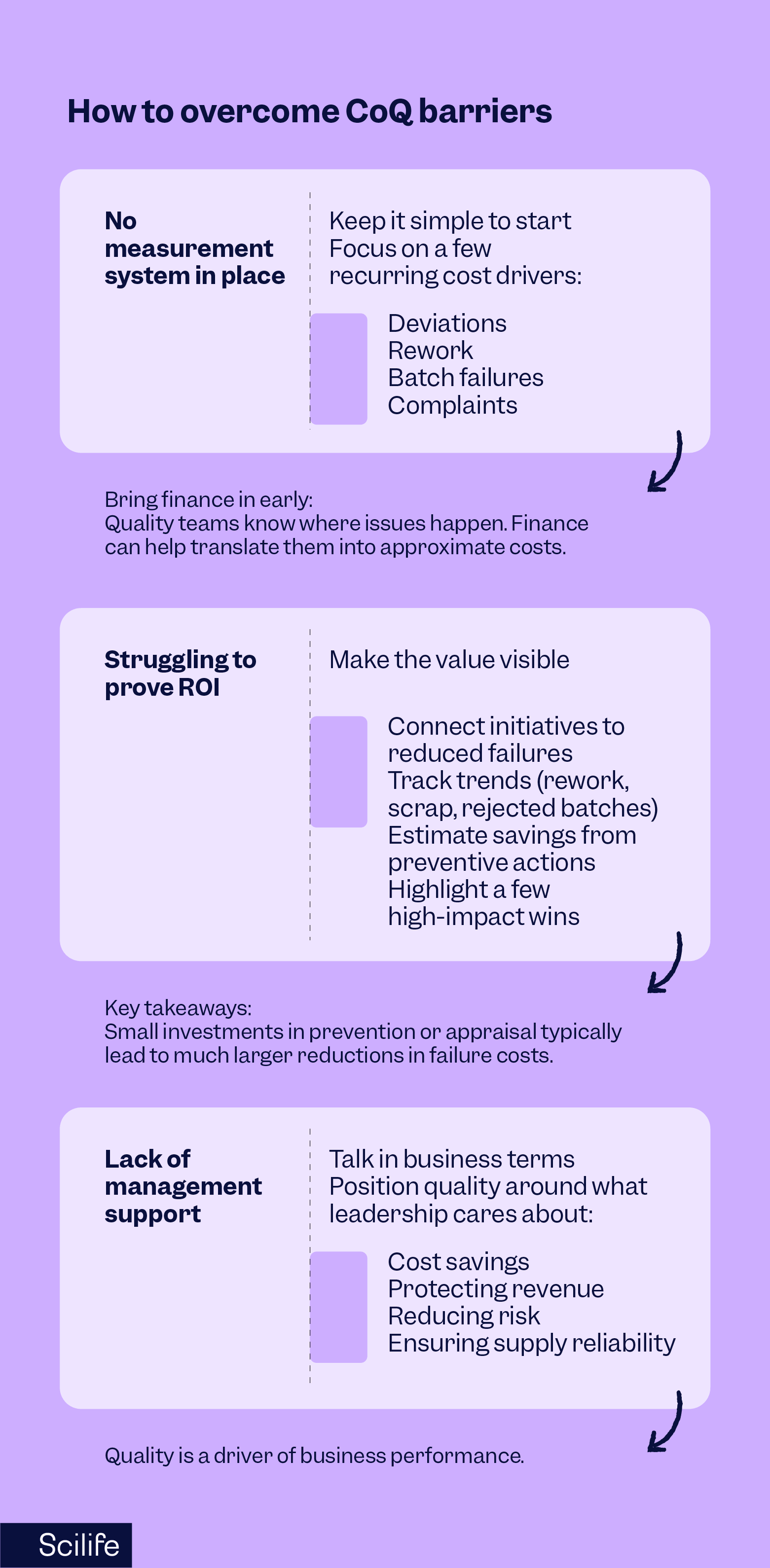
How to overcome CoQ barriers
1. If you’re lacking measurement systems
Start simple.
Track a few recurring quality cost drivers such as:
- Deviations
- Rework
- Batch failures
- Complaints
Then involve the financial team to help assign at least approximate costs. Quality teams usually know where the losses happen, while finance can help quantify them.
2. If demonstrating ROI proves difficult
The problem is often not that CoQ has no return on investment. The problem is that the quality team is not able to show that ROI clearly enough.
To improve that:
- Link quality initiatives to mitigated failures.
- Show trends in rework, scrap, and rejected batches.
- Estimate money saved after preventive actions or process improvements.
- Use a few high-impact examples instead of trying to quantify everything at once.
This matters because CoQ programs tend to gain traction when teams can show that a relatively small increase in prevention or appraisal reduces much larger failure costs.
3. If management is reluctant to offer support
Management usually responds when quality is translated into business terms.
That means framing quality in terms of:
- Cost savings
- Revenue protection
- Risk reduction
- Supply reliability
In other words, speak the language of business.
How to calculate the Cost of Quality, step by step
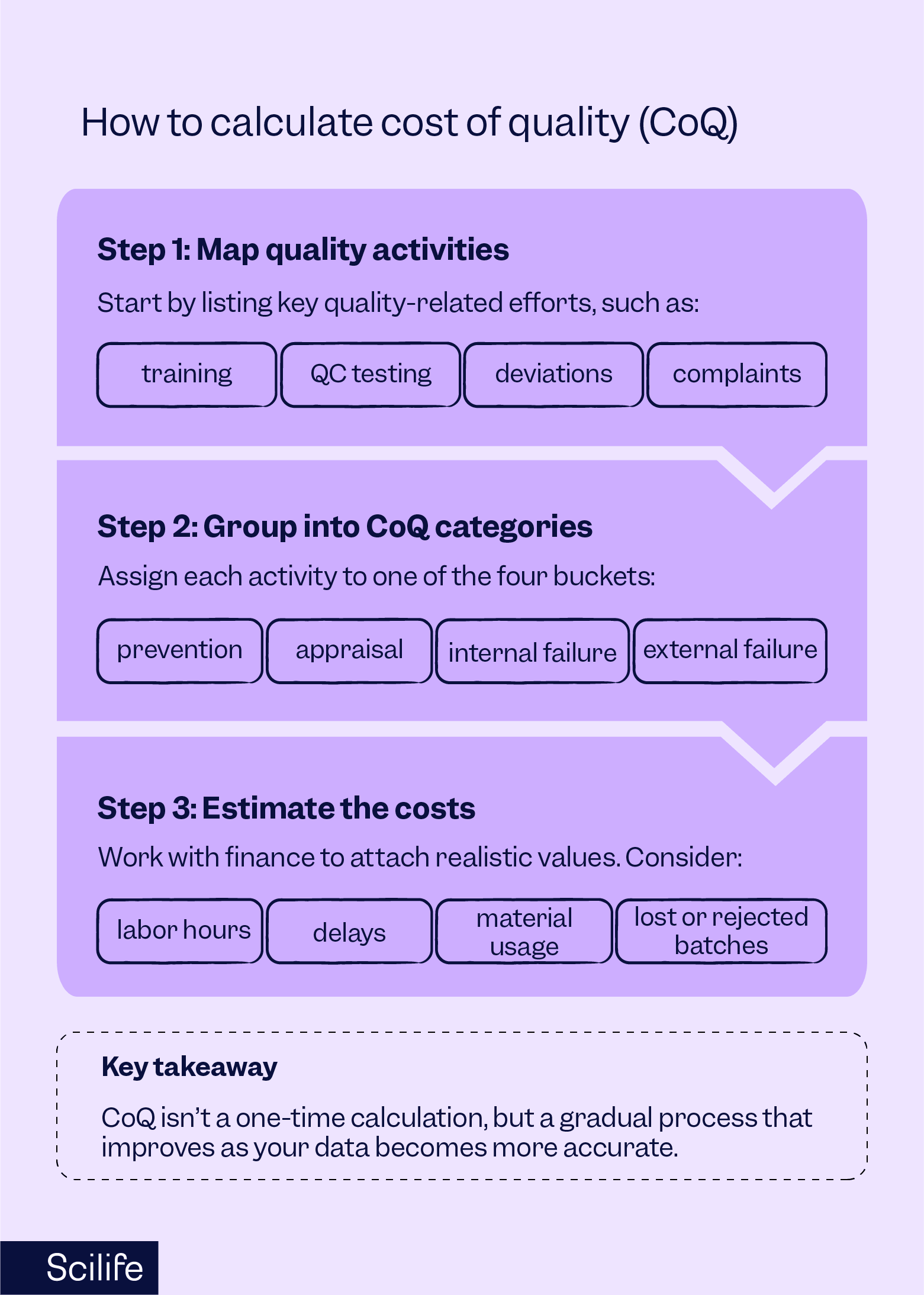
Instead of relying on a single formula for the Cost of Quality, the most effective approach is practical and iterative.
Step 1: Identify quality-related activities
Examples include:
- Training
- QC testing
- Deviations
- Complaints
Step 2: Classify them
Place each activity into one of the four categories:
- Prevention
- Appraisal
- Internal failure
- External failure
Step 3: Assign costs (involve the financial team)
Include elements such as:
- Labor time
- Materials
- Delays
- Lost batches
Example: small biotech company (100 employees)
To better understand this concept, let’s look at a practical Cost of Quality example in a small biotech company. Let’s assume the company tracks the following annual costs:
Prevention costs
- GMP training: $80,000
- Process validation: $120,000
Appraisal costs
- QC testing: $200,000
- QA batch review: $10,000
Internal failure costs
- Batch rejection (2 batches): $300,000
- Rework and investigations: $150,000
- Downtime: $50,000
External failure costs
- Complaints handling: $40,000
- Minor recall: $160,000
This adds up to:
- Total CoQ = $1,110,000
- Cost of Poor Quality = $700,000 (~63%)
In this case, poor quality represents about 63% of total quality costs.
An achievable goal for most companies is to reduce the cost of poor quality to around 20–40% of total Cost of Quality, which typically reflects a more mature and optimized system.
That is a strong signal that even a moderate reduction in failures could create significant financial impact.
What metrics are used to measure the Cost of Quality?
Understanding what metrics are used to measure the Cost of Quality is essential to make CoQ actionable.
Here are some of the most useful ones:
- Cost of Poor Quality (COPQ): the total cost of internal and external failures.
- Failure cost as % of sales: shows how much revenue is being lost to poor quality.
- Cost of Quality as % of revenue: gives a high-level view of overall efficiency.
- Deviation rate: the number of deviations per batch or per period.
- Batch rejection rate: the percentage of batches that fail release.
- Cost per deviation or CAPA: shows the average financial burden of quality events.
- Right First Time (RFT): the percentage of batches completed without rework.
- Batch release cycle time: how long it takes to release a product.
- Recall frequency: how often recalls occur over time.
- Scrap or yield loss: the amount of material lost due to failure or inefficiency.
Tracking these metrics gives teams better visibility into the Cost of Quality and where the biggest losses occur.
Recommended learning:
What is CoPQ? The true cost of poor quality and how to reduce it

Conclusion: the role of an eQMS in reducing the Cost of Quality
Managing the Cost of Quality manually is a heavy lift, especially in regulated environments where complexity adds up quickly. An eQMS like Scilife brings structure and visibility by centralizing deviations, CAPAs, and training, while surfacing real-time quality metrics that highlight the true drivers of poor quality.
Instead of chasing data, teams can focus on understanding it thus reducing manual workload, improving compliance, and making more informed decisions that impact both quality and cost. Over time, this shifts the role of the quality unit from a reactive, compliance-focused function to a proactive driver of process improvement and operational efficiency. That’s where the real value lies.
Discover how Scilife’s eQMS can help you build processes to manage your Cost of Quality strategies and improve your quality processes.