“When you open a CAPA and it automatically triggers the forced review on the documents or vice versa, or from an event to a CAPA, that’s so useful. The links between the different modules, that's really the strong suit of Scilife.”
Choosing between Scilife and Veeva Vault comes down to one key question: do you need a broader life sciences ecosystem or a focused, scalable quality platform?
If you're comparing eQMS platforms, chances are Veeva Vault has come up. It's one of the best-known names in life sciences, and for good reason. But a well-established platform isn't automatically the right fit for every company.
Scilife and Veeva Vault take different approaches to quality management. Scilife is an eQMS built around GxP quality processes that helps growing life sciences companies get up and running quickly with a pre-validated platform. Veeva Vault is part of a broader suite of highly configurable applications designed to support complex requirements across larger life sciences organizations.
So which eQMS is right for your company?
Keep reading for a detailed comparison of Scilife and Veeva Vault, including features, implementation, validation, pricing, integrations, and the types of organizations each platform is best suited for.
Scilife is a validated cloud-based eQMS built for life sciences organizations, including pharma, biotech, and medical device companies. It provides a centralized platform for managing core quality processes and is designed for GxP-regulated environments.
Scilife uses a pre-validated, GAMP 5-aligned approach intended to reduce the validation work required from customers. It primarily serves emerging and mid-sized life sciences companies, with customers across Europe and a growing presence in North America.
Veeva Vault is a cloud platform comprising applications for different life sciences functions. Vault QMS provides quality management capabilities, while other Vault applications support areas such as regulatory, clinical, and safety operations. Vault QMS uses configurable workflows to manage quality processes and is designed for organizations with complex, multi-site or cross-functional requirements.
Veeva Vault is widely used by large and complex life sciences organizations, including companies operating across multiple sites, functions, and regions.
Scilife follows a structured implementation program designed to get teams live in around 90 days. Guided configuration, a dedicated test environment, training, and a pre-validated GAMP 5 package help reduce the work required from your team. During onboarding, this typically means just 3–5 hours per week from 2–3 people, with no need for a full-time project manager or internal IT team.
Veeva Vault QMS can also be implemented quickly for focused deployments, but timelines vary with the scope and complexity of the project. Larger implementations involving multiple sites, integrations, workflows, or other Vault applications typically require more planning and resources.
Scilife offers a more standardized path to go-live, while Veeva provides flexibility for more complex implementations.
Scilife is designed to keep everyday quality work straightforward. Its QMS modules sit within one system, so teams can manage documents, deviations, CAPAs, training, and other quality processes without moving between separate applications.
Veeva Vault QMS offers a more configurable experience within the broader Vault platform. That flexibility can be valuable for organizations with complex processes and interconnected systems, but it can also mean a steeper learning curve for teams that simply want to manage core QMS activities.
For teams seeking a simpler path to adoption, Scilife minimizes the validation work required from your team.
Scilife uses tiered plans (Essential, Core, and Core+) so companies can choose the capabilities they need and add functionality as they grow. The final cost depends on the modules and scope your organization needs.
Veeva Vault pricing is not publicly listed and is typically customized based on users, applications, and implementation scope. For organizations using multiple Vault applications, costs can also extend beyond QMS licensing to include additional applications, configuration, integrations, and implementation services.
The result is a simpler pricing model to evaluate with Scilife, while Veeva requires a more tailored assessment of the total cost of the Vault ecosystem.
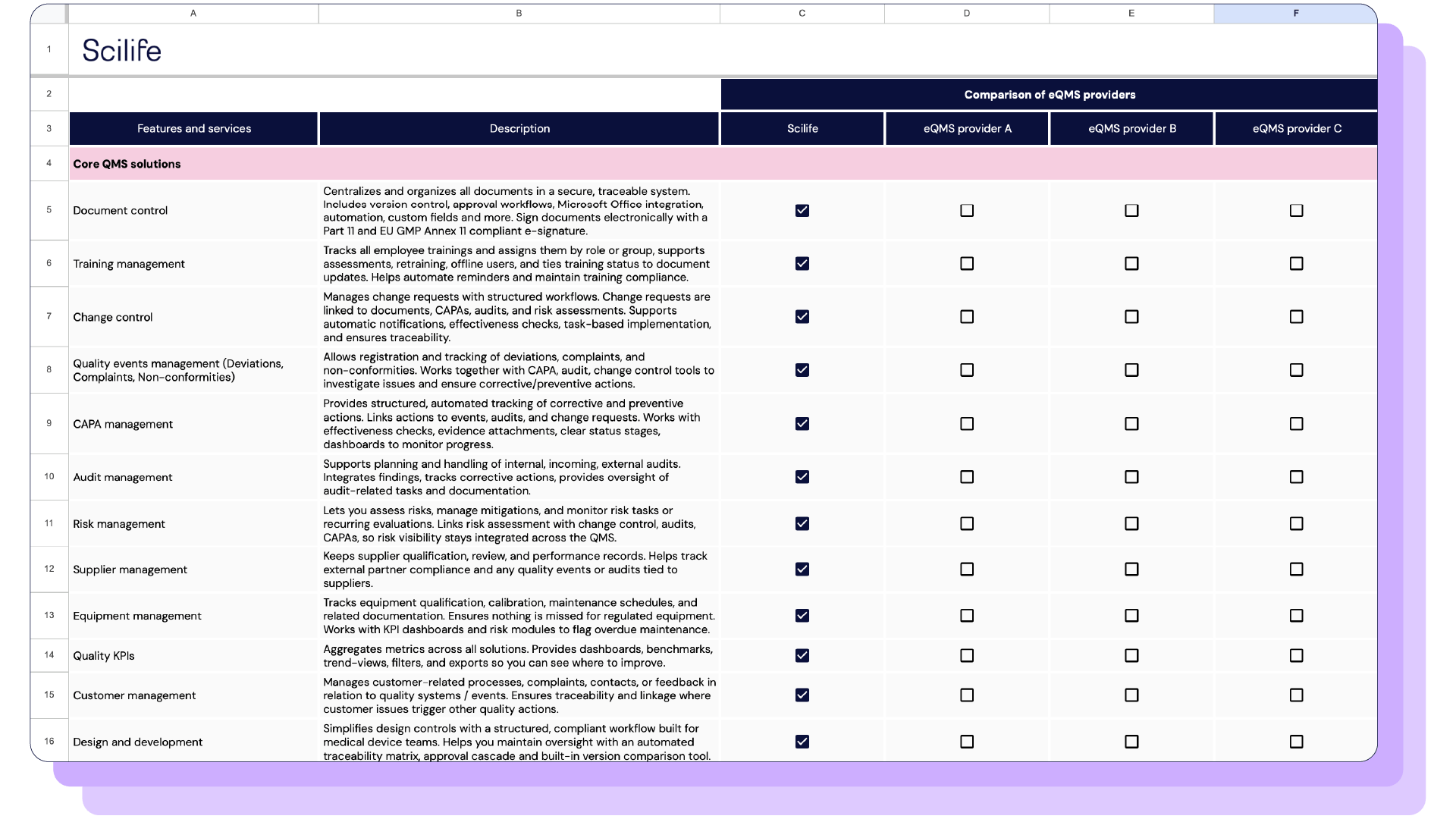
Both Scilife and Veeva Vault QMS cover the core quality processes most life sciences organizations expect, including CAPA, document control, training, change control, audits, and complaint management. The bigger difference is how those capabilities are organized.
Scilife brings these processes together in a dedicated eQMS, giving teams one place to manage day-to-day quality activities. Veeva Vault QMS connects the same core processes within the broader Vault platform, which can be particularly valuable for organizations also using Vault applications for regulatory, clinical, safety, or other functions.
Scilife provides each module with a pre-validated GAMP 5 package, including risk analysis, a validation plan, executed test scripts, and a validation summary report. This gives customers a substantial head start on their validation activities, with the remaining work focused on their specific configuration and intended use.
Veeva Vault QMS is also a validated platform and provides validation documentation to support customer validation activities. Because Vault can be configured extensively to meet organization-specific processes and requirements, the amount of customer-specific validation can vary depending on the implementation and configuration.
Scilife's pre-validated approach provides a simpler starting point for teams looking to reduce the validation work required to get an eQMS into operation.
Scilife provides a structured onboarding program with a dedicated Onboarding Project Manager and Customer Success team supporting customers through implementation, go-live, and beyond.
Veeva Vault provides customer support alongside an ecosystem of implementation and consulting partners. For larger or more complex deployments, customers may work with partners for configuration, implementation, and ongoing services.
The main difference is the support model: Scilife provides a more hands-on, guided experience, while Veeva offers the scale and partner ecosystem typically associated with larger enterprise deployments.
Both Scilife and Veeva Vault QMS can support growing quality organizations, but they differ in how governance and traceability scale with the system.
Scilife connects quality processes within one eQMS, providing end-to-end traceability across events, investigations, CAPAs, changes, documents, and training. Standardized controls such as audit trails and electronic signatures provide a consistent governance framework as teams, sites, and quality requirements grow.
Veeva Vault QMS offers extensive configuration capabilities, allowing organizations to create tailored workflows, data models, and governance structures within the broader Vault platform. This can support complex organizations as they expand across teams, sites, and processes, but typically requires more formal system ownership and configuration governance.
If speed to compliance and day-to-day ease of use matter more than deep customization, Scilife may be the better fit. It's particularly well suited to growing pharma, biotech, and medical device companies that want to get inspection-ready without requiring extensive internal validation or system administration resources. Scilife can also scale as your needs evolve, from adding sites and products to expanding your regulatory scope.
If you're a larger, multi-site organization with complex quality requirements, Veeva Vault QMS may be the stronger fit. It's especially compelling if you're already using Veeva for regulatory, clinical, safety, or other processes and want quality connected to the wider Vault ecosystem. Its extensive configurability can also be valuable when your processes require more customization and you're able to dedicate the resources needed to support a broader implementation.
Customer reviews can add useful context to a software comparison because they show how platforms perform in day-to-day use. Reviews on G2 highlight strengths and recurring areas of feedback for both Scilife and Veeva Vault QMS.
“When you open a CAPA and it automatically triggers the forced review on the documents or vice versa, or from an event to a CAPA, that’s so useful. The links between the different modules, that's really the strong suit of Scilife.”
Rob Van den Berghen, QA Manager, ODTH
Company Size
Industry
“Validation is a huge work. So the fact that Scilife is validated, it's such a big benefit. If you have to choose a system and it is not validated, I wouldn't even start.”
Tinne Bockx, QA Manager, Inovet
Company Size
Industry
“We work with several remote partners and we need to provide them with up-to-date quality documents, Scilife serves as a great time-saver… it makes it possible at all for us to work the way we do.”
Neanke Bouwman, Director of QA, Cellpoint
Company Size
Industry
Still comparing your QMS options? Book a personalized demo to see how Scilife fits your team, explore the features that matter most, and get your questions answered.
Yes. Scilife is a strong Veeva Vault alternative for growing life sciences companies that want a dedicated eQMS with faster implementation, built-in validation support, and a simpler user experience. Veeva Vault QMS may be a better fit for larger organizations that need extensive customization or want to connect quality with other Veeva applications.
Both Scilife and Veeva Vault QMS support regulated life sciences environments, including FDA 21 CFR Part 11 and GxP requirements. Scilife also specifically supports standards and regulations including ISO 13485, EU MDR, MDSAP, and ICH Q10.
Scilife's structured onboarding program is designed to get customers live in around 90 days. Veeva Vault QMS can also be implemented quickly for focused deployments, but timelines vary based on factors such as configuration, integrations, data migration, number of sites, and the wider Vault applications involved.
No. Companies of different sizes use Veeva Vault, but its broad application ecosystem and extensive configurability make it particularly well suited to larger and more complex life sciences organizations. Smaller companies may find Scilife's dedicated QMS approach and tiered pricing model a better fit for their needs.
Yes. Moving from Veeva Vault to Scilife is possible, but the scope depends on the data, processes, integrations, and validation requirements involved. A migration typically includes data export and mapping, configuration of Scilife, data migration, testing, and any customer-specific validation required before go-live. The timeline will depend on the complexity of the existing QMS and the amount of historical data being migrated.
For many small and mid-sized life sciences companies, Scilife can offer a more predictable cost structure through its tiered plans and dedicated QMS approach. Veeva Vault uses customized pricing based on the applications, users, and scope of the deployment, which can make it better suited to organizations with larger budgets and broader platform requirements.
No. CDMOs, CROs, and spin-offs can use their own electronic Quality Management System (eQMS) even when a parent company or client uses Veeva Vault QMS. Organizations can choose a QMS that fits their operational needs, while managing collaboration through quality agreements, defined responsibilities, and the exchange of relevant documentation.
Methodology and disclosure
This comparison was researched and written by Scilife using publicly available information, including vendor documentation, product information, and verified G2 reviews.
We regularly review and update our comparison content to reflect the latest available information, with this article current as of September 2026.
EMEA Office
Kantersteen 47
1000 Brussels
Belgium
US Office
Scilife Inc.
228 E 45th St. RM 9E
New York, NY 10017
PRODUCT
INDUSTRIES
RESOURCES
COMPANY
Contact Us
EMEA Office
Kantersteen 47
1000 Brussels
Belgium
US Office
Scilife Inc.
228 E 45th St. RM 9E
New York, NY 10017
Copyright 2026 Scilife N.V. All rights reserved.