

If you work QARA in medical devices or pharma, you know that CAPAs aren’t just paperwork - they’re at the heart of compliance and audits.
That said, writing CAPA reports that hold up under inspection can be tricky.
Teams often struggle with vague problem statements, weak root cause analysis, or actions that don’t fully address the problem.
Knowing the difference between CAPA forms, action plans, and the full CAPA report is key, both for staying compliant and for making your quality system actually work.
In this guide, I’ll break down what regulators expect, highlight common pitfalls, and show how modern tools like an eQMS can make the process smoother.
By the end, you’ll know how to create CAPA reports that are clear, auditable, and inspection-ready.
And if you’d like to dive deeper into CAPA best practices, check out our complete guide on corrective and preventive actions.
Key takeaways
What is a CAPA report in the life sciences?
If you’ve worked in QARA for any length of time, you’ve probably written or contributed to more CAPAs than you care to remember. And when you deal with them often, it’s easy to start feeling like they’re just another audit requirement.
In reality, though, CAPA reports are one of the clearest ways regulators judge whether a quality system actually works.
At its core, a CAPA report is the documented story of how an organization:
-
Investigates a quality issue
-
Identifies the real root cause, and
-
Puts actions in place to prevent it from happening again
While FDA, ISO 13485, and GMP guidelines use slightly different language, they’re aligned on intent: CAPAs must be systematic, risk-based, and demonstrably effective.
What often gets missed is that a CAPA report isn’t the action itself - it’s the evidence trail. That distinction matters.
CAPA-related observations remain some of the most common and serious inspection findings. Not because issues happen, but because organizations struggle to show learning over time. That’s why auditors don’t just check that a CAPA exists; they read it carefully and critically.
Create an effective CAPA form using the 8D approach


CAPA Report vs CAPA Action Plan vs CAPA Form
This is one of those topics that seems pedantic until you’re in an audit and an inspector asks for a CAPA report, and someone hands over a half-filled CAPA action form.
I’ve seen this confusion play out so many times, so let’s clearly separate the three.
The short version (how they relate: Capa report vs Capa action plan vs Capa form)
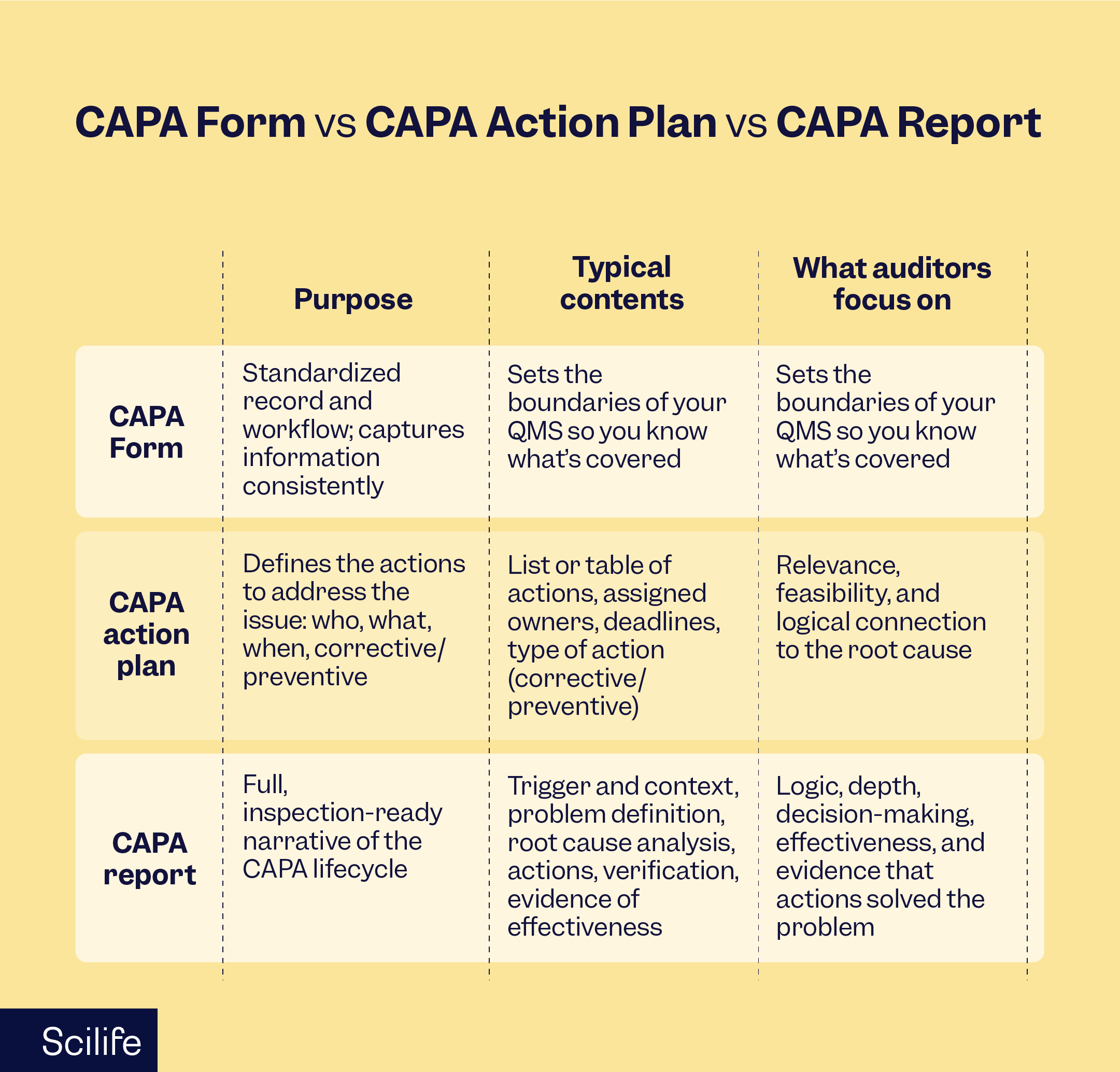
Think of CAPA documentation as a stack, not a single document:
-
CAPA form: the framework that organizes and captures all the necessary information.
-
CAPA action plan: the layer that details what will be done, who’s responsible, and when.
-
CAPA report: the full, top layer that tells the complete story - investigation, decisions, actions, and proof that they worked.
They’re linked, but they are not interchangeable.
How to write a CAPA report? Anatomy of a great CAPA report
When regulators review a CAPA report, they’re not judging how well you filled out your CAPA report template.
For this piece of CAPA documentation, they’re looking for evidence that you understand your own system, can explain what went wrong, and have put controls in place that actually last. Strong CAPA reports read like a clear investigation story, not a set of disconnected fields.
It always starts with a precise, evidence-based problem definition. Inspectors want to see exactly what failed, where and when it happened, how it was detected, and what data supports it.
From there, the focus shifts to the root cause. Regulators don’t care which methodology you use, but they do care that the analysis is structured, documented, and supported by evidence.
Actions are then assessed against the root cause. Inspectors look for corrective and preventive actions that clearly address why the issue occurred, not just what happened. Risk also matters. CAPA reports should show that patient, product, and compliance risk were considered, and that the scope of action matches the level of risk.
Finally, regulators expect proof that actions were implemented as planned and that effectiveness was verified. Closure isn’t administrative - it’s a regulatory judgment call based on effectiveness checks.
Make your CAPA management process simpler and more collaborative


CAPA report structure (inspection-ready)
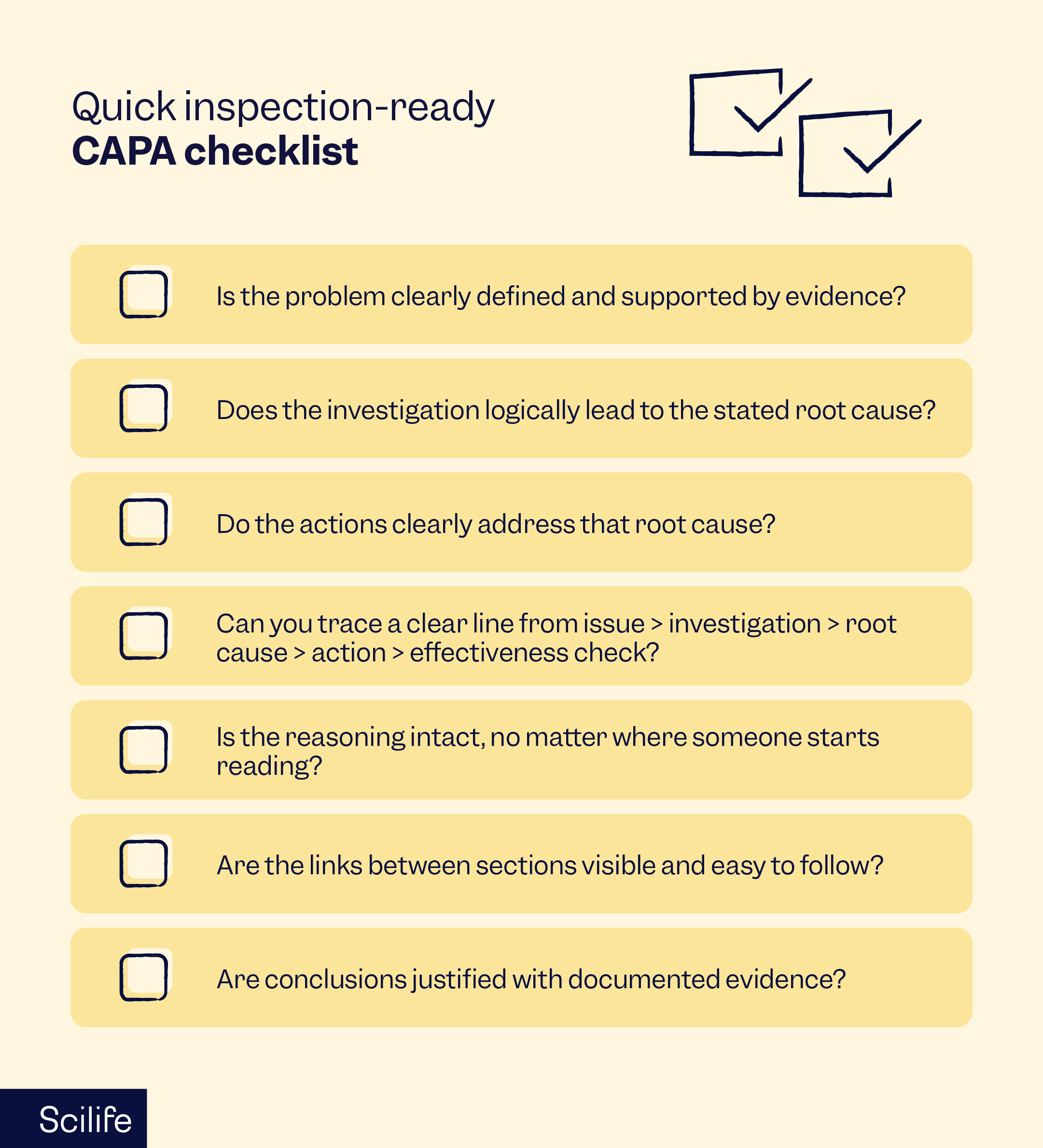
When inspectors review a CAPA, they tend to come back to the same question again and again: does this make sense, and can you prove it?
They’re not reading your report line by line. They jump between sections, checking whether the logic holds together no matter where they start.
A well-structured CAPA report supports that reading style. The investigation, actions, and verification should feel like parts of a single chain rather than standalone entries. If an inspector starts at the action section, it should be immediately clear what problem those actions address. If they start at the root cause, they should be able to trace forward and see how it drove specific decisions.
Logical flow isn’t about order on the page; it’s about whether the reasoning stays intact under scrutiny.
Traceability is what makes that flow visible. Regulators expect to follow clear links between the issue that triggered the CAPA, the evidence used to investigate it, the decisions that were made, and the checks used to confirm effectiveness. When those links aren’t obvious in the report itself, follow-up questions tend to multiply quickly.
This is also why structure matters far more than formatting.
Scilife Tip:
Auditors don’t care whether your CAPA lives in a Word document, a spreadsheet, or an eQMS. They care that the logic is sound, the connections between sections are clear, and the conclusions are justified. A CAPA report that’s easy to navigate is far more likely to stand up during inspection, simply because it makes sense wherever an auditor chooses to look.

Common CAPA report mistakes (and why inspectors flag them)
Auditors aren’t trying to punish you - they just want evidence that your system actually works.
The top culprits I see repeatedly are:
Vague problem statements
Examples: describing the issue as “process failure” or “human error” without evidence, or failing to link it to a specific event, product, or process.
Why it matters: Auditors can’t tell if the CAPA addresses the right problem. Clear, specific problem statements are one of the easiest ways to prevent findings.
Root cause and action disconnect
Examples: Skipping a structured investigation or some of the steps in the investigation, blaming only training/human error, and/or implementing fixes that don’t directly address the root cause.
Why it matters: Actions that don’t logically prevent recurrence are flagged as ineffective CAPA. A simple check: every action should clearly tie to a root cause.
Weak or missing effectiveness checks
Examples: marking a CAPA complete without verifying that the problem was actually solved, measuring task completion instead of outcome.
Why it matters: Effectiveness checks provide proof that your CAPA actually works, not just that you completed tasks.
Traceability gaps
Examples: attachments exist but aren’t linked to the investigation, the narrative doesn’t connect problem → cause → action → verification.
Why it matters: Lack of traceability immediately raises questions about whether your system truly functions.
The most common CAPA mistakes inspectors see and how to fix them.

These high-impact mistakes are relatively easy to fix.
Once you structure your CAPA reports with clear problem statements, link root causes and actions, verify effectiveness, and trace evidence, your next audit will undoubtedly result in fewer CAPA findings.
Conclusion: How CAPA reports fit into a modern eQMS
Writing a strong CAPA report is only half the battle. It also needs to live in a system that ensures traceability, accountability, and efficiency, which is where a modern eQMS shines.
In an eQMS, CAPAs are automatically linked to their triggering events, and every step is traceable. Version control and audit trails ensure changes and approvals are fully documented. CAPAs can also be connected to deviations, complaints, nonconformances, and change controls, giving a complete view of quality trends and recurring issues. It’s a way to make all your related CAPA documentation simpler to manage and easier to find.
The result: CAPAs that are not only compliant but fully inspection-ready.
![CAPA: FDA's #1 Most Cited Inspection Finding [Full Guide]](https://www.scilife.io/hubfs/The-ultimate-corrective-and-preventive-action-%28CAPA%29-guide-every-life-science-professional-needs.png)