



Any QA professional in life sciences who has ever prepared an annual product quality review knows how demanding it can be. What should be a structured quality exercise often turns into weeks of pulling information from everywhere—spreadsheets, emails, binders, and disconnected systems.
Batch records in one place, deviations in another, stability data somewhere else. By the time everything is finally assembled, the APQR can feel more like an administrative marathon than a quality review.
Yet APQR exists for a reason. First introduced in US GMPs through 21 CFR 211.180(e) and later expanded globally through ICH Q7 (2000) and the EU GMP Product Quality Review requirement (2005), it has become a core expectation for pharmaceutical manufacturers.
Scilife Tip:
More importantly, when done well, APQR in pharma is one of the most effective ways to uncover issues you didn’t know you had—recurring deviations, subtle process shifts, or emerging stability trends—and focus on meaningful improvements.

In this blog, I’ll explain what is APQR in pharma, what it’s for, how APQR differs from APR and PQR, the key APQR guidelines and regulations, when it’s typically completed, who owns APQR compliance, and how to build an APQR step by step.
TL;DR — APQR at a glance
- Definition: The Annual Product Quality Review (APQR) is a yearly, structured product quality review that evaluates a pharmaceutical product’s manufacturing, quality performance, and compliance history over a defined period.
- Purpose: APQR helps confirm process consistency, identify trends and risks, and determine whether changes, CAPAs, or revalidation activities are needed to continuously improve product quality.
- Regulatory basis: APQR is required under FDA 21 CFR 211.180(e) and globally aligned through EU GMP, PIC/S, WHO GMP, and ICH Q7 (for APIs).
- Who conducts it: APQR is owned by Quality Assurance, with key input from QC, Manufacturing, Engineering/Validation, and Regulatory Affairs.
- Submission frequency: One APQR report per product per year, typically finalized within three months after the end of the review period, using either a calendar year or a rolling 12-month cycle.
What Is the Annual Product Quality Review (APQR)?
APQR is an acronym for Annual Product Quality Review. It is a regulatory requirement under which pharmaceutical companies are expected to conduct a yearly and comprehensive product quality review of their commercialized products—this is what APQR in the pharmaceutical industry means in practical terms.
How to create an ICH Q10 pharmaceutical quality system

What is the purpose of APQR in pharmaceutical companies?
The purpose of the Annual Product Quality Review (APQR) is to provide a structured, yearly evaluation of whether changes are needed in the manufacturing process, product specifications, or control strategy to minimize defects and reduce patient risk. Ultimately, these assessments turn historical quality data into actionable knowledge that strengthens process performance and continuously improves product quality.
APQR vs APR vs PQR in pharma: Key differences
Across the industry, several regulations and guidelines define the requisites of an APQR/PQR. In US practice, the annual evaluation required by 21 CFR 211.180(e) has traditionally been referred to as the Annual Product Review (APR). In recent years, many companies and some FDA communications have adopted the term Annual Product Quality Review (APQR), although the regulation itself does not mandate a specific acronym.
In contrast, Product Quality Review (PQR) is the standard term used across EU GMP, PIC/S, and WHO guidance. For simplicity and consistency, this article uses APQR and PQR interchangeably.
APQR guidelines and regulatory requirements
Across the industry, multiple APQR guidelines define how annual reviews should be conducted. The most relevant are FDA 21 CFR 211.180(e), EU GMP Chapter 1, PIC/S, and WHO GMP guidance.
- FDA 21 CFR 211.180(e) establishes the US legal requirement, mandating an annual evaluation of written records for each drug product, including batch outcomes, complaints, recalls, returns, and investigations. While it is the least prescriptive framework, FDA inspectors still expect a complete and meaningful APQR.
- ICH Q7, published in 2000, introduced the concept of Product Quality Review (PQR) for APIs. This approach later informed the EU GMP PQR requirement, incorporated into the EU GMP Guide in 2005.
- EU GMP Chapter 1.10 provides the most detailed and structured framework and is often used as the reference model. PIC/S and WHO GMP closely align with this structure, serving as globally harmonized adaptations of the EU approach.
You’ll see how these regulatory expectations translate into practice in the “How to build a compliant APQR in 4 steps” section below.
Introduction to Good Manufacturing Practices (GMP) Handbook - the building blocks of your PQS.


When should you submit the APQR?
Most companies follow one of two approaches:
- Calendar year: January–December, with the APQR report issued by the end of Q1.
- Rolling 12-month period: Common for low-volume products or mid-year launches. For example, a July 2023–June 2024 review period, with its results in the APQR report being finalized within three months (by the end of September 2024).
Who is responsible for APQR compliance?
APQR ownership sits with Quality Assurance, supported by QC, Manufacturing, Engineering/Validation, and Regulatory Affairs. All these business functions collaborate to prepare a comprehensive APQR report with inputs from all the stakeholders. The report must be finally reviewed by a senior Quality Assurance person before it is submitted to the concerned regulatory agency.
A clear SOP defining responsibilities, timelines, and data sources is essential (it often determines how painful the overall APQR experience will be).
Ready-to-use APQR template - get it for free!

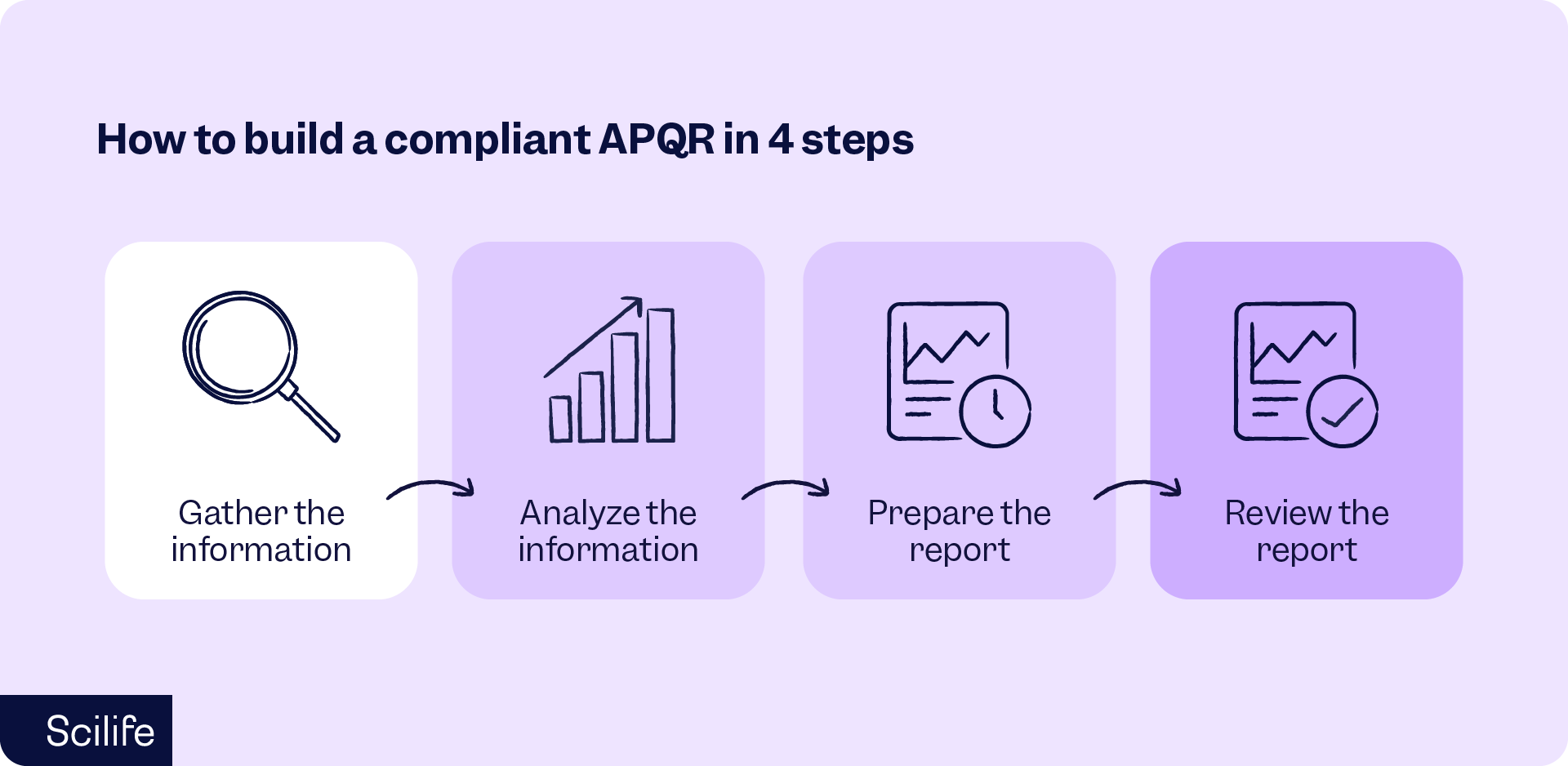
How to build a compliant APQR in 4 steps
1. Gather all the relevant information
The first step in preparing a robust APQR is to gather all relevant information that reflects the product’s quality, process performance, and regulatory status over the review period.
This is usually the longest and most time-consuming phase of the entire APQR process, and for good reason: without complete and accurate data, nothing else matters. It’s also essential to collect data from all markets where the product is sold and across all strengths, formats, and presentations to ensure the review reflects the product’s full footprint.
The information you need to collect is clearly defined across global regulatory references, including the 21 CFR 211.180(e), EU GMP Chapter 1, ICH Q7, PIC/S, and WHO GMP. Now, let’s go point by point through the information you need to gather for your APQR:
a) Starting materials, packaging components, and supplier performance:
- Starting materials and packaging components
- API quality, traceability
- Supplier performance and relevant technical or quality agreements
b) Product and process performance data:
- All batches manufactured (approved and rejected)
- In-process control results and finished product testing
- Stability trends
- Yields and yield variability
c) Planned changes:
- Process or analytical method changes
- Change controls related to the product raised, approved, or implemented during the period
d) Unplanned events and quality system outcomes:
- Reworks, scrap
- Deviations, OOS/OOT, and CAPAs effectiveness
- Complaints, returns, recalls
e) Compliance data:
- Validation and qualification status (process, equipment, cleaning, method, etc.)
- Regulatory affairs status for all product variants (submitted, approved, pending, or rejected)
Tools like Scilife can reduce the “data chase” by centralizing batch records, deviations, complaints, and change controls so you’re not stitching together an APQR from emails and spreadsheets.
2. Analyze the information: Turn data into knowledge
Once you’ve gathered all the relevant information for your APQR, the next step is to analyze that data thoughtfully and systematically. The objective is to gain real knowledge about your product and process, and basically turn historical data into insight that supports proactive quality decisions.
Digital quality systems like Scilife make the analysis easier and more reliable because the underlying quality data stays structured and searchable instead of living in static files.
3. Compile the APQR report: Organize and structure the knowledge you’ve gained
The analyzed data is then organized into a clear, structured APQR report aligned with the corresponding regulation and your internal APQR SOP. The report should present trends, key findings, risks, and conclusions in a way that is easy for QA leadership, auditors, and regulators to understand.
This is where you tell the story of the product’s performance during the year. A downloadable APQR report template is provided at the end of this article.
Platforms like Scilife also help standardize the APQR report structure and keep supporting evidence linked, which makes the final narrative faster to build and easier to defend.
Step 4 — Review the report: validate and align
Once the APQR is compiled, it should be reviewed cross-functionally—typically by QA, QC, Manufacturing, Engineering/Validation, and Regulatory Affairs—to confirm data accuracy and validate conclusions.
This step is also a key opportunity for teams outside QA to engage directly with the APQR, understand the identified risks and improvement opportunities, and align on priorities for the year ahead. Final approval by senior QA ensures the conclusions are sound, communicated, and ready to be acted upon.
A system like Scilife streamlines cross-functional review by assigning ownership, tracking comments/approvals, and maintaining a clear audit trail of what changed and why.
APQR report
The APQR report should mention the product name, year, and unique APQR number, along with the name of the manufacturer. The data/information in APQR can be represented with the help of tables, graphs, flow charts, appropriate statistics, etc. Below is an example of an outline of an APQR Report:
- Objective
- Introduction
- Product details
- Process flow
- Review of manufacturing-related information
- Batch
- Stagewise yield
- Rejections
- Reworking
- Review of critical quality parameters
- In-process and intermediate testing results
- Review of finished product testing results
- Out of specification
- Review of:
- Events
- Changes
- Market complaints
- Control samples
- Recall and returns
- Stability data
- Validation and qualification status
- Post-marketing commitments
- Quality of APIs, key raw materials, and key packing materials
- Technical agreement
- Statistical evaluation of the data
- Review of status against previous APQR
- Conclusion
- Recommendations
- Abbreviations
- Annexures
- Approval
Why is the APQR important?
Just in case you’re still not convinced, as a manufacturer, you have several benefits of complying with the APQR requirements as follows:
- It identifies potential failure areas in the future and prevents expenses on investigating an out-of-specification result.
- It is a proactive approach that can be leveraged by the manufacturers to reduce rework.
- It decreases the downtime in manufacturing by actively monitoring the control procedures.
- It increases productivity by developing a better understanding of the manufacturing processes.
- It decreases the risk of product recalls.
- It prevents damage to the manufacturer’s reputation by reducing the chances of product recalls.
Deeper product and process understanding empowers you to consistently meet regulatory commitments in terms of product quality.
Additionally, it improves communication between different business functions, including but not limited to regulatory affairs, quality assurance, engineering, and production.
Conclusion
APQR is often seen as a regulatory obligation, but when done properly, it becomes one of the most valuable tools in a pharmaceutical quality system. A well-executed APQR helps teams understand how a product and its processes truly perform over time, uncover risks early, and focus improvement efforts where they matter most.
Instead of collecting information once a year from multiple tools, Scilife supports a continuous product quality review approach, making APQR preparation faster, more accurate, and inspection-ready at any time. Find out how!